
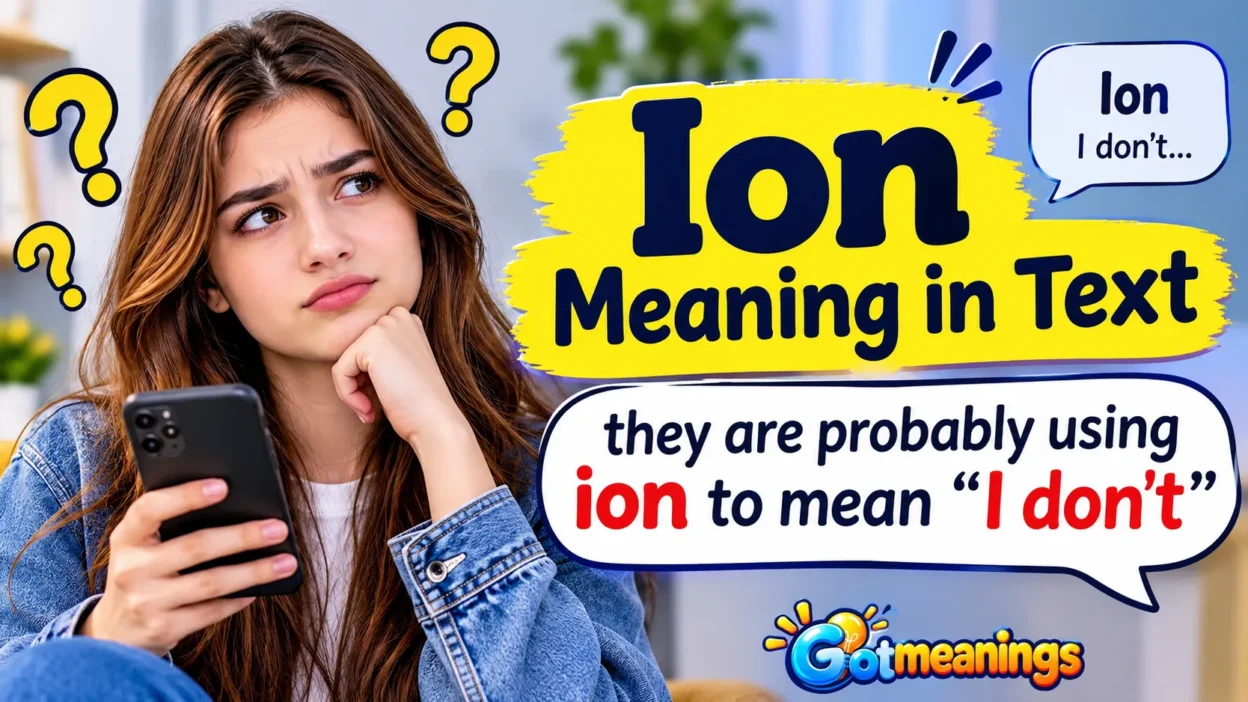
If someone texts you “ion know” or “ion wanna go,” they are probably using ion to mean “I don’t”.
This informal spelling is common in casual texting, social media conversations, and online chats. It represents how “I don’t” can sound when spoken quickly, especially in relaxed speech.
You might see ion in messages between friends, comments on TikTok, Instagram captions, or everyday conversations on Snapchat and WhatsApp.
Although it may look like a science term at first, its meaning in texting is completely different.
In this guide, you’ll learn what ion means in text, how people use it, where it appears, how to reply, and which similar slang expressions you may encounter.
We’ll also explain how context helps you understand the intended meaning.
| Quick Detail | Meaning |
|---|---|
| Text slang | Ion |
| Most common meaning | I don’t |
| Full form | I don’t |
| Type | Informal texting slang |
| Tone | Casual, conversational |
| Common usage | Text messages, social media, online chats |
| Example | Ion know = I don’t know |
What Does Ion Mean in Text & Chat?
Ion most commonly means “I don’t” in text messages and online conversations. It is an informal spelling that reflects the pronunciation of the words when spoken quickly.
Instead of typing “I don’t,” someone may write “ion.” This makes a message feel relaxed, natural, and similar to everyday speech.
For example:
- Ion know = I don’t know
- Ion care = I don’t care
- Ion wanna go = I don’t want to go
- Ion think so = I don’t think so
The meaning usually becomes clear from the words that follow ion.
Why Do People Write Ion Instead of I Don’t?
People use ion because it is short, easy to type, and matches how they speak.
In casual conversations, many people shorten words or use phonetic spellings. Ion fits this style because it represents a familiar spoken expression.
It can also make a message feel more personal or informal. However, ion is not suitable for every situation.
Is Ion a Slang Word or an Abbreviation?
Ion is best understood as an informal phonetic spelling rather than a traditional abbreviation.
It does not work like an acronym in which each letter represents a separate word. Instead, it represents the sound of “I don’t” in casual speech.
This distinction helps explain why ion often appears in complete phrases rather than standing alone.
Full Form, Stands For & Short Meaning of Ion
The texting meaning of ion is straightforward:
Ion = I don’t
It is not a formal acronym with an official letter-by-letter expansion.
Here are some common expressions:
| Ion Expression | Standard English |
|---|---|
| Ion know | I don’t know |
| Ion like it | I don’t like it |
| Ion want that | I don’t want that |
| Ion need it | I don’t need it |
| Ion remember | I don’t remember |
| Ion understand | I don’t understand |
| Ion feel like it | I don’t feel like it |
| Ion believe you | I don’t believe you |
Does Ion Always Mean I Don’t?
Not always.
In casual texting, “I don’t” is the most common interpretation. However, the meaning can depend on the surrounding words and the conversation.
For example, “ion” could occasionally be a typo, a username, or a reference to something unrelated to texting slang.
If you see ion in a phrase such as “ion know,” the intended meaning is almost certainly “I don’t know.”
Origin, History & First Known Use of Ion
Ion in texting comes from informal spoken English rather than from a newly invented technical abbreviation.
When people speak quickly, “I don’t” may sound closer to “I-don” or “I-on.” Ion reflects this relaxed pronunciation in written conversations.
How Did Ion Become a Texting Expression?
The use of phonetic spelling is not new. People have long written words according to how they sound in casual speech.
Online messaging made this style especially convenient because conversations often favor speed, simplicity, and a natural speaking voice.
Ion fits into a broader pattern of informal expressions such as:
- Gonna = going to
- Wanna = want to
- Tryna = trying to
- Ain’t = informal negative expression
- Imma = I’m going to
These expressions reflect casual speech and are often used to make written conversations feel less formal.
Is There a Confirmed First Use of Ion?
There is no widely established single person or exact date credited with inventing ion as texting slang.
It is safer to understand ion as a spelling that developed through informal speech and online communication rather than assigning it an unsupported origin story.
How People Use Ion in Daily Conversations
People usually use ion when they want to express a negative statement in a relaxed way.
The expression can communicate a lack of knowledge, interest, desire, agreement, or understanding.
Ion to Express Not Knowing Something
One of the most common uses is to say that someone does not know an answer.
Example:
“ion know where he went”
This means:
“I don’t know where he went.”
It is a casual way to respond when someone asks a question.
Ion to Show Disinterest
Ion can also express a lack of interest.
Example:
“ion feel like watching a movie tonight”
This means:
“I don’t feel like watching a movie tonight.”
Depending on the conversation, this may sound neutral or slightly dismissive.
Ion to Express Disagreement
Someone may use ion when they do not agree with another person’s opinion.
Example:
“ion think that’s a good idea”
This means:
“I don’t think that’s a good idea.”
It is a casual way to disagree without necessarily sounding aggressive.
Ion to Express Feelings or Boundaries
Ion can also communicate personal feelings.
Examples:
- “ion want to talk about it”
- “ion like being ignored”
- “ion need anything right now”
These messages can be serious even though the spelling is informal.
Important: Casual spelling does not automatically mean the message is joking or unimportant. Always consider what the person is saying.
Ion Meaning Across WhatsApp, Instagram, TikTok & Snapchat
The meaning of ion generally stays the same across social media platforms.
Whether someone uses ion on WhatsApp, Instagram, TikTok, or Snapchat, it most commonly means “I don’t.”
| Platform | Example | Meaning |
|---|---|---|
| Ion know | I don’t know | |
| Ion care | I don’t care | |
| TikTok | Ion wanna do that | I don’t want to do that |
| Snapchat | Ion feel like going | I don’t feel like going |
Ion Meaning on WhatsApp
On WhatsApp, ion usually appears in private messages, group chats, and casual conversations.
Friends may use it when replying quickly or chatting in an informal style.
Example:
“ion know what time we’re leaving”
The message simply means the sender does not know the departure time.
Ion Meaning on Instagram
On Instagram, ion can appear in direct messages, comments, captions, and replies.
People may use it to express an opinion, explain a feeling, or respond to a post.
Example:
“ion think this outfit matches”
This means the person does not think the outfit matches.
Ion Meaning on TikTok
TikTok users may use ion in comments, video captions, and conversations about trends or everyday situations.
Example:
“ion understand this trend”
The person is saying they do not understand the trend.
Ion Meaning on Snapchat
On Snapchat, ion is common in informal messages between friends.
Example:
“ion wanna go out today”
This means the person does not want to go out today.
The spelling does not change between platforms. The conversation provides the meaning.
Different Meanings of Ion in Other Fields
Although ion commonly means “I don’t” in texting, it has another well-established meaning in science.
Ion in Chemistry
Scientific meaning
In chemistry, an ion is an atom or molecule that carries an electrical charge because it has gained or lost electrons.
There are two main types:
- Cation: A positively charged ion.
- Anion: A negatively charged ion.
For example, sodium can lose an electron and become a positively charged sodium ion.
This scientific meaning is unrelated to the texting expression “I don’t.”
Ion in Everyday Online Conversations
The intended meaning depends on how the word is used.
| Context | Meaning |
|---|---|
| “Ion know” | I don’t know |
| “Ion care” | I don’t care |
| Chemistry lesson | Electrically charged atom or molecule |
| Scientific article | Chemical ion |
| Username or brand | Depends on the name |
If someone writes “ion” in a chemistry discussion, they may be referring to the scientific term rather than slang.
Common Confusions, Mistakes & Wrong Interpretations
Ion is easy to misunderstand when someone is unfamiliar with informal texting language.
Confusing Ion With the Scientific Word
The spelling is identical, but the meanings are different.
In “ion know,” the word represents “I don’t.”
In “positive ion,” it refers to a charged particle in chemistry.
The surrounding words usually make the intended meaning clear.
Thinking Ion Means I Know
Some readers may mistakenly interpret ion as “I know.”
However, in common texting slang, ion usually means I don’t, not “I know.”
For example:
“ion know what happened”
means:
“I don’t know what happened.”
It expresses a lack of knowledge rather than certainty.
Assuming Ion Is Always Rude
Ion can sound dismissive in certain messages, especially when paired with phrases such as “ion care.”
But the expression itself is not automatically rude.
For example:
“ion know lol”
may sound casual or playful.
On the other hand:
“ion care about your opinion”
may sound cold or disrespectful.
The tone comes from the full message, not only the slang.
Treating Ion as Formal English
Ion is appropriate for casual chats and informal online communication.
In school assignments, professional emails, reports, and formal writing, use “I don’t” instead.
This keeps your writing clear and grammatically appropriate.
Similar Terms, Alternatives & Related Slang
Ion belongs to a larger group of informal expressions used in texting.
These terms can make conversations shorter or reflect casual speech.
| Slang | Meaning |
|---|---|
| Ion | I don’t |
| IDK | I don’t know |
| IDC | I don’t care |
| IMO | In my opinion |
| IK | I know |
| NGL | Not gonna lie |
| FR | For real |
| TBH | To be honest |
| Gonna | Going to |
| Wanna | Want to |
| Ain’t | Informal negative expression |
Ion vs. IDK
Ion and IDK are related but not identical.
- Ion is a phonetic spelling of “I don’t.”
- IDK is an abbreviation for “I don’t know.”
Example:
“ion know”
and
“IDK”
both communicate a lack of knowledge.
However, ion can be used with many different verbs, while IDK specifically means “I don’t know.”
Ion vs. IDC
IDC stands for “I don’t care.”
Ion can express the same meaning when it appears in the phrase “ion care.”
For example:
- “Ion care about the game.”
- “IDC about the game.”
Both mean that the person is not interested in the game.
Ion vs. IK
IK means “I know.”
Ion usually means “I don’t.”
These expressions have opposite meanings, so confusing them can change the entire message.
Examples of Ion in Real Chat Situations
Here are realistic examples showing how ion works in different conversations.
Example 1: Asking About Plans
Person A: “Are you coming to the party tonight?”
Person B: “Ion know yet.”
Meaning: Person B does not know whether they will attend.
Example 2: Talking About Food
Person A: “Do you want pizza?”
Person B: “Ion really like pizza.”
Meaning: Person B is saying they do not really like pizza.
Example 3: Casual Conversation
Person A: “Did you finish the assignment?”
Person B: “Ion finish it yet 😭”
Meaning: Person B has not finished the assignment. The emoji adds a playful or frustrated tone.
Example 4: Showing Disinterest
Person A: “Let’s watch that movie again.”
Person B: “Ion feel like watching it lol.”
Meaning: Person B does not feel like watching the movie. “Lol” makes the refusal feel lighter.
Example 5: Expressing Confusion
Person A: “Why did everyone leave early?”
Person B: “Ion understand what happened.”
Meaning: Person B does not understand the situation.
Example 6: Setting a Boundary
Person A: “Can you tell everyone what happened?”
Person B: “Ion wanna talk about it.”
Meaning: Person B does not want to discuss the situation. The message may be serious.
Example 7: Playful Disagreement
Person A: “This is the best song ever.”
Person B: “Ion think so 😂”
Meaning: Person B disagrees in a playful way. The laughing emoji softens the response.
Example 8: Expressing Frustration
Person A: “Why didn’t you answer my message?”
Person B: “Ion see your message earlier.”
Meaning: Person B is explaining that they did not see the message before.
These examples show that ion can communicate different feelings depending on the situation.
How to Reply When Someone Says Ion
Your reply depends on the complete message.
Since ion means “I don’t,” it is usually part of a longer sentence rather than a standalone expression.
If Someone Says Ion Know
You can respond with:
- “No worries.”
- “That’s okay.”
- “Let me know when you find out.”
- “Okay, I’ll check.”
If Someone Says Ion Care
If the message is casual, you can keep your response simple.
Examples:
- “Fair enough.”
- “Okay lol.”
- “That’s your choice.”
If it sounds disrespectful, you can calmly explain how you feel.
Example:
“That’s fine, but I’d appreciate a respectful response.”
If Someone Says Ion Wanna Go
You can reply:
- “No problem.”
- “Maybe next time.”
- “That’s okay, we can stay home.”
- “Are you sure? It’ll be fun.”
If Someone Says Ion Understand
You can offer clarification.
Examples:
- “Which part is confusing?”
- “Let me explain it again.”
- “No worries, I’ll make it simpler.”
If You’re Unsure What Ion Means
You can simply ask:
- “What do you mean by ion?”
- “Do you mean I don’t?”
- “Can you explain that?”
Asking directly is often the easiest way to avoid misunderstanding.
Is Ion Still Popular? Trends & Online Usage
Ion remains recognizable as informal texting slang, especially in conversations that use casual, phonetic spelling.
However, there is no single reliable measure that proves how frequently everyone uses it across all platforms in 2026.
Its continued appearance in online conversations does not mean every age group, region, or social community uses it equally.
Why Do People Continue Using Ion?
Several practical reasons explain why ion fits casual messaging:
- It is short and easy to type.
- It reflects natural spoken language.
- It makes messages sound informal.
- It works with many common expressions.
- It fits the relaxed style of online conversations.
Is Ion Appropriate for Every Conversation?
No.
Ion is best suited to casual conversations with friends, familiar people, or online communities where informal language is accepted.
For professional communication, academic writing, or situations where clarity matters, “I don’t” is the better choice.
Understanding the expression is useful even if you do not use it yourself.
Frequently Asked Questions
What does ion mean in text messages?
Ion usually means “I don’t” in text messages. It is an informal spelling used in casual conversations, such as “ion know” meaning “I don’t know.”
What does ion know mean in texting?
“Ion know” means “I don’t know.” People use it when they are unsure about something or do not have an answer.
Does ion mean I know or I don’t?
Ion usually means “I don’t,” not “I know.” For example, “ion understand” means “I don’t understand.”
Is ion rude or disrespectful?
Not necessarily. Ion is an informal spelling. It can sound friendly, neutral, playful, or dismissive depending on the message and situation.
What does ion mean on Snapchat?
On Snapchat, ion usually means “I don’t.” For example, “ion wanna go” means “I don’t want to go.”
What does ion mean on TikTok?
On TikTok, ion generally means “I don’t.” It may appear in comments, captions, and informal conversations.
How do you respond to ion in a text?
Respond to the complete message rather than the word itself. If someone says “ion know,” you can reply “No worries” or “I’ll check.”
Is ion the same as IDK?
No. Ion means “I don’t,” while IDK specifically means “I don’t know.” Both can communicate uncertainty when used in the appropriate phrase.
What does ion mean in chemistry?
In chemistry, an ion is an atom or molecule with an electrical charge because it has gained or lost electrons. This is different from the texting meaning.
Can I use ion in formal writing?
It is better to avoid ion in formal writing. Use “I don’t” in professional emails, academic work, and other formal communication.
Conclusion
Ion is a simple but useful texting expression that usually means “I don’t.” People use it in casual messages, social media comments, and everyday online conversations to express feelings, opinions, uncertainty, or a lack of interest.
Phrases such as “ion know,” “ion care,” and “ion wanna go” are easy to understand once you recognize the spelling.
The expression generally keeps the same meaning across WhatsApp, Instagram, TikTok, and Snapchat. However, context still matters because ion can also refer to a charged particle in chemistry or something unrelated to slang.
Remember that ion is informal, so “I don’t” is a better choice in professional or academic writing. Once you understand its meaning, reading and responding to ion in everyday chats becomes much easier.

Milo Carter is a tax writer who explains tax terms, rules, and common questions in simple, easy-to-understand language.