
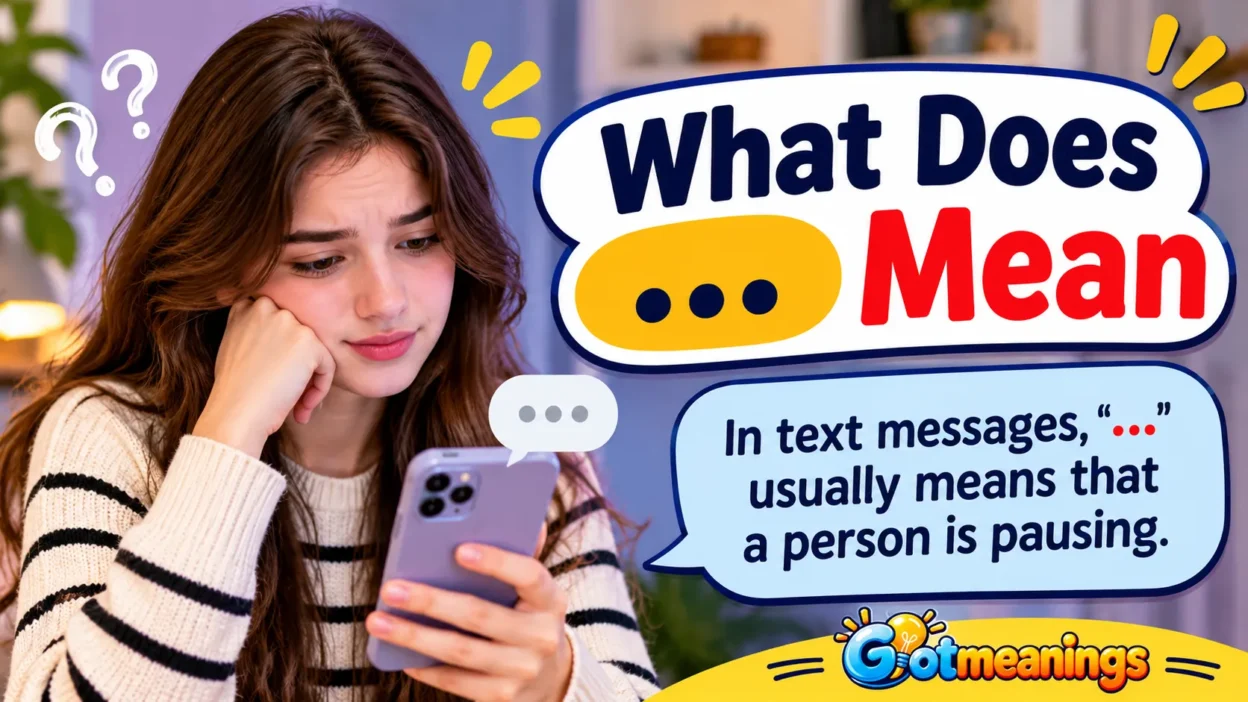
The three dots (...) are a common part of texting, online chats, and social media. They are called an ellipsis, and they can show a pause, an unfinished thought, missing words, or a feeling that is left unsaid. When someone sends you a message with three dots, the meaning often depends on the words around them and your relationship with that person.
For example, “I guess…” may sound unsure, while “Wait…” can show surprise or give someone a moment to think. In some conversations, three dots may also make a message seem awkward, serious, or slightly annoyed.
In this guide, you will learn what … means in text, how people use it on WhatsApp, Instagram, TikTok, and Snapchat, and how to understand its tone. You will also see real chat examples and learn how to reply when someone sends you three dots.
| Quick reference | Meaning |
|---|---|
| Term | ... (three dots) |
| Name | Ellipsis |
| Main meaning | A pause, unfinished thought, or omitted words |
| Typical tone | Neutral, thoughtful, uncertain, dramatic, or context-dependent |
| Common usage | Text messages, social media comments, and online chats |
| Full form | Not an abbreviation; it has no full form |
What Does … Mean in Text & Chat?
In text messages, ... usually means that a person is pausing, leaving a thought unfinished, or suggesting that something remains unsaid. It can also make a message feel more emotional or dramatic.
The meaning is not always negative. Three dots can express hesitation, curiosity, disappointment, or even playful teasing. You need to read the full message to understand the sender’s intention.
Here are the most common meanings of three dots in texting.
| Meaning | Example | What it suggests |
|---|---|---|
| A pause | “Well…” | The person is thinking or hesitating. |
| An unfinished thought | “I wanted to tell you…” | Something remains unsaid. |
| Uncertainty | “Maybe…” | The person is not completely sure. |
| Surprise | “You did what…” | The person may be shocked. |
| Disappointment | “Okay…” | The person may feel unhappy or unsure. |
| Suspense | “Guess what…” | The person is building curiosity. |
| Missing words | “I told you …” | Some words have been left out. |
Can three dots change the tone of a message?
Yes. Punctuation can affect how a message feels, even when the words stay the same.
For example:
- “Okay.” can sound direct or final.
- “Okay!” often sounds cheerful or enthusiastic.
- “Okay…” may suggest hesitation, doubt, or disappointment.
- “Okay 😂” usually adds a playful or humorous feeling.
However, these are possible interpretations, not fixed rules. Some people use three dots out of habit, while others use them to express a particular emotion.
Full Form, Stands For & Short Meaning of …
The symbol ... does not stand for a phrase or set of words. It is called an ellipsis.
An ellipsis consists of three dots used to show that words have been omitted, a sentence has been left unfinished, or a pause occurs in a statement. In casual texting, people often use it to suggest that they have more to say but are not saying it directly.
Short meaning: Three dots usually represent a pause, an unfinished thought, or something left unsaid.
For example:
Person A: “I have something to tell you…”
Person B: “What is it? Now I’m curious! 😊”
Here, the three dots create suspense. They suggest that the speaker has more to say.
Is … an acronym or abbreviation?
No. An acronym is formed from the first letters of words, while an abbreviation is a shortened form of a word or phrase. An ellipsis is a punctuation mark, so it does not have a full form.
You may see it used instead of a complete sentence, especially in informal messages. But its exact meaning depends on the conversation.
Origin, History & First Known Use of …
The ellipsis has a long history in written language. Writers have used it to indicate omitted text, incomplete thoughts, and pauses in writing.
Today, the three-dot form is widely recognized in books, articles, emails, and digital messages. In texting, it serves both a grammatical purpose and a conversational one.
Unlike a word such as “LOL,” which represents a phrase, the ellipsis is a punctuation symbol. Its use in modern chats does not require a separate slang definition.
Why do people use three dots in texting?
People often use ellipses because everyday conversations are not always complete or direct. A person may want to pause, express uncertainty, or let the reader guess what comes next.
For example:
Person A: “I thought we were meeting today…”
Person B: “We are! I’ll be there at 6.”
The first person may be confused or checking whether the plan has changed. The dots leave room for the other person to respond.
It is important not to assume that every ellipsis carries a hidden message. Sometimes, the sender simply prefers that style of writing.
How People Use … in Daily Conversations
People use three dots in many different ways when texting friends, family members, partners, or coworkers. The same symbol can communicate different feelings depending on the words around it.
To show hesitation
Someone may use three dots when they are unsure how to answer a question.
Person A: “Do you want to come with us?”
Person B: “I don’t know…”
The reply suggests uncertainty. The person may need more time to decide.
To leave a thought unfinished
Three dots can show that a person has more to say but chooses not to finish the sentence.
Person A: “If you knew what happened yesterday…”
Person B: “What happened? Tell me!”
This creates curiosity because the first message leaves the reader waiting for more information.
To express disappointment or frustration
An ellipsis can make a short response feel less positive than it would with different punctuation.
Person A: “Sorry, I forgot our plans.”
Person B: “It’s fine…”
The reply could suggest disappointment, but it might also be neutral. The sender’s usual texting style and the earlier conversation matter.
To create suspense or excitement
People also use three dots to build anticipation before revealing something.
Person A: “I have some big news…”
Person B: “Don’t leave me waiting! What is it? 😄”
Here, the ellipsis makes the message feel like a teaser rather than a complete statement.
To suggest that something is obvious
Sometimes, three dots imply that the reader should already understand the point.
Person A: “You said you would finish it yesterday…”
Person B: “You’re right. I’ll finish it now.”
Depending on the relationship, this may sound disappointed, impatient, or mildly sarcastic.
… Meaning Across WhatsApp, Instagram, TikTok & Snapchat
The meaning of three dots generally stays the same across social media platforms. The symbol does not have a special, universal slang definition on WhatsApp, Instagram, TikTok, or Snapchat.
However, the type of conversation can affect how people interpret it.
| Platform | Common use | Possible interpretation |
|---|---|---|
| Private messages and group chats | A pause, hesitation, or unfinished thought | |
| Direct messages and comments | Suspense, uncertainty, or a reaction | |
| TikTok | Comments and direct messages | Sarcasm, curiosity, or a dramatic pause |
| Snapchat | Casual messages between friends | An unfinished thought or an emotional pause |
Three dots on WhatsApp
On WhatsApp, a message such as “Okay…” might sound hesitant or disappointed. But some users add ellipses to almost every message, so the punctuation alone cannot tell you how they feel.
Read the message as a whole before deciding what the sender means.
Three dots on Instagram and TikTok
On Instagram and TikTok, three dots can make comments sound dramatic or sarcastic.
For example, someone might comment, “That’s an interesting choice…” to suggest doubt or mild criticism. The same words could also be sincere in a different conversation.
Three dots on Snapchat
On Snapchat, people may use ellipses in casual conversations to pause before sharing something or to make a message feel mysterious.
For example:
Person A: “You’ll never guess who I saw today…”
Person B: “Who? 👀”
The dots encourage the other person to ask a follow-up question.
Remember that ... is different from a platform’s typing indicator or other interface symbols. In a message, it is usually punctuation rather than a special Snapchat or Instagram feature.
Different Meanings of … in Other Fields
Although three dots are common in texting, the ellipsis has other uses in writing and technical settings. These meanings can help you understand why the symbol appears in different places.
In grammar and everyday writing
An ellipsis can show that a sentence trails off or that a speaker pauses.
Example: “I was going to say something, but…”
The sentence remains unfinished, leaving the reader to infer what might come next.
In quotations
Writers sometimes use an ellipsis to show that words have been omitted from a quotation.
For example, a longer statement may be shortened to “The results … were different.”
The missing words are not included in the shortened version. When quoting important information, the omission should not change the original meaning.
In mathematics
Three dots can appear in mathematical expressions to show that a pattern continues or that certain terms have been left out.
For example, 1, 2, 3, ... indicates that the sequence continues beyond the numbers shown.
In programming and technical contexts
In some programming languages, three dots or a related ellipsis symbol can have a specific technical role. Its meaning depends on the language and the way it is written.
Therefore, a programmer’s use of an ellipsis may have nothing to do with emotions or texting slang.
The key point is that the symbol has several established uses. In a casual message, its conversational meaning is usually the most relevant one.
Common Confusions, Mistakes & Wrong Interpretations
One of the biggest mistakes people make is assuming that three dots always indicate anger, sadness, or a hidden message. The symbol can suggest these feelings, but it does not prove them.
Thinking that … always means someone is angry
A message such as “Fine…” may sound annoyed, especially after an argument. However, the sender could simply be unsure or thinking about what to say.
Look at the conversation before and after the message rather than judging the punctuation alone.
Confusing an ellipsis with a typing indicator
On some messaging apps, animated dots appear while another person is typing. These are interface indicators, not necessarily the same thing as three dots typed into a message.
A typed ... is punctuation. A typing indicator tells you that someone may be composing a message.
Assuming that … means rejection
If someone replies “Maybe…” to an invitation, they may be uncertain rather than rejecting it.
If you need a clear answer, ask politely instead of guessing.
Treating every ellipsis as sarcasm
Three dots can make a sentence sound sarcastic, but they can also show suspense, hesitation, or an ordinary pause.
For example, “That sounds great…” could be sincere or doubtful. The sender’s usual style and the surrounding conversation help you interpret it.
Ignoring the words and emojis around it
Punctuation is only one part of a message. Words, emojis, timing, and the relationship between the people can all affect its tone.
Compare these messages:
- “Wait…” — may show surprise or hesitation.
- “Wait… 😂” — may suggest a funny or unexpected moment.
- “Wait…” — after a serious argument, may signal concern or disbelief.
The same three dots can feel very different in different situations.
Similar Terms, Alternatives & Related Slang
Several punctuation marks can serve a similar purpose in texting, but each creates a slightly different tone.
| Symbol | Name | Common effect in a message |
|---|---|---|
... | Ellipsis | Pause, hesitation, or unfinished thought |
. | Period | Ends a sentence; may sound direct or final |
! | Exclamation mark | Adds excitement, emphasis, or urgency |
? | Question mark | Asks a question or shows uncertainty |
?! | Question and exclamation marks | Shows surprise, disbelief, or strong emotion |
— | Em dash | Marks an interruption, break, or change in thought |
Ellipsis vs. period
A period often gives a sentence a clear ending. An ellipsis can make the same sentence feel unfinished or less direct.
For example:
- “I understand.” — a clear statement.
- “I understand…” — may suggest hesitation or an unspoken thought.
Neither punctuation mark is automatically rude.
Ellipsis vs. exclamation mark
An exclamation mark often adds energy or emphasis, while an ellipsis creates a pause.
Compare “Really!” with “Really…” The first may express excitement or surprise, while the second may suggest doubt or disbelief.
Ellipsis vs. question mark
A question mark directly signals a question. An ellipsis may leave the reader wondering what the sender wants to ask or say.
For example, “Are you serious?” asks for an answer, while “Are you serious…” may sound more doubtful or dramatic.
These symbols can also appear together, and their effect depends on the full message.
Examples of … in Real Chat Situations
The following examples show how three dots can work in everyday conversations. Each one has a slightly different purpose.
Example 1: Showing uncertainty
Person A: “Are you joining us for dinner?”
Person B: “I’m not sure yet…”
Meaning: Person B has not made a decision. The dots suggest hesitation or that more thought is needed.
Example 2: Building suspense
Person A: “Guess what happened at school today…”
Person B: “What happened? Tell me! 😂”
Meaning: Person A is creating curiosity before sharing the story.
Example 3: Showing possible disappointment
Person A: “I can’t make it to your birthday party.”
Person B: “Oh, okay…”
Meaning: Person B may be disappointed. Still, the message alone does not prove that they are upset.
Example 4: Sounding sarcastic
Person A: “I finished the entire project in five minutes.”
Person B: “Sure…”
Meaning: Person B may doubt the claim. The ellipsis adds a skeptical tone.
Example 5: Leaving something unsaid
Person A: “There’s something I’ve wanted to tell you for a while…”
Person B: “I’m listening. Go ahead. ❤️”
Meaning: Person A is preparing to share something important. The dots make the message feel personal or serious.
Example 6: Expressing surprise
Person A: “I just found out we’re moving next week.”
Person B: “Wait… what?”
Meaning: Person B is surprised and needs more information. The dots create a brief pause before the question.
Example 7: Using three dots casually
Person A: “What movie should we watch?”
Person B: “Maybe a comedy…”
Person A: “Good idea! Let’s find one.”
Meaning: Person B is making a suggestion, not necessarily expressing a negative feeling.
These examples show why context matters. Three dots can make a message feel serious, playful, uncertain, or sarcastic without changing the actual words.
How to Reply When Someone Says …
When someone sends you a message containing three dots, you do not need to assume that something is wrong. First, consider what they said and how the conversation has been going.
Here are some natural ways to respond.
If the message seems serious
If someone writes, “We need to talk…,” they may be preparing to discuss something important.
You could reply:
- “Sure, what’s going on?”
- “I’m listening. Is everything okay?”
- “Okay, tell me when you’re ready.”
These replies show that you are willing to listen without jumping to conclusions.
If the message seems playful
If a friend writes, “I have a secret…,” they may be teasing you or building suspense.
You could reply:
- “Now you have to tell me! 😂”
- “Don’t leave me curious!”
- “Okay, I’m listening 👀”
Match their playful tone if it feels natural.
If you cannot understand the meaning
If the message seems unclear, asking a direct question is often the easiest solution.
You could say:
- “What do you mean by that?”
- “Is something bothering you?”
- “I’m not sure how to read that message. Can you explain?”
A simple question can prevent an unnecessary misunderstanding.
If the message seems rude or sarcastic
If someone replies, “Whatever…,” you may sense frustration. Instead of responding angrily, keep your answer calm.
You could reply:
- “Did I say something that upset you?”
- “Let’s talk about it if there’s a problem.”
- “I don’t want to misunderstand you. What do you mean?”
If the conversation is becoming tense, it may help to pause and return to it later.
Best tip: Respond to the actual message, not just the three dots. If you are unsure about someone’s feelings, asking politely is more reliable than guessing.
Is … Still Popular? Trends & Online Usage
The ellipsis remains a familiar punctuation mark in digital communication. People use it in text messages, social media posts, comments, emails, and other forms of online writing.
However, it is better to separate its continued everyday use from claims about specific trends. There is no single meaning that applies to every age group, platform, or online community.
Why people continue to use …
Three dots are useful because they can express a pause without requiring a long explanation. They can also make a message feel more casual or leave room for the other person to respond.
For example, “Well…” can suggest that the sender is thinking, while “And then…” invites the reader to expect more.
Does … mean something different in 2026?
There is no universal new slang meaning for ... that applies across all texting platforms in 2026. Its established uses remain relevant: pauses, omitted words, unfinished thoughts, and implied emotions.
Individual users may develop their own habits. One person might use three dots to sound thoughtful, while another uses them in almost every message.
Rather than relying on a supposed online trend, pay attention to the sender’s wording, communication style, and the situation.
Frequently Asked Questions
What does … mean in text from a girl or a boy?
It usually means a pause, an unfinished thought, or something left unsaid. The sender’s gender does not give the symbol a fixed meaning. The surrounding conversation is more useful for understanding the intended tone.
Does … mean someone is mad at you?
Not necessarily. Three dots can suggest annoyance or disappointment in some situations, but they can also show hesitation, suspense, or a normal pause. Look at the full message before deciding how the person feels.
What does it mean when someone replies with just …?
A reply containing only three dots may express surprise, confusion, hesitation, or a desire for you to continue. It can also be a way of reacting when the person does not know what to say. If you are unsure, ask what they mean.
What does … mean from a crush?
It may suggest nervousness, curiosity, hesitation, or an unfinished thought. However, three dots alone do not prove that someone likes you or is flirting. Look at the full conversation rather than reading romantic meaning into punctuation.
What does … mean on WhatsApp?
On WhatsApp, the ellipsis usually has the same meaning as in other text messages. It can indicate a pause, an unfinished thought, or a possible emotional reaction. Its meaning depends on the words and context.
Is … rude in texting?
It can sound rude or passive-aggressive in certain situations, especially when used in a short reply after a disagreement. But it is not inherently rude. Some people use ellipses simply as part of their normal writing style.
What is the difference between … and a period?
A period usually marks the end of a sentence. An ellipsis can show that a thought is unfinished, words are missing, or a pause is taking place. Both can sound neutral or carry an emotional tone depending on the message.
Does … have a full form?
No. Three dots are called an ellipsis, which is a punctuation mark rather than an acronym. It does not stand for a phrase or have a full form.
How many dots should an ellipsis have?
The standard ellipsis is written with three dots: .... Some writing systems and applications use a single ellipsis character (…), which looks like three connected dots. Both forms can represent an ellipsis.
How should I respond when someone texts …?
Your reply should depend on the conversation. You might ask, “What do you mean?” if the message is unclear, or respond playfully if the person is teasing you. Avoid assuming they are angry without more evidence.
Conclusion
The meaning of ... in text is usually simple: it shows a pause, an unfinished thought, omitted words, or something left unsaid. This punctuation mark is called an ellipsis, and it is used in everyday messages, social media conversations, and other forms of writing.
However, three dots do not always express the same emotion. Depending on the words and situation, they can suggest uncertainty, surprise, suspense, disappointment, or sarcasm. Sometimes, they are simply part of a person’s usual texting style.
If someone sends you three dots, read the complete message before deciding what they mean. Consider the conversation, the sender’s tone, and your relationship with them. When the meaning is still unclear, asking a polite question is usually the best choice.
Understanding the ellipsis can help you read messages more accurately and avoid unnecessary misunderstandings in online conversations.

Milo Carter is a tax writer who explains tax terms, rules, and common questions in simple, easy-to-understand language.