
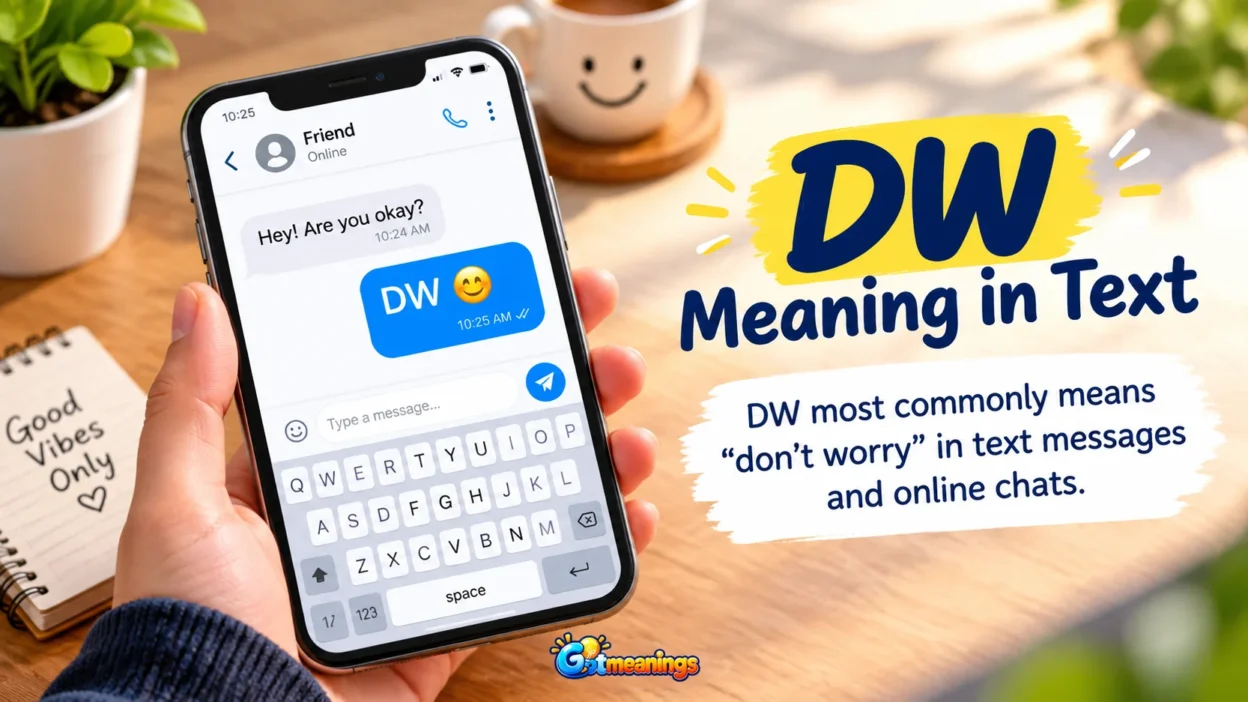
If you have received a text that says “DW,” you may wonder what the person means. DW most commonly means “don’t worry” in text messages and online chats.
People use it to reassure someone, calm their concerns, or let them know that a problem is not serious.
For example, if someone says, “Sorry I’m late,” you might reply, “DW, take your time.” Here, DW simply means “don’t worry.”
You may see DW in texting, WhatsApp, Instagram messages, Snapchat, TikTok comments, and other casual online conversations.
Its meaning can change in some situations, but “don’t worry” is the most common interpretation in everyday chat.
This guide explains what DW means, how people use it, its tone, possible meanings in different contexts, and how to reply when someone sends you DW.
| Quick Reference | Meaning |
|---|---|
| Term | DW |
| Most common meaning | Don’t worry |
| Full form | Don’t worry |
| Typical tone | Friendly, casual, reassuring |
| Common usage | Texting, social media, online chats |
What Does DW Mean in Text & Chat?
DW usually means “don’t worry” in text and chat.
It is an informal abbreviation that makes messages faster and shorter. Someone may use it when they want to reassure you, tell you not to stress, or show that they are not upset about something.
For example:
“DW, I can wait.”
This means:
“Don’t worry, I can wait.”
DW is usually friendly and neutral. It does not normally carry a hidden meaning or negative tone. However, the exact feeling behind it depends on the conversation.
When someone uses DW to reassure you
A person might send DW after you apologize, ask for help, or express concern.
For example:
“I forgot to send you the file. I’m really sorry.”
“DW, you can send it tomorrow.”
In this case, DW tells the other person that the mistake is not a big problem.
Is DW formal or informal?
DW is mainly used in casual communication. It is common among friends, family members, classmates, coworkers who chat casually, and people communicating online.
For formal emails, business letters, or professional documents, writing “don’t worry” is usually clearer and more appropriate.
Full Form, Stands For & Short Meaning of DW
The most common full form of DW is “don’t worry.”
It is simply a shortened version of the phrase. Like many texting abbreviations, DW removes unnecessary words and makes casual communication quicker.
DW = Don’t worry
The phrase can have several related uses:
- Reassurance: “DW, everything is okay.”
- Comfort: “DW, you’ll do fine.”
- Acceptance: “DW about being late.”
- Reducing concern: “DW, I already handled it.”
- Calming someone: “DW, it’s not a big deal.”
The abbreviation usually keeps the same basic meaning even when the situation changes.
DW can also depend on context
Although “don’t worry” is the standard meaning in texting, abbreviations can have other meanings in different communities or fields.
For example, DW might represent a name, organization, technical term, or other phrase outside casual texting. That is why the surrounding message matters.
If someone sends only “DW” during a normal conversation, however, “don’t worry” is usually the best interpretation.
Origin, History & First Known Use of DW
There is no single, well-established origin date for DW as a texting abbreviation that can be stated with confidence.
Its formation is straightforward: the letters D and W come from the first letters of “don’t” and “worry.” It follows the same basic shortening style used by many internet and texting abbreviations.
As text-based communication became more casual and people began using shorter messages, abbreviations such as DW became useful for quick conversations.
However, it is better not to attach a specific invention date or claim that one particular person created DW without reliable evidence.
The important point for modern readers is simple: DW is widely understood in casual online communication as “don’t worry.”
How People Use DW in Daily Conversations
People use DW when they want to make a message shorter while still sounding reassuring.
The abbreviation often appears at the beginning of a sentence:
“DW, I’m almost there.”
It can also appear after another sentence:
“I already fixed it, DW.”
Or as a complete response:
“DW 😊”
The meaning is usually clear from the surrounding conversation.
DW after an apology
One common use is responding to someone who has apologized.
Person A: “Sorry, I forgot to call you.”
Person B: “DW, it happens.”
Meaning: Person B is telling Person A not to feel bad about forgetting.
DW when someone is concerned
Person A: “Are you sure you can finish this today?”
Person B: “Yeah, DW. I’ve got it.”
Meaning: Person B is reassuring the other person that there is no need to worry.
DW in a friendly conversation
Person A: “I might be five minutes late.”
Person B: “DW, take your time. 😊”
Meaning: The person is saying that being late by a few minutes is not a problem.
DW can sound different depending on punctuation
Compare these messages:
- “DW 😊” — warm and friendly
- “DW!” — reassuring or energetic
- “dw” — very casual
- “DW.” — can sound more serious or firm depending on the conversation
The abbreviation itself does not determine the entire tone. The words around it, punctuation, emojis, and relationship between the speakers can change how it feels.
DW Meaning Across WhatsApp, Instagram, TikTok & Snapchat
The meaning of DW generally stays the same across major social and messaging platforms.
On WhatsApp, Instagram, TikTok, Snapchat, and ordinary text messages, DW most commonly means “don’t worry” when used in a normal personal conversation.
| Platform | Common meaning of DW | Typical use |
|---|---|---|
| Don’t worry | Reassuring a friend | |
| Don’t worry | DMs and casual replies | |
| TikTok | Don’t worry | Comments or messages |
| Snapchat | Don’t worry | Quick conversations |
| Text messages | Don’t worry | Everyday communication |
DW on WhatsApp
WhatsApp users may use DW as a quick response to an apology or concern.
“Sorry, I’ll send the pictures later.”
“DW, whenever you can.”
DW on Instagram
In Instagram DMs, DW can be used in the same casual way.
“Sorry I didn’t reply earlier!”
“DW 😊”
DW on Snapchat
Because Snapchat conversations are often quick and informal, short abbreviations such as DW fit naturally into messages.
“I lost the streak yesterday, sorry!”
“DW, we can start again.”
DW on TikTok
DW may also appear in TikTok comments or direct messages. Its meaning should still be judged from the surrounding words.
If the discussion is about a completely different subject, DW could potentially have another meaning. But in ordinary conversational English, “don’t worry” is the most likely meaning.
Different Meanings of DW in Other Fields
While “don’t worry” is the main meaning of DW in texting, the abbreviation can represent other things outside casual chat.
The context is especially important in technical, professional, entertainment, and organizational settings.
For example, DW can sometimes be used as an abbreviation for a name, company, publication, technical expression, or other term. These meanings are not necessarily related to texting slang.
That does not mean you should automatically assume another definition whenever you see DW.
A useful rule is:
If DW appears in a casual personal message, “don’t worry” is usually the intended meaning. If it appears in a specialized document or professional context, check the surrounding information before interpreting it.
Texting meaning vs. specialized meaning
| Context | Likely interpretation |
|---|---|
| Friend texting you | Don’t worry |
| Instagram DM | Don’t worry |
| Snapchat message | Don’t worry |
| Casual group chat | Don’t worry |
| Technical document | Could have a specialized meaning |
| Name or organization | Depends on the specific context |
Avoid assuming that every abbreviation has one universal definition. Context always matters.
Common Confusions, Mistakes & Wrong Interpretations
One common mistake is assuming that DW always means the same thing everywhere.
In ordinary texting, “don’t worry” is the safest interpretation, but the conversation should confirm it.
Another mistake is confusing DW with similar-looking abbreviations. For example, someone who is unfamiliar with internet slang may not immediately recognize whether an abbreviation is meant as reassurance, a name, or a specialized term.
Can DW sound rude?
Usually, no. DW is generally friendly or neutral.
However, tone depends on context.
For example:
“DW, I don’t care.”
This could sound dismissive because of the rest of the sentence.
By contrast:
“DW, everything is okay. ❤️”
sounds warm and supportive.
The abbreviation itself is not normally rude.
Can DW be sarcastic?
It can be, although that is less common.
Someone could write:
“DW, I’m totally fine…”
If the conversation suggests they are actually annoyed or upset, DW might be used sarcastically.
This is why reading only the abbreviation is not always enough. Look at the entire message and the conversation before it.
Does DW mean “dear wife”?
In some personal or relationship-related contexts, people may use DW as shorthand for “dear wife.” This is much less likely when you receive a normal casual text containing DW.
For example, in a family or relationship discussion, a person might use DW to refer to their wife. Context makes the intended meaning clear.
If a friend texts:
“DW, it’s okay.”
the intended meaning is almost certainly “don’t worry.”
Similar Terms, Alternatives & Related Slang
Several other abbreviations and phrases can communicate a similar idea to DW.
Some are direct alternatives, while others have slightly different tones.
| Term | Meaning | Tone |
|---|---|---|
| DW | Don’t worry | Casual, reassuring |
| No worries | It’s okay / Don’t worry | Friendly |
| Nw | No worries | Very casual |
| NP | No problem | Casual |
| It’s okay | The situation is fine | Neutral |
| You’re good | No problem / You are fine | Casual |
| All good | Everything is okay | Casual |
These expressions are not always perfect substitutes.
For example, “no worries” often responds to an apology or request, while “DW” is commonly used to reassure someone who is concerned.
Examples of DW in Real Chat Situations
Here are several natural examples showing how DW can appear in everyday conversations.
Example 1: After an apology
Person A: “Sorry, I forgot to bring your book.”
Person B: “DW, just bring it tomorrow. 😊”
Meaning: Person B is telling the other person that the mistake is not serious.
Example 2: When someone is running late
Person A: “I’m going to be about ten minutes late.”
Person B: “DW, I’m still getting ready.”
Meaning: The delay is not a problem.
Example 3: Offering reassurance
Person A: “I’m nervous about tomorrow’s presentation.”
Person B: “DW, you’ve prepared really well.”
Meaning: Person B is trying to make their friend feel less worried.
Example 4: A casual group chat
Person A: “I accidentally sent the wrong photo 😂”
Person B: “DW 😂 nobody noticed.”
Meaning: The situation is being treated as a small, funny mistake.
Example 5: A potentially serious situation
Person A: “I’m sorry I couldn’t help earlier.”
Person B: “DW. We’ll figure it out.”
Meaning: The speaker is reassuring the other person and showing that they can handle the situation.
Example 6: A short response
Person A: “Sorry for bothering you.”
Person B: “DW 😊”
Meaning: “Don’t worry about it.”
The emoji makes the short reply feel warmer and more friendly.
How to Reply When Someone Says DW
If someone sends you DW meaning “don’t worry,” your response depends on the situation.
You do not always need to reply. If DW ends the conversation naturally, a simple reaction or acknowledgment may be enough.
Friendly replies
You can respond with:
- “Thanks!”
- “Okay, thanks 😊”
- “I appreciate it.”
- “Got it!”
- “Thanks for understanding.”
If you were apologizing
If someone says:
“DW, it’s okay.”
You could reply:
“Thanks for understanding!”
or:
“I appreciate that 😊”
If you are still concerned
Sometimes DW may not completely answer your concern. You can politely ask for clarification.
For example:
“Thanks, but are you sure everything is okay?”
This works well when the situation feels more serious.
If you are not sure what DW means
If the context is unclear, simply ask:
“What do you mean by DW?”
There is nothing wrong with asking. Abbreviations can have different meanings, so clarification is better than guessing.
Is DW Still Popular? Trends & Online Usage
DW remains easy to understand in casual digital communication because it is short, intuitive, and directly formed from the phrase “don’t worry.”
People continue to use abbreviations in texting because quick messages are a natural part of online communication. However, usage can vary by age group, community, platform, and personal writing style.
Not everyone prefers abbreviations. Some people may write the complete phrase “don’t worry” instead, especially when they want to sound more personal or clear.
The important takeaway is that DW is still recognizable as a casual abbreviation, but its tone depends on how it is used.
For example:
“DW 😊”
feels different from:
“DW.”
The first can feel warm and comforting, while the second may sound more direct. Neither punctuation choice automatically changes the basic meaning.
Frequently Asked Questions
What does DW mean in text?
DW most commonly means “don’t worry.” It is a casual abbreviation used to reassure someone or tell them that a situation is not a problem.
What does DW stand for in texting?
In texting, DW usually stands for “don’t worry.” It is commonly used in messages between friends, family members, and other people having casual conversations.
Is DW a rude word?
No. DW is generally not rude. It is usually friendly or neutral and is often used to reassure someone. However, the surrounding message can make it sound dismissive or sarcastic in some situations.
What does DW mean on WhatsApp?
On WhatsApp, DW usually means “don’t worry.” For example, “DW, take your time” means “Don’t worry, take your time.”
What does DW mean on Instagram or Snapchat?
DW usually has the same meaning on Instagram and Snapchat: “don’t worry.” It is commonly used in DMs and casual conversations.
How should I reply to DW?
You can reply with “Thanks!”, “I appreciate it,” “Okay, thanks 😊,” or simply acknowledge the message. If you are unsure what the sender means, ask them for clarification.
Can DW mean something other than “don’t worry”?
Yes. In some specialized or personal contexts, DW can represent other words or phrases. However, in an ordinary text message, “don’t worry” is usually the most likely meaning.
Does DW mean “dear wife”?
It can in some relationship or family contexts, but that is not the usual meaning in everyday texting. When someone sends “DW” as reassurance, it almost certainly means “don’t worry.”
What is the difference between DW and no worries?
Both can communicate reassurance, but DW is a short abbreviation for “don’t worry,” while “no worries” is a complete casual phrase. Their meanings often overlap.
Conclusion
So, what does DW mean in text? In most casual messages, DW means “don’t worry.” People use it to reassure someone, respond to an apology, reduce concern, or show that a small problem is not a big deal.
You may see DW in text messages, WhatsApp chats, Instagram DMs, Snapchat conversations, TikTok messages, and other informal online communication.
Its tone is usually friendly and relaxed, especially when combined with words or emojis that show warmth.
Context still matters. In a specialized conversation, DW may have another meaning, and punctuation can slightly change how the message feels.
But when someone simply sends “DW” during an everyday conversation, interpreting it as “don’t worry” is usually the right choice.

Milo Carter is a tax writer who explains tax terms, rules, and common questions in simple, easy-to-understand language.