
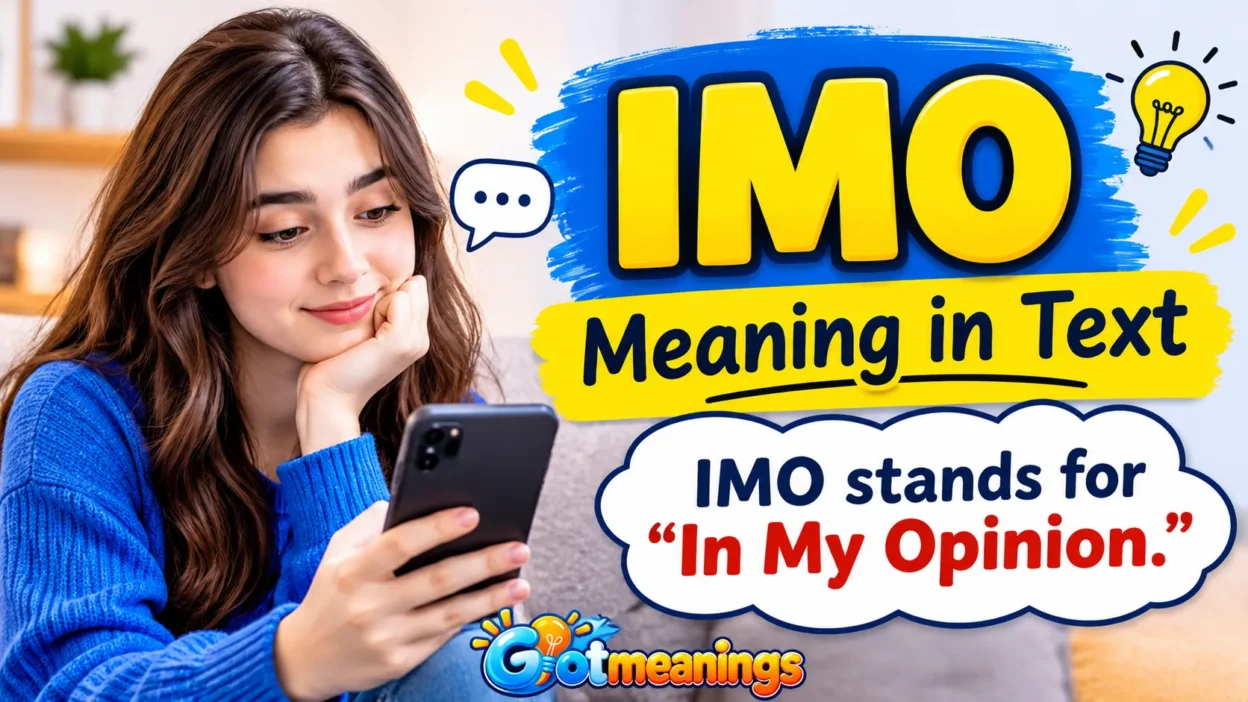
If someone sends you “IMO” in a text message, they are usually sharing their opinion. IMO stands for “In My Opinion.” People use it in texting, online chats, social media comments, and everyday digital conversations to show that a statement reflects their personal view rather than an objective fact.
For example, someone might write, “IMO, this movie is better than the first one.” They are simply expressing what they think.
The abbreviation can make a message sound casual, friendly, or less forceful, especially when people are discussing different preferences.
Understanding the IMO meaning in text can help you follow conversations and respond naturally. In this guide, you will learn what IMO means, whether it has a full form, how people use it on different platforms, and how to reply when someone sends it. You will also discover common misunderstandings, similar abbreviations, and realistic examples of IMO in everyday chats.
| Detail | Meaning |
|---|---|
| Term | IMO |
| Most common meaning | In My Opinion |
| Full form | In My Opinion |
| Typical tone | Casual, personal, and conversational |
| Common usage | Text messages, group chats, comments, and online discussions |
| Example | “IMO, this is the best option.” |
What Does IMO Mean in Text & Chat?
IMO means “In My Opinion.” It is a common internet abbreviation used when someone wants to share a personal thought, preference, judgment, or belief.
Instead of typing the complete phrase, people use IMO to keep their messages short. It is especially useful in informal conversations where people exchange recommendations, discuss entertainment, compare products, or disagree about a topic.
For example:
Person A: “Which phone do you think is better?”
Person B: “IMO, the second one is worth the money.”
In this conversation, the second person is giving a personal recommendation. They are not claiming that everyone must agree with them.
IMO can also help make an opinion sound less absolute. Compare these two statements:
- “This is the best restaurant.”
- “IMO, this is the best restaurant.”
The first statement sounds more definite. The second makes it clear that the speaker is expressing a personal judgment.
However, IMO does not automatically make a message polite. The words that follow it still matter.
For instance, “IMO, your idea needs more work” may sound constructive in a helpful conversation. In a tense discussion, the same words might feel critical.
The main point is simple: when you see IMO in a message, read it as a signal that the person is sharing their own perspective.
Full Form, Stands For & Short Meaning of IMO
The full form of IMO is In My Opinion. It is an abbreviation formed from the first letters of the three words.
Here is a quick breakdown:
| Letter | Word |
|---|---|
| I | In |
| M | My |
| O | Opinion |
The short meaning is “this is what I think.”
People commonly place IMO before or near the beginning of an opinion. However, its position can vary depending on the sentence.
Examples include:
- “IMO, we should leave early.”
- “That game is overrated, IMO.”
- “IMO, learning a new skill takes patience.”
- “The blue design looks better IMO.”
All four examples express a personal view.
IMO vs. IMHO
You may also see IMHO, which usually stands for “In My Humble Opinion.” It serves a similar purpose but includes the word “humble.”
| Abbreviation | Full form | Main purpose |
|---|---|---|
| IMO | In My Opinion | Shares a personal view |
| IMHO | In My Humble Opinion | Shares a view, sometimes with a softer or more modest tone |
In everyday online conversations, the two abbreviations often serve the same basic function. Still, IMHO may sound more deliberately modest, depending on the speaker.
Origin, History & First Known Use of IMO
IMO belongs to the broader group of internet abbreviations that make digital communication quicker and easier.
The phrase “in my opinion” existed long before texting and social media. The abbreviation became useful as people began communicating through online discussion groups, chat rooms, email, and other forms of computer-mediated communication.
Short expressions helped users share thoughts without typing every word. Abbreviations such as IMO, FYI, and BTW became familiar parts of informal online language.
However, it is important to separate the general history of internet shorthand from the exact history of IMO. Without reliable historical evidence, it would be misleading to identify a specific person, website, or year as the definite origin of the abbreviation.
Today, IMO is widely recognizable in informal digital communication. It remains useful because people still need a quick way to distinguish personal opinions from statements they present as facts.
Its basic meaning has remained consistent: “In My Opinion.”
How People Use IMO in Daily Conversations
People use IMO when sharing preferences, making recommendations, offering feedback, or expressing disagreement.
The meaning stays the same in these situations, but the tone can change with the conversation.
Sharing Personal Opinions
IMO is often used to introduce a personal belief or judgment.
Example:
“IMO, the new update looks much better.”
The speaker is sharing their own assessment of the update.
Giving Recommendations
People also use IMO when suggesting something they personally like.
Example:
“IMO, you should watch the original movie first.”
This makes the recommendation sound like personal advice rather than a strict instruction.
Disagreeing Politely
IMO can help someone express a different view without presenting it as the only correct answer.
Example:
“IMO, we should try another approach.”
This sounds like a suggestion, although the surrounding conversation can affect how it is received.
Discussing Preferences
The abbreviation is common when people talk about food, music, clothing, games, and entertainment.
Example:
“IMO, chocolate ice cream tastes better than vanilla.”
The statement is clearly based on personal preference.
Offering Feedback
IMO can introduce constructive criticism or an honest assessment.
Example:
“IMO, your presentation would be clearer with fewer slides.”
Depending on the relationship between the people, this could sound helpful, direct, or slightly critical.
In general, IMO works best when the speaker wants to share a view without implying that everyone must agree.
IMO Meaning Across WhatsApp, Instagram, TikTok & Snapchat
The IMO meaning usually remains the same across messaging apps and social media platforms. It generally means “In My Opinion,” although the surrounding conversation determines what the person is expressing.
IMO on WhatsApp
On WhatsApp, people may use IMO in private messages, family group chats, or conversations with friends.
Example:
Person A: “Should we meet on Saturday?”
Person B: “IMO, Saturday evening would be better.”
Here, IMO introduces a personal suggestion about the meeting time.
IMO on Instagram
On Instagram, IMO may appear in comments, direct messages, captions, or discussions about posts.
Example:
“IMO, this outfit looks better with white shoes.”
The person is sharing a fashion preference. They are not stating a universal rule about clothing.
IMO on TikTok
TikTok users may use IMO in comments or messages when discussing videos, trends, music, creators, or opinions about popular topics.
Example:
“IMO, the original version is still the best.”
The abbreviation signals that the comment reflects the user’s personal judgment.
IMO on Snapchat
On Snapchat, IMO can appear in quick messages between friends.
Example:
Person A: “Do you like this picture?”
Person B: “IMO, the second one looks more natural.”
The second person is offering a personal opinion about the pictures.
Does IMO Have Different Meanings on Different Platforms?
Usually, no. IMO generally means “In My Opinion” on WhatsApp, Instagram, TikTok, and Snapchat.
The main difference is the setting. A private message may feel more personal, while a public comment may invite discussion or disagreement.
Always consider the full message before deciding what the sender intends.
Different Meanings of IMO in Other Fields
Although “In My Opinion” is the most common meaning of IMO in informal online conversations, the same three letters can mean something else in a different context.
One notable example is International Maritime Organization, a United Nations specialized agency concerned with international shipping safety, maritime security, and the prevention of pollution from ships.
This meaning is more likely to appear in news reports, government documents, shipping discussions, and maritime publications.
For example:
“The IMO adopted new measures related to international shipping.”
In this sentence, IMO refers to the organization, not someone’s personal opinion.
The context makes the difference clear.
| Context | Likely meaning |
|---|---|
| Casual text message | In My Opinion |
| Online discussion | In My Opinion |
| Personal recommendation | In My Opinion |
| Maritime policy or shipping news | International Maritime Organization |
In technical documents, workplace messages, or specialist discussions, avoid assuming that IMO always refers to the texting abbreviation.
Look at the subject, surrounding words, and purpose of the conversation. These clues usually make the intended meaning clear.
Common Confusions, Mistakes & Wrong Interpretations
Although IMO is simple, people sometimes misunderstand its purpose or confuse it with similar abbreviations.
Confusing IMO With IMHO
IMO means “In My Opinion,” while IMHO generally means “In My Humble Opinion.”
Both introduce personal views, and they are often interchangeable in casual conversations. However, IMHO includes an extra word that may suggest modesty.
Thinking IMO Means a Proven Fact
IMO introduces an opinion, not proof.
For example, “IMO, this is the best laptop” expresses a preference. It does not establish that the laptop is objectively better than every alternative.
If the speaker makes a factual claim after IMO, that claim may still need evidence.
Assuming IMO Is Always Polite
Some people use IMO to soften disagreement. Others use it before blunt criticism.
Compare:
- “IMO, we should choose the cheaper option.”
- “IMO, that was a terrible decision.”
The first sounds like a practical suggestion. The second is much more critical.
The abbreviation does not remove the emotional impact of the words that follow it.
Confusing IMO With IMHO or Other Internet Slang
IMO is sometimes confused with abbreviations such as TBH, IMHO, and IIRC.
- IMO: In My Opinion.
- IMHO: In My Humble Opinion.
- TBH: To Be Honest.
- IIRC: If I Recall Correctly.
These expressions have related conversational uses, but they are not identical.
Assuming Capitalization Changes the Meaning
IMO, imo, and Imo may be used to express the same idea in informal messages.
Capital letters often make the abbreviation easier to recognize, but lowercase spelling is also common in casual typing.
Ignoring the Surrounding Conversation
A message containing IMO may be serious, funny, helpful, or sarcastic. The abbreviation alone cannot tell you everything about the sender’s mood.
Pay attention to the full sentence, punctuation, emojis, and your relationship with the person.
Similar Terms, Alternatives & Related Slang
Several internet abbreviations help people express opinions, introduce information, or communicate their feelings.
Understanding the differences makes it easier to interpret messages correctly.
| Term | Full form | How it differs from IMO |
|---|---|---|
| IMHO | In My Humble Opinion | Expresses a view, sometimes more modestly |
| TBH | To Be Honest | Emphasizes honesty or directness |
| I think | I think | Introduces a personal thought in ordinary language |
| IIRC | If I Recall Correctly | Signals uncertainty about a memory |
| FYI | For Your Information | Introduces information someone may find useful |
| AFAIK | As Far As I Know | Indicates the limits of someone’s knowledge |
Here are a few examples of how these expressions work.
IMO: “IMO, this plan is more practical.”
The speaker is sharing a personal judgment.
TBH: “TBH, I didn’t enjoy the movie.”
The speaker emphasizes honesty or openness.
IIRC: “IIRC, the meeting starts at nine.”
The speaker is relying on their memory and allowing for the possibility of being mistaken.
FYI: “FYI, the office closes early today.”
The speaker is providing information rather than necessarily expressing an opinion.
You do not need to use internet abbreviations in every conversation. Full phrases are often clearer in formal emails, school assignments, professional reports, and situations where the reader may not know the shorthand.
Examples of IMO in Real Chat Situations
The following examples show how people might naturally use IMO in different everyday conversations.
Example 1: Sharing a Preference
Person A: “Which song do you like more?”
Person B: “IMO, the first one has a better beat. 🎵”
Meaning: The second person is sharing a personal music preference.
Example 2: Making a Recommendation
Person A: “Should I buy this jacket?”
Person B: “IMO, yes! It looks great on you. 😊”
Meaning: IMO introduces a personal recommendation. The positive wording and emoji make the reply friendly.
Example 3: Disagreeing With a Friend
Person A: “I think the sequel is much better.”
Person B: “IMO, the original was more interesting.”
Meaning: The second person disagrees without claiming that their opinion is the only correct one.
Example 4: Giving Helpful Feedback
Person A: “What do you think of my essay?”
Person B: “IMO, your main idea is strong, but the introduction could be clearer.”
Meaning: The speaker offers a personal assessment and a practical suggestion.
Example 5: Talking About Food
Person A: “Pizza or burgers?”
Person B: “IMO, pizza wins every time. 🍕”
Meaning: The person expresses a playful preference. The phrase “every time” adds emphasis.
Example 6: Discussing a Game
Person A: “Was that a good match?”
Person B: “IMO, it was the best one we’ve played this week.”
Meaning: The speaker gives a positive opinion about the match.
Example 7: A Sarcastic Opinion
Person A: “Do you think I need another cup of coffee?”
Person B: “IMO, you’ve only had about five already. 😂”
Meaning: The reply is playful and sarcastic. The exaggerated reference to five cups and the laughing emoji help signal the joke.
Example 8: Expressing a Strong Opinion
Person A: “I love the new design.”
Person B: “IMO, it’s too crowded and needs simplifying.”
Meaning: The speaker disagrees directly. Although IMO frames the statement as a personal view, the criticism remains clear.
Example 9: Choosing a Meeting Time
Person A: “Should we meet in the morning or evening?”
Person B: “IMO, evening would work better for everyone.”
Meaning: IMO introduces a suggestion based on the speaker’s perspective.
Example 10: Responding to an Online Discussion
Person A: “This is the most underrated movie ever.”
Person B: “IMO, it’s definitely underrated, but there are a few better ones.”
Meaning: The second person partly agrees while adding their own perspective.
These examples demonstrate that IMO does not have a separate meaning for each emotion. Its core meaning remains “In My Opinion,” while the rest of the message establishes the tone.
How to Reply When Someone Says IMO
Your reply depends on what the person is discussing. Since IMO usually introduces an opinion, you can agree, disagree politely, ask a question, or invite the person to explain their reasoning.
When You Agree
You can show that you share their view.
Examples:
- “I agree with you!”
- “Same here, IMO that’s the best choice.”
- “Exactly! I was thinking the same thing.”
You do not need to repeat IMO if your meaning is already clear.
When You Disagree Politely
A different opinion does not have to turn into an argument.
Examples:
- “I see your point, but I prefer the other option.”
- “That’s fair. I look at it a little differently.”
- “I get what you mean, although I disagree.”
These replies acknowledge the other person’s perspective while allowing you to express your own.
When You Want More Information
If you are unsure why someone holds a particular view, ask a simple follow-up question.
Examples:
- “What makes you think that?”
- “Why do you prefer that one?”
- “Can you explain your reasoning?”
These questions can help keep the discussion constructive.
When the Message Is Playful
If the person is joking about a preference, you can respond with humor.
Examples:
- “Haha, that’s your official opinion? 😂”
- “Fair enough! Everyone has their favorites.”
- “I knew you were going to say that!”
Use this approach when the conversation already has a playful tone.
When the Opinion Sounds Rude
IMO does not make every statement respectful. If someone uses it to criticize you harshly, you can set a boundary without escalating the situation.
Examples:
- “You’re entitled to your opinion, but please say it respectfully.”
- “I understand that’s how you feel. I don’t agree.”
- “Let’s keep the conversation constructive.”
Choose a response that fits the situation and your relationship with the person.
Is IMO Still Popular? Trends & Online Usage
IMO remains a recognizable abbreviation in informal digital communication because it expresses a common idea in just three letters.
People continue to encounter it in text messages, online discussions, gaming conversations, social media comments, and other settings where short messages are useful.
Its continued usefulness does not mean it is always the best choice. Many people prefer ordinary phrases such as “I think,” “personally,” or “in my opinion,” especially when writing to someone who may not understand internet shorthand.
The abbreviation is also easy to understand because its meaning is closely tied to a familiar everyday expression.
However, without current, reliable usage data, it would be inaccurate to claim a precise popularity ranking or a specific increase or decrease in use during 2026.
Should You Use IMO in 2026?
Yes, IMO is appropriate for most casual digital conversations when you want to share a personal view.
It works well in:
- Friendly text messages.
- Informal group chats.
- Social media comments.
- Discussions about entertainment or hobbies.
- Casual recommendations and feedback.
For formal writing, professional correspondence, or important discussions, consider spelling out “in my opinion” or expressing your view directly.
The best choice depends on your audience. Use IMO when the tone is informal and the meaning will be clear to the reader.
Frequently Asked Questions
What does IMO mean in text messages?
IMO means “In My Opinion.” People use it in text messages to introduce a personal thought, preference, judgment, or recommendation.
What does IMO stand for in texting?
IMO stands for “In My Opinion.” It is a short form commonly used in online chats and informal digital communication.
Is IMO rude or disrespectful?
No, IMO is not inherently rude. It is generally neutral, but the words that follow it can sound friendly, critical, sarcastic, or disrespectful.
What is the difference between IMO and IMHO?
IMO means “In My Opinion,” while IMHO usually means “In My Humble Opinion.” Both introduce a personal view, but IMHO may suggest a more modest tone.
What does IMO mean on WhatsApp?
On WhatsApp, IMO usually means “In My Opinion.” People use it when sharing preferences, offering suggestions, or discussing something with friends and family.
What does IMO mean on Instagram and TikTok?
On Instagram and TikTok, IMO generally has the same meaning: “In My Opinion.” It can appear in comments, direct messages, and discussions about videos, trends, or other topics.
How should I reply when someone texts IMO?
You can agree, disagree politely, or ask for more information. For example, you might say, “That’s fair, but I prefer the other option,” depending on the conversation.
Can IMO mean something other than In My Opinion?
Yes. In maritime and international policy contexts, IMO can refer to the International Maritime Organization. In ordinary texting, however, “In My Opinion” is the usual interpretation.
Does IMO mean the same thing as TBH?
No. IMO means “In My Opinion,” while TBH means “To Be Honest.” Both can introduce personal statements, but they emphasize different things.
Should I use IMO in formal emails?
It is usually better to write “in my opinion” in full or phrase your point directly in formal emails. IMO is more suitable for casual conversations and informal online discussions.
Conclusion
The most common IMO meaning in text is “In My Opinion.” It is a simple abbreviation that helps people share their thoughts, preferences, recommendations, and judgments in everyday digital conversations.
You may see IMO in WhatsApp messages, Instagram comments, TikTok discussions, Snapchat chats, and other online spaces. Its basic meaning usually stays the same across these platforms, although the surrounding words can change the tone. A message may sound friendly, serious, playful, or critical depending on what the person says.
Remember that IMO introduces a personal perspective rather than proving that a statement is a fact. It is also different from related expressions such as IMHO and TBH, even though they can serve similar conversational purposes.
When someone uses IMO, focus on the complete message to understand their intention. You can then respond naturally, whether you agree, disagree, or simply want to learn more about their point of view.

Milo Carter is a tax writer who explains tax terms, rules, and common questions in simple, easy-to-understand language.