
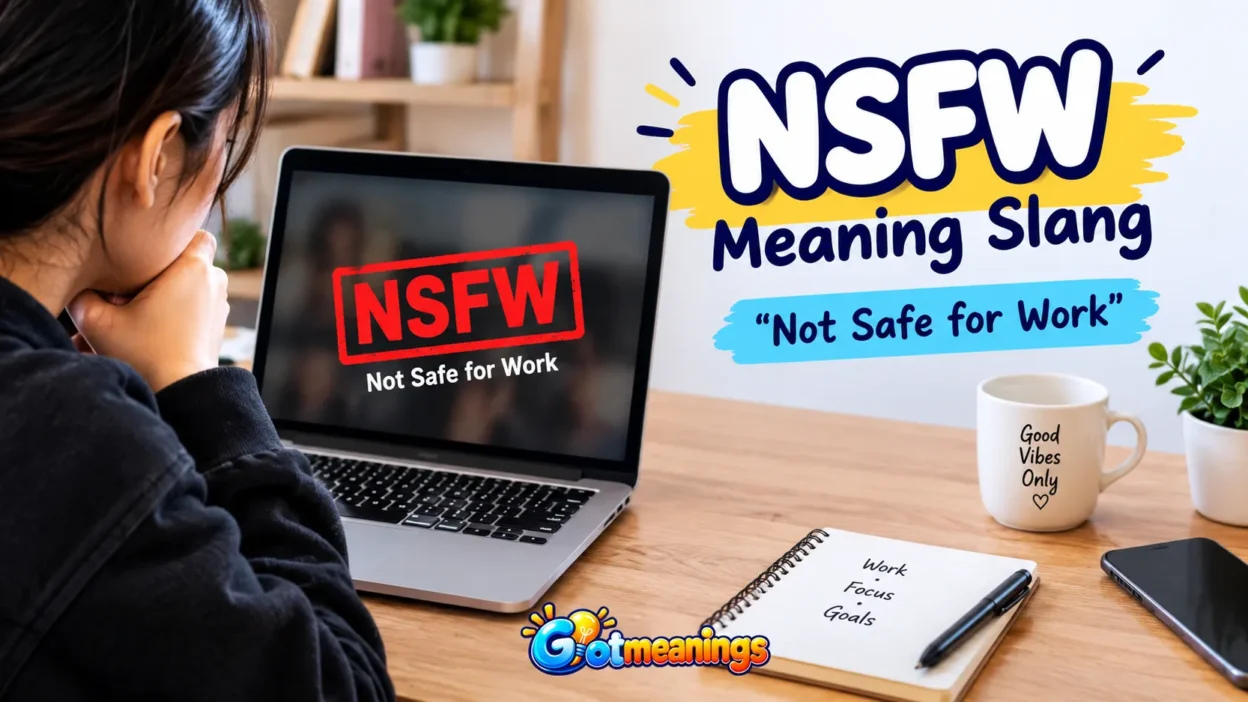
The NSFW meaning slang is “Not Safe for Work.” People use NSFW to warn others that a photo, video, message, website, or other content may be inappropriate to view in a workplace or public setting.
This content may include nudity, sexual material, graphic violence, strong language, or other things that could make people uncomfortable around others.
You may see NSFW on social media, in text messages, online forums, group chats, and links shared by friends. For example, someone might write “NSFW 😂” before sending a funny but inappropriate picture. Another person may add an NSFW label to a post so viewers know what to expect before opening it.
Understanding this abbreviation helps you avoid awkward situations and recognize content warnings online. In this guide, you will learn what NSFW means in text, how people use it on different platforms, how to reply, and how it differs from similar internet slang.
| Quick detail | Meaning |
|---|---|
| Slang term | NSFW |
| Full form | Not Safe for Work |
| Main purpose | Warns about potentially inappropriate content |
| Typical tone | Neutral, cautionary, or joking |
| Common usage | Text messages, social media, links, images, and videos |
| Related term | SFW (Safe for Work) |
What Does NSFW Mean in Text & Chat?
NSFW means “Not Safe for Work” in text messages and online chats. It warns someone that content may be unsuitable to view at work, school, or another public place.
The term does not always mean that something is dangerous. Instead, it usually means that the content could be embarrassing, offensive, distracting, or inappropriate for the setting.
For example, a friend might send you a message saying, “Don’t open this here, it’s NSFW.”
They are telling you to wait until you are somewhere private before viewing the content.
What Kind of Content Is NSFW?
NSFW can describe several types of material, depending on the platform and situation.
- Sexual content: Nudity, sexually suggestive images, or explicit material.
- Graphic violence: Disturbing injury photos, violent videos, or graphic scenes.
- Strong language: Profanity or offensive jokes that may not suit a professional setting.
- Adult humor: Sexual jokes, crude memes, or other content that could embarrass someone in public.
- Sensitive images: Content that may be upsetting or uncomfortable for some viewers.
Not every NSFW post contains all these things. The label is a general warning, and the actual content determines why it was used.
Does NSFW Always Mean Something Sexual?
No. NSFW often refers to sexual or adult content, but it can also describe graphic violence, offensive language, or disturbing images.
For example:
Person A: “This video is NSFW. Watch it later.”
Person B: “Is it something sexual?”
Person A: “No, it shows some really graphic injuries.”
The example shows why you should not assume the content is sexual just because it has an NSFW label.
Full Form, Stands For & Short Meaning of NSFW
NSFW stands for Not Safe for Work. It is an abbreviation used to warn people about content that may not be appropriate to view in a professional or public environment.
The phrase is easy to understand when you break it down:
- N: Not
- S: Safe
- F: For
- W: Work
In everyday online communication, people usually write the four letters rather than spelling out the full phrase.
NSFW Meaning in Simple English
In simple English, NSFW means “Don’t open or watch this where other people might see your screen.”
It is a quick warning that helps people decide when and where to view something.
NSFW Meaning in Urdu
NSFW ka matlab hai “Not Safe for Work,” yani aisa content jo office, school, ya public place mein dekhna munasib na ho.
Is mein adult pictures, inappropriate jokes, graphic videos, ya offensive material shamil ho sakta hai.
NSFW vs. SFW
SFW stands for “Safe for Work.” It is commonly used for content that is generally suitable to view in a workplace or public setting.
| Term | Full form | Meaning |
|---|---|---|
| NSFW | Not Safe for Work | Content may be inappropriate in public or at work |
| SFW | Safe for Work | Content is generally suitable for public or work settings |
| NSFL | Not Safe for Life | A strong warning for extremely disturbing or graphic content |
NSFL is a separate internet abbreviation, not another form of NSFW. It generally signals content that may be especially disturbing, but its use is informal and can vary.
Origin, History & First Known Use of NSFW
NSFW developed as part of internet communication, where short labels help people share information quickly. Its full phrase, “Not Safe for Work,” describes the practical purpose of the warning.
As people began sharing more links, images, videos, and discussions online, a short label became useful for identifying content that might be unsuitable for an office computer or a shared screen.
The abbreviation is now recognizable across many types of online communication, including forums, social platforms, messaging apps, and content-sharing communities.
However, it is difficult to identify one universally accepted first use of the exact abbreviation without reliable historical evidence. It would be misleading to assign a specific creator, website, or date without verification.
Why Did People Start Using NSFW?
The abbreviation offers a simple way to warn someone before they open a link or view an image.
Imagine receiving a message while sitting beside your coworkers. A short NSFW label can help you avoid displaying something embarrassing on a shared or visible screen.
It is also useful for online communities because members may have different expectations about appropriate content. A warning gives readers a chance to decide whether they want to continue.
How NSFW Became Part of Everyday Internet Language
NSFW is no longer limited to traditional office settings. People also use it when talking about classrooms, public transport, family gatherings, or any place where viewing certain content might be uncomfortable.
Today, it often appears as a content label rather than a complete sentence. For example, someone may simply write “NSFW” above an image or place it in a post title.
How People Use NSFW in Daily Conversations
People use NSFW to warn others, label content, or make a joke about something inappropriate. Its meaning usually stays the same, but the tone can change with the conversation.
1. Warning a Friend
A person may use NSFW when sharing a video, meme, or picture that contains adult humor or other potentially inappropriate material.
Person A: “I found a hilarious meme. It’s NSFW, though.”
Person B: “I’ll check it when I get home 😂”
Meaning: The sender is warning the friend not to open the meme in a public place.
2. Labeling a Link
Someone might add NSFW before a link to help the recipient decide whether to open it.
Person A: “NSFW: Don’t open this during the meeting.”
Person B: “Thanks for the warning!”
Meaning: The label signals that the linked content may be unsuitable for the current setting.
3. Making a Joke
Friends sometimes use NSFW playfully when sharing a crude joke or an embarrassing meme.
Person A: “My search history is NSFW today 💀”
Person B: “I’m not asking any questions.”
Meaning: The conversation uses NSFW humorously. It does not necessarily indicate that the person has shared an actual image or video.
4. Describing a Workplace Problem
NSFW can also be used seriously when discussing content that should not be displayed on a work computer.
Person A: “Please remove that NSFW image from the presentation.”
Person B: “You’re right. I’ll replace it.”
Meaning: Here, NSFW is a practical warning rather than a joke.
Does Tone Change the Meaning?
The core definition stays the same, but the intent can vary.
- Neutral: A simple warning about unsuitable content.
- Serious: A request to avoid displaying inappropriate material.
- Playful: A joke about embarrassing or adult-themed content.
- Sarcastic: A humorous label for something only mildly inappropriate.
Emojis, punctuation, and the relationship between the people help reveal the intended tone.
NSFW Meaning Across WhatsApp, Instagram, TikTok & Snapchat
NSFW generally means “Not Safe for Work” across social media and messaging platforms. The abbreviation itself does not usually change meaning from one app to another.
What changes is how people use it and how each platform handles potentially sensitive content.
NSFW on WhatsApp
On WhatsApp, people may write NSFW before sending a link, image, video, or message in a private chat or group.
For example:
Person A: “NSFW video 😂 Watch it later.”
Person B: “Okay, I’ll wait until I’m alone.”
The label serves as a warning from the sender. It does not automatically mean WhatsApp has reviewed or marked the content.
NSFW on Instagram
On Instagram, NSFW may appear in captions, comments, direct messages, or discussions about adult-themed memes and images.
People may use it to warn followers that a post contains suggestive or otherwise unsuitable material. However, writing NSFW in a caption does not guarantee that the content is hidden or restricted by Instagram.
NSFW on TikTok
TikTok users may use NSFW when discussing videos, jokes, links, or content that might not be suitable for every audience.
For example, a creator might describe a joke as NSFW because it contains strong language. The label is an informal description, not an official guarantee about the video’s suitability or visibility.
NSFW on Snapchat
On Snapchat, people may use NSFW in chats when sending potentially inappropriate pictures, videos, or links.
For example:
Person A: “This snap is NSFW. Open it later.”
Person B: “Got it, thanks for telling me.”
The sender is asking the recipient to consider their surroundings before viewing the content.
Does NSFW Have a Different Meaning on Each App?
No. Its basic meaning is consistent across WhatsApp, Instagram, TikTok, and Snapchat.
| Platform | Common use |
|---|---|
| Warning before sharing a message, image, or video | |
| Labeling suggestive posts, memes, or links | |
| TikTok | Describing mature jokes or potentially unsuitable content |
| Snapchat | Warning a friend before they open a snap or link |
| Labeling posts or discussions that may contain unsuitable material |
Remember that platform rules and content controls differ. An NSFW label is not a substitute for a platform’s own safety features or content warnings.
Different Meanings of NSFW in Other Fields
Although NSFW has a well-established meaning online, its practical use can vary by community.
NSFW in Online Communities
In forums and discussion groups, NSFW may be used as a tag in a post title. It alerts readers that the post could contain mature, explicit, graphic, or otherwise unsuitable material.
Some communities use labels to help readers filter content. Others rely on warnings in titles or captions.
The exact rules depend on the community.
NSFW in Professional Communication
In a workplace, NSFW usually refers to content that should not be viewed or displayed in a professional environment.
For example, an employee might describe an inappropriate image as NSFW when asking a colleague to remove it from a shared presentation.
The term can also be used in workplace chat to warn coworkers about a link before they open it.
NSFW in Content Moderation
Some online services use NSFW as a label or category for potentially mature content. Depending on the service, this may affect how content is displayed, filtered, or accessed.
However, NSFW is not a universal technical standard. One platform’s labeling system may work differently from another’s.
Is NSFW a Technical Acronym?
NSFW began as an informal abbreviation and is widely used in digital communication. Some services have adopted it as a content label, but it does not have one universal technical definition that applies to every platform.
In most everyday situations, the standard meaning remains “Not Safe for Work.”
Common Confusions, Mistakes & Wrong Interpretations
NSFW is simple once you know the full form, but people sometimes misunderstand how the label works.
Mistake 1: Thinking NSFW Always Means Pornography
NSFW often relates to sexual content, but it can also refer to violence, offensive language, crude humor, or disturbing images.
The label tells you to be cautious. It does not identify the exact content.
Mistake 2: Thinking NSFW Means Dangerous
The phrase does not automatically mean that a link contains malware, a scam, or another digital threat.
It warns about the nature of the content, not necessarily the security of the website. You should still be careful with unfamiliar links because an NSFW label does not prove that a link is safe.
Mistake 3: Assuming Every NSFW Post Is Explicit
Some people use NSFW loosely for mildly embarrassing jokes, suggestive memes, or content that may not suit a particular audience.
The label can be serious or humorous. The actual content matters more than the letters alone.
Mistake 4: Thinking the Label Hides the Content Automatically
Writing NSFW in a message or caption does not necessarily blur an image, block a video, or prevent other people from seeing it.
Some platforms offer separate content-warning or sensitive-media features. Those features may work differently from a simple text label.
Mistake 5: Confusing NSFW With SFW
NSFW warns that content may be unsuitable for a particular setting. SFW describes content that is generally suitable for work or public viewing.
Neither label guarantees that every person will find the content appropriate.
Mistake 6: Ignoring the Situation
A meme marked NSFW may be harmless to one person but uncomfortable for another. Workplace rules, cultural expectations, age, and personal boundaries can all affect what is appropriate.
When unsure, wait until you are in a private setting or ask the sender what the warning refers to.
Similar Terms, Alternatives & Related Slang
Several abbreviations appear alongside NSFW in online conversations. Learning the differences makes them easier to understand.
| Term | Full form or meaning | Main difference |
|---|---|---|
| SFW | Safe for Work | Indicates generally suitable content |
| NSFL | Not Safe for Life | Warns about extremely disturbing or graphic content |
| 18+ | Adults only | Indicates an age-related restriction or recommendation |
| TW | Trigger Warning | Alerts readers to potentially distressing material |
| CW | Content Warning | Warns readers about specific content that may be upsetting |
| TMI | Too Much Information | Describes sharing more personal or graphic detail than someone wants |
| PG-13 | Parental guidance suggested for viewers under 13 | A film rating in the United States, not a direct synonym for NSFW |
NSFW vs. SFW
These are direct opposites in common online use.
- NSFW: The content may be inappropriate to view at work or in public.
- SFW: The content is generally suitable for those settings.
For example, a harmless picture of a dog would usually be considered SFW. A graphic injury photo would generally be considered NSFW.
NSFW vs. NSFL
NSFW is a broad warning for content that may be unsuitable for a workplace or public setting. NSFL is a stronger informal warning often associated with disturbing or graphic material.
The labels are not official ratings, and people may use them differently.
NSFW vs. TW and CW
TW means “Trigger Warning,” while CW means “Content Warning.” Both help prepare readers for material that may be distressing.
NSFW focuses on whether content may be unsuitable for a work or public environment. TW and CW focus more on the nature of the content and its possible emotional impact.
A post may use more than one warning if several concerns apply.
Examples of NSFW in Real Chat Situations
These examples show how NSFW can appear naturally in messages, captions, and group conversations.
Example 1: Warning Before Sharing a Meme
Person A: “I found a funny meme, but it’s NSFW 😂”
Person B: “I’ll save it for later.”
Meaning: The sender is warning the recipient that the meme may be inappropriate to view in public.
Example 2: Sharing a Link at Work
Person A: “Is that link safe to open in the office?”
Person B: “It has an NSFW label, so wait until you’re home.”
Meaning: The warning suggests the content may not be suitable for a workplace.
Example 3: Asking About a Social Media Post
Person A: “Why did you write NSFW in your caption?”
Person B: “The video has some pretty strong language.”
Meaning: The label refers to potentially inappropriate language rather than sexual content.
Example 4: Using NSFW as a Joke
Person A: “My playlist is NSFW today 😭”
Person B: “How bad are these song lyrics?”
Meaning: The sender is using the term humorously, perhaps because the lyrics contain explicit language.
Example 5: A Serious Workplace Reminder
Person A: “That picture is NSFW. Please don’t put it on the office screen.”
Person B: “Understood. I’ll remove it.”
Meaning: The sender is making a clear request to avoid displaying unsuitable content in a professional setting.
Example 6: Asking for Clarification
Person A: “NSFW warning before you open this.”
Person B: “Thanks. Is it graphic or just adult humor?”
Person A: “It’s a graphic medical image.”
Meaning: The recipient asks what kind of content to expect rather than assuming the warning refers to sexual material.
Example 7: Sharing Content With a Group
Person A: “Quick warning: the next video is NSFW.”
Person B: “I’ll skip it for now. I’m watching with my family.”
Meaning: The recipient understands that the current setting may not be suitable for the video.
These examples show that NSFW can be serious, casual, or playful. The surrounding conversation helps clarify the intended meaning.
How to Reply When Someone Says NSFW
Your response depends on what the sender means and whether you want to view the content.
If You Appreciate the Warning
You can keep your reply short and polite.
- “Thanks for the heads-up!”
- “Good to know. I’ll check it later.”
- “Thanks for warning me.”
These replies work well when someone is helping you avoid an awkward situation.
If You Want to Know What the Content Contains
Ask a simple question before opening the link.
- “What kind of content is it?”
- “Is it graphic or just inappropriate language?”
- “Should I wait until I’m somewhere private?”
This is useful when the label does not explain the specific concern.
If the Sender Is Being Playful
If a friend uses NSFW jokingly, you can respond in the same light tone.
- “Now I’m curious 😂”
- “I’ll save that for later.”
- “Why does that sound suspicious? 💀”
Use playful replies only when you are comfortable with the conversation.
If You Do Not Want to View It
You do not need to open or respond positively to unsuitable content.
You could say:
- “I’ll pass, thanks.”
- “That’s not really my thing.”
- “Please don’t send me that kind of content.”
If someone continues sending unwanted material, it is reasonable to set a clear boundary or use the platform’s available blocking and reporting tools.
If You Are Unsure Whether It Is Safe
Remember that NSFW is a content warning, not a cybersecurity guarantee. If the message contains an unfamiliar or suspicious link, do not assume it is trustworthy just because the sender labeled it NSFW.
Is NSFW Still Popular? Trends & Online Usage
NSFW remains a recognizable abbreviation in internet communication because it serves a clear purpose: warning people about potentially unsuitable content before they view it.
It can be useful in private messages, social media captions, discussion forums, workplace chats, and content labels. However, without reliable current usage data, it is better not to claim that the term is increasing or decreasing in popularity.
Why People Continue to Use NSFW
There are several practical reasons the abbreviation remains useful.
- It is short: Four letters can replace a longer warning.
- It gives context: Readers know to consider their surroundings before opening content.
- It works across platforms: Its basic meaning is widely understood in online conversations.
- It can describe different material: It is not limited to one type of inappropriate content.
Is NSFW Formal or Informal?
NSFW is mainly an informal internet abbreviation, but it can also be useful in professional communication.
For example, a workplace chat message might use NSFW as a quick warning. A formal policy document would usually explain the type of content and the relevant workplace rules more clearly.
Should You Use NSFW in Every Warning?
No. Use it when the label helps the reader understand the risk of viewing the content in their current setting.
If the material may be emotionally distressing, a specific content warning may be more helpful. If the concern is cybersecurity, explain that the link is suspicious rather than relying on NSFW.
A clear warning is more useful than an abbreviation when the reader needs specific information.
Frequently Asked Questions
What does NSFW mean in slang?
NSFW stands for “Not Safe for Work.” It warns people that a photo, video, message, or link may contain content that is inappropriate to view at work or in public.
Does NSFW mean something sexual?
Often, but not always. It can refer to sexual material, nudity, graphic violence, strong language, or other content that may be unsuitable for a particular setting.
What does NSFW mean on Instagram?
On Instagram, NSFW is an informal warning used in captions, comments, messages, or discussions to describe potentially inappropriate content. It does not automatically hide or restrict a post.
What does NSFW mean on WhatsApp?
On WhatsApp, NSFW usually warns someone that a shared image, video, message, or link may be unsuitable to open around coworkers, classmates, or family members.
What is the opposite of NSFW?
SFW stands for “Safe for Work.” It describes content that is generally suitable to view in a workplace or public setting.
How should I reply when someone sends NSFW content?
You can say, “Thanks for the warning,” or “I’ll check it later.” If you do not want to view the content, you can politely decline or ask the sender not to send similar material.
Is NSFW a bad word?
No. NSFW is an abbreviation, not a swear word. It is used to warn people about content that may be inappropriate, explicit, graphic, or unsuitable for a particular environment.
Does NSFW mean a link is dangerous?
No. NSFW describes potentially unsuitable content, not whether a link contains malware or is otherwise unsafe. Treat unfamiliar links with care regardless of their label.
What does NSFW mean in a meme?
In a meme, NSFW usually warns that the joke or image may contain adult humor, sexual references, offensive language, or other material that could be awkward to view in public. Sometimes people also use it jokingly.
What does NSFW mean in a work chat?
In a work chat, NSFW warns coworkers that content may not be suitable for a professional environment. It can help people avoid displaying inappropriate material on a shared screen or office computer.
Conclusion
The NSFW meaning slang is simple: it stands for “Not Safe for Work” and warns people that online content may be inappropriate to view in a workplace, classroom, or public setting.
You may see it before a link, in a social media caption, or in a message from a friend.
Although NSFW often refers to adult or sexual content, it can also describe graphic images, strong language, and crude jokes.
The label does not automatically mean that a link is dangerous, nor does it guarantee that a platform will hide the content.
When you see NSFW, consider the warning before opening the material. If you are unsure what it contains, ask the sender for clarification.
And if the content makes you uncomfortable, you can choose not to view it.
Understanding NSFW helps you communicate clearly, respect other people’s boundaries, and use online spaces more thoughtfully.

Milo Carter is a tax writer who explains tax terms, rules, and common questions in simple, easy-to-understand language.