
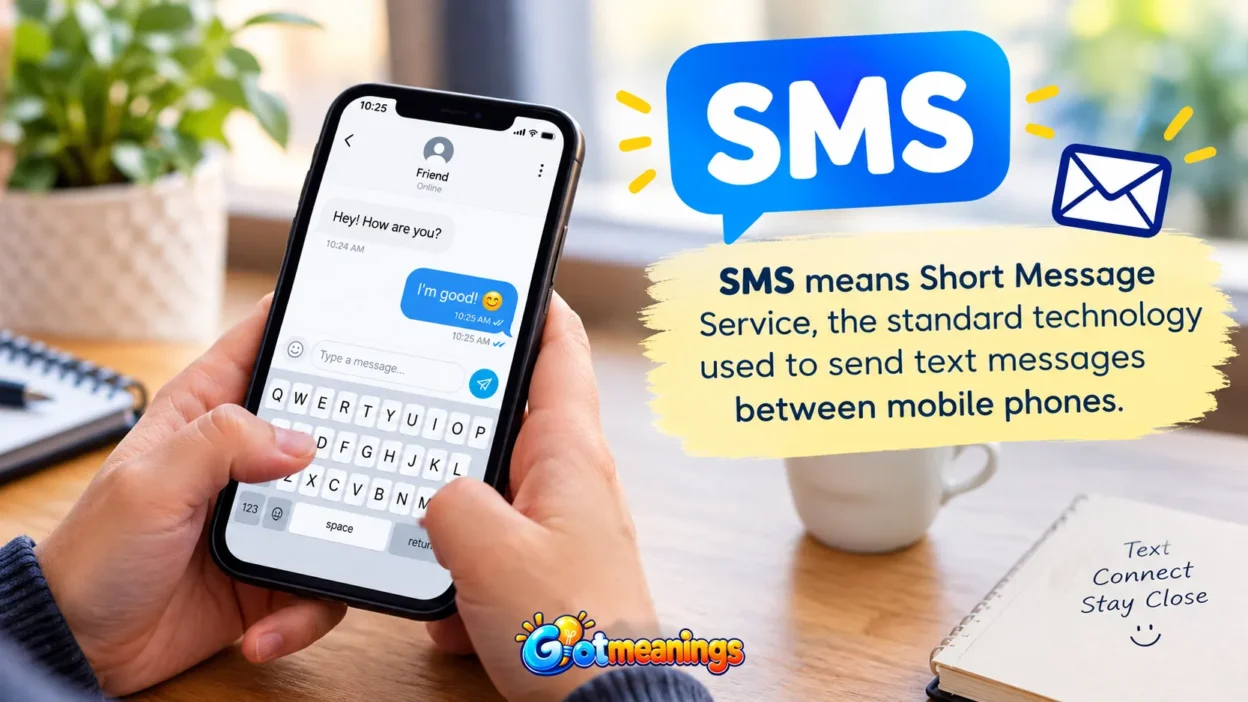
If you have seen SMS on your phone or in a conversation, you may wonder what it means. SMS stands for Short Message Service.
It is the technology used to send short text messages between mobile phones through a cellular network.
In everyday conversations, people often use the term SMS when talking about regular text messages rather than messages sent through internet-based apps.
You might see SMS when your phone displays a message notification, when a company sends you a verification code, or when someone asks you to send them an SMS.
Although texting apps such as WhatsApp and Instagram offer other ways to communicate, SMS remains a common way to send messages directly to a phone number.
In this guide, you will learn what SMS means in texting, how it works, how it differs from other messaging services, and how to use it in everyday conversations.
You will also find realistic examples and helpful answers to common questions.
| Quick Detail | Meaning |
|---|---|
| Term | SMS |
| Full form | Short Message Service |
| Most common meaning | A standard mobile text message |
| Typical tone | Neutral and practical |
| Common usage | Phone messaging, verification codes, alerts, and personal texts |
| Internet required? | No, not for traditional SMS |
| Common alternative | Text message |
What Does SMS Mean in Text & Chat?
SMS means Short Message Service, the standard technology used to send text messages between mobile phones. In everyday chat, people usually use SMS to refer to a regular text message sent through a mobile carrier.
For example, if someone says, “I’ll send you an SMS,” they mean they will send you a text message to your phone number. They are usually referring to a standard phone messaging service rather than a message sent through an app such as WhatsApp.
SMS is not slang or an abbreviation created for social media. It is the established name of a mobile messaging technology.
Here are some common ways people use the term:
- “I’ll send you an SMS with the details.”
- “Did you get my SMS?”
- “Check your phone for the SMS code.”
- “Please reply to my SMS when you have time.”
In each example, SMS refers to a text message sent through a mobile messaging service.
The term itself is neutral. It does not express a particular emotion, such as happiness, anger, or affection. The surrounding words and the situation determine the tone.
For instance, “I’ll send you an SMS later” sounds casual and practical, while “Please check the SMS from your bank” sounds more formal.
Does SMS Mean the Same Thing as Texting?
In everyday conversation, the terms are closely related, but they are not exactly the same.
SMS is a specific messaging technology, while texting is the act of sending text messages.
People may say they are texting someone even when they are using an internet-based messaging app. Strictly speaking, however, a traditional SMS is sent through a mobile carrier.
Full Form, Stands For & Short Meaning of SMS
SMS stands for Short Message Service.
The name describes a service designed to send short written messages between mobile devices. It became an important part of mobile communication because it allowed people to exchange text without making a phone call.
Here is a simple breakdown of the term:
| Part | Meaning |
|---|---|
| Short | Designed for relatively brief messages |
| Message | Written information sent to another person or device |
| Service | A communication service provided through a mobile network |
Although the name sounds technical, its everyday meaning is simple: SMS is the technology behind traditional mobile text messages.
What Is the Short Meaning of SMS?
The shortest explanation is:
SMS = Short Message Service = Regular mobile text messaging.
For example, if someone asks, “Can you send me an SMS?” they are asking you to send a text message to their phone.
Is SMS a Slang Word?
No. SMS is a technical abbreviation, not internet slang.
Unlike abbreviations such as LOL, BRB, and IDK, which represent common expressions used in digital conversations, SMS names a messaging service.
People may use it informally in everyday speech, but its meaning remains the same.
Origin, History & First Known Use of SMS
SMS developed as part of the growth of digital mobile communication. It was designed to let mobile phones exchange short written messages through cellular networks.
The idea offered a simple alternative to voice calls. Instead of calling someone, a person could send a brief message that the recipient could read when convenient.
As mobile phones became more widely used, text messaging became a regular part of daily life. People began using SMS for personal conversations, appointment reminders, business notices, and other short communications.
Over time, SMS also became useful for automated messages. Companies and online services began sending verification codes, delivery updates, account alerts, and appointment confirmations through text messages.
Why Did SMS Become So Common?
SMS offered several practical benefits:
- Simple communication: People could send short messages without making a call.
- Wide availability: Traditional SMS could work on basic mobile phones as well as smartphones.
- No mobile internet required: Standard SMS uses a cellular messaging service rather than an internet connection.
- Direct delivery to phone numbers: People did not need to use the same messaging app.
- Useful notifications: Businesses could send important updates directly to customers.
SMS later shared the messaging landscape with internet-based services, including messaging apps and richer communication technologies.
Although the ways people communicate have expanded, SMS still serves a useful role in mobile communication.
The exact history of SMS involves technical standards and developments in mobile networks. It is best to distinguish that documented technical history from the modern everyday use of the abbreviation.
How People Use SMS in Daily Conversations
People use SMS when they want to send or receive a traditional mobile text message.
The term appears in casual conversations, workplace communication, customer notifications, and discussions about phone settings.
1. Making Plans
Friends may use SMS when arranging a meeting or sharing information.
Example:
Person A: “I’ll send you an SMS when I leave home.”
Person B: “Okay, I’ll be ready!”
Here, SMS simply means a regular text message.
2. Sharing Important Information
People may send an SMS when they need to share an address, appointment time, or other short detail.
Example:
Person A: “Did you get the SMS with the meeting time?”
Person B: “Yes, it says 3 PM.”
The term refers to a message containing practical information.
3. Receiving Verification Codes
Many services use SMS to deliver temporary verification codes to a phone number.
Example:
Person A: “The app says it sent an SMS code.”
Person B: “Check your phone’s messages.”
In this situation, SMS refers to a text message generated by a service rather than a message written by another person.
4. Communicating at Work
SMS may appear in professional conversations when someone needs to contact a colleague or customer.
Example:
Person A: “Please send the customer an SMS reminder.”
Person B: “Sure, I’ll send it this afternoon.”
The wording is neutral and work-related.
5. Asking Whether a Message Arrived
People sometimes use SMS to distinguish a traditional text message from an email or an app notification.
Example:
Person A: “I sent you an SMS yesterday.”
Person B: “Sorry, I missed it. I’ll check now.”
The meaning is straightforward and does not imply any special emotion.
SMS Meaning Across WhatsApp, Instagram, TikTok & Snapchat
SMS has the same basic meaning across messaging platforms: Short Message Service. However, people may mention SMS when comparing traditional text messages with messages sent through internet-based apps.
The main difference is the communication method, not the definition of SMS.
| Platform or Service | How SMS Relates to It |
|---|---|
| SMS may be used to receive a verification code or when someone asks for a regular text message instead of a WhatsApp message. | |
| SMS may be used for account verification or security codes, depending on the available settings. | |
| TikTok | SMS may be used for verification or account-related messages when supported. |
| Snapchat | SMS may be used for account verification or security purposes when available. |
| Phone messaging app | SMS refers to a traditional text message sent through a mobile carrier. |
SMS on WhatsApp
WhatsApp uses an internet connection to send messages through its service. Traditional SMS uses a mobile carrier’s messaging service.
For example, someone might say, “I’ll text you on WhatsApp instead of sending an SMS.”
This means they prefer to communicate through WhatsApp rather than through a standard mobile text message.
SMS on Instagram
Instagram is primarily an internet-based social platform. When people mention SMS in connection with Instagram, they may be talking about a verification code or an account security message.
An SMS code is different from a direct message sent within Instagram.
SMS on TikTok
On TikTok, SMS may be relevant when a service sends a verification code or account-related notification by text.
It does not mean that TikTok comments, videos, or direct messages are themselves SMS messages.
SMS on Snapchat
Snapchat conversations generally take place through the app’s messaging service. SMS may come into the picture when a user receives a text for verification or discusses sending someone a regular phone text.
Remember: SMS does not acquire a new definition on each platform. The context determines why someone is talking about it.
Different Meanings of SMS in Other Fields
SMS has a clear and widely established meaning in mobile communication: Short Message Service.
In other contexts, the same three letters may be used as an abbreviation for something else. The intended meaning depends on the subject being discussed.
1. Mobile Communication
In telecommunications, SMS refers to the service used to exchange traditional text messages through mobile networks.
This is the relevant meaning when discussing phones, text messages, and mobile messaging.
2. Business and Customer Communication
Businesses often use SMS to send appointment reminders, delivery updates, promotional messages, and service notifications.
For example, a company might describe its system as an SMS notification service. This means it sends notifications through text messages.
3. Technical and Organizational Contexts
In some industries, SMS may stand for a different technical or organizational term. Its meaning may depend on the specific system, document, or field.
For example, an organization might use SMS as an abbreviation for a safety management system. In that case, it is not referring to mobile texting.
How Can You Identify the Correct Meaning?
Use the surrounding words to understand which meaning applies.
| Context | Likely Meaning |
|---|---|
| “I sent you an SMS.” | A traditional text message |
| “Enter the SMS code.” | A verification code received by text |
| “Our SMS campaign starts tomorrow.” | A business text-messaging campaign |
| “Review the company’s SMS procedures.” | Potentially a safety management system, depending on the industry |
When the conversation is about mobile phones or texting, Short Message Service is the most likely interpretation.
Common Confusions, Mistakes & Wrong Interpretations
Although SMS is a straightforward term, it is sometimes confused with other messaging abbreviations and technologies.
1. Thinking SMS Means Social Media
SMS does not stand for social media service. Its established full form is Short Message Service.
Social media apps may use SMS for verification, but that does not change what the abbreviation means.
2. Confusing SMS With MMS
SMS and MMS are different messaging technologies.
SMS is designed for text messages, while MMS stands for Multimedia Messaging Service and supports multimedia content, such as pictures and certain other media.
The exact features available can depend on the device, carrier, and messaging service.
3. Assuming SMS Always Requires Internet
Traditional SMS does not require a mobile internet connection. It uses a cellular network’s messaging service.
However, a phone generally needs suitable cellular coverage and an active service that supports sending and receiving SMS.
Internet-based messaging apps work differently and typically require internet access.
4. Assuming SMS Is a Private App
SMS is not a standalone social messaging app. It is a messaging service that phones and other systems can use.
Your phone’s default messaging application may provide the interface for reading and sending SMS messages.
5. Thinking SMS Has an Emotional Meaning
SMS does not automatically mean someone is angry, serious, or upset.
For example, “I’ll send you an SMS” is usually neutral. The emotional tone comes from the surrounding conversation.
6. Confusing SMS With Internet-Based Chat
A message sent through WhatsApp is not automatically an SMS simply because it contains text.
The distinction depends on the service used to send the message, not just the fact that it contains written words.
Similar Terms, Alternatives & Related Slang
Several terms are associated with SMS, but they do not all mean the same thing.
| Term | Full Form or Meaning | Main Difference |
|---|---|---|
| SMS | Short Message Service | Traditional mobile text messaging |
| MMS | Multimedia Messaging Service | Supports multimedia messages |
| Text | A written message | Common everyday term for a message |
| DM | Direct Message | A private message on a social platform |
| PM | Private Message | A private message within a service |
| IM | Instant Messaging | Messaging through an internet-based service |
| RCS | Rich Communication Services | A modern messaging standard with richer features where supported |
| OTP | One-Time Password | A temporary code used for verification |
| LOL | Laughing Out Loud | An expression used in digital conversations |
| BRB | Be Right Back | An informal chat abbreviation |
SMS vs. Text Message
These terms are often used interchangeably in everyday speech.
However, SMS technically refers to a specific messaging service, while text message is a broader everyday expression. People may use the phrase “text me” even when the exact messaging technology is not specified.
SMS vs. MMS
SMS is associated with traditional text messaging. MMS supports multimedia content, such as pictures and certain other media.
The distinction is useful when discussing mobile messaging features, although modern messaging apps may handle images and other media through their own systems.
SMS vs. DM
A DM is a direct message sent through a platform that supports private messaging.
For example, a message sent through Instagram’s direct messaging feature is a DM, not a traditional SMS.
SMS vs. RCS
RCS stands for Rich Communication Services. It is a messaging standard that can provide features beyond traditional SMS, such as typing indicators, read receipts, and higher-quality media sharing when supported by the devices, network, and service.
SMS remains useful for basic text messaging, while RCS offers a richer messaging experience in compatible environments.
Examples of SMS in Real Chat Situations
The following examples show how people use SMS naturally in everyday conversations.
Example 1: Making Plans
Person A: “I’ll send you an SMS when I reach the station.”
Person B: “Great! I’ll wait near the entrance. 😊”
Meaning: Person A will send a regular text message after arriving.
Example 2: Asking About a Missing Message
Person A: “Did you receive my SMS this morning?”
Person B: “Not yet. Let me check my messages.”
Meaning: Person A wants to know whether the text message arrived.
Example 3: Verification Code
Person A: “I can’t log in because the app hasn’t sent the SMS code.”
Person B: “Check whether your phone has a cellular signal.”
Meaning: They are discussing a verification code sent through a text message.
Example 4: A Work Reminder
Person A: “Can you send the client an SMS about tomorrow’s appointment?”
Person B: “Yes, I’ll take care of it.”
Meaning: One person is asking another to send a professional text reminder.
Example 5: Choosing Between Messaging Services
Person A: “Should I send you the details on WhatsApp or by SMS?”
Person B: “SMS is better because I’m not using mobile data right now.”
Meaning: The speakers are choosing between internet-based messaging and traditional text messaging.
Example 6: A Casual Reminder
Person A: “I sent you an SMS about dinner earlier.”
Person B: “Oh, I missed it! What time are we meeting?”
Meaning: Person A is reminding the other person about a previous text.
Example 7: A Potentially Annoyed Message
Person A: “I sent you three SMS messages. Why haven’t you replied?”
Person B: “Sorry, I was busy and didn’t see them.”
Meaning: The sender may sound frustrated because the recipient has not responded. The frustration comes from the wording, not from SMS itself.
Example 8: A Friendly Conversation
Person A: “I’ll send you an SMS when I get home. ❤️”
Person B: “Okay, take care!”
Meaning: The message is practical, while the heart emoji adds warmth or affection.
These examples show that SMS itself is neutral. The purpose and emotional tone depend on what the people say around it.
How to Reply When Someone Says SMS
Your reply depends on what the other person means. Usually, a simple and direct answer is enough.
1. When Someone Says They Will Send You an SMS
You can acknowledge their message politely.
Example:
Person A: “I’ll send you an SMS with the address.”
Person B: “Sounds good. I’ll look out for it.”
Other suitable replies include:
- “Okay, thanks!”
- “Sure, I’ll check my messages.”
- “Great, send it whenever you’re ready.”
2. When Someone Asks Whether You Received an SMS
Answer honestly.
Example:
Person A: “Did you get my SMS?”
Person B: “Yes, I received it. Thanks for letting me know.”
If you have not received it, you can say, “Not yet. Could you send it again?”
3. When Someone Asks You to Send an SMS
If you agree, confirm what you will do.
Example:
Person A: “Can you send me an SMS when you arrive?”
Person B: “Of course. I’ll text you when I’m there.”
This response is natural because people commonly use “text you” as an everyday alternative to “send you an SMS.”
4. When You Do Not Understand the Term
You can ask for clarification without making the conversation awkward.
Example:
Person A: “I’ll contact you by SMS.”
Person B: “Do you mean a regular text message to my phone?”
This is useful if you are unsure whether the person means a mobile text or a message through an app.
5. When Someone Sounds Upset About a Missing Reply
Respond to the concern rather than focusing on the abbreviation.
Example:
Person A: “I sent you an SMS earlier, but you didn’t reply.”
Person B: “Sorry, I missed your message. I’ll check it now.”
A calm response can help avoid unnecessary confusion.
Is SMS Still Popular? Trends & Online Usage
SMS remains an established part of mobile communication, even though people now have many ways to send messages.
Its continued usefulness comes from its simplicity. Traditional SMS can send text directly to a mobile phone number without requiring the sender and recipient to use the same internet messaging app.
Why People Still Use SMS
Verification codes: Online services may send temporary codes by text when SMS verification is supported.
Service notifications: Businesses may use SMS for appointment reminders, delivery updates, and account alerts.
Basic communication: People can send short text messages without opening a separate social messaging platform.
Broad device support: SMS is supported by a wide range of mobile phones, although availability depends on the carrier and service.
How Messaging Habits Have Changed
Internet-based messaging services now offer features such as group chats, voice messages, video calls, file sharing, and reactions.
These features can make messaging apps more convenient for ongoing conversations. However, SMS still serves situations where a direct message to a phone number is useful.
It is important not to confuse continued use with a claim that SMS is the most popular messaging method everywhere. Messaging habits vary by country, age group, device, carrier, and personal preference.
The practical takeaway is that SMS remains relevant, but it is now one part of a broader mobile communication system.
Frequently Asked Questions
What does SMS stand for in texting?
SMS stands for Short Message Service. It is the technology used to send traditional text messages between mobile phones through a cellular network.
Does SMS mean a text message?
Yes, in everyday conversation, SMS usually refers to a standard mobile text message. Technically, SMS is the service used to send that message.
Is SMS the same as WhatsApp?
No. Traditional SMS uses a mobile carrier’s messaging service, while WhatsApp sends messages through its internet-based platform. Both can be used to communicate through written messages.
Does SMS require internet access?
Traditional SMS does not require mobile internet. However, it generally requires cellular coverage and an active mobile service that supports SMS. Internet-based messaging apps typically require an internet connection.
What does SMS mean on Instagram or Snapchat?
SMS usually has the same meaning on these platforms: Short Message Service. It may refer to a verification code or another text message sent to your phone, rather than a direct message within the app.
What is the difference between SMS and MMS?
SMS is used for traditional text messages, while MMS stands for Multimedia Messaging Service and supports multimedia content, such as pictures and certain other media. Available features depend on the service and device.
Is SMS slang?
No. SMS is a technical abbreviation, not slang. It stands for Short Message Service, although people often use it casually when talking about text messages.
How do you reply when someone asks you to send an SMS?
You can reply with something simple, such as “Sure, I’ll text you,” or “Okay, I’ll send it shortly.” The best response depends on what the other person needs.
Can SMS have different meanings?
Yes, the abbreviation may stand for other terms in specialized fields. However, when the subject is mobile phones or texting, Short Message Service is the usual meaning.
Why did I receive an SMS verification code?
An online service may send an SMS verification code to help confirm access to a phone number or account. Only enter the code in the service you intended to use, and never share it with someone who contacts you unexpectedly.
Conclusion
SMS means Short Message Service, the technology behind traditional mobile text messages. When someone says they will send you an SMS, asks whether you received one, or tells you to check an SMS code, they are usually talking about a regular text message sent to your phone.
Although SMS is sometimes confused with internet messaging apps, the two are not identical. Traditional SMS uses a mobile carrier’s messaging service, while apps such as WhatsApp and Instagram use their own messaging systems.
SMS may also have other meanings in specialized fields, but mobile text messaging is the most relevant interpretation in everyday conversations.
The good news is that understanding SMS is simple. Pay attention to the surrounding words to identify exactly what someone means.
Whether you are discussing a personal message, a work reminder, or a verification code, knowing the difference helps you communicate clearly and avoid confusion.

Milo Carter is a tax writer who explains tax terms, rules, and common questions in simple, easy-to-understand language.