
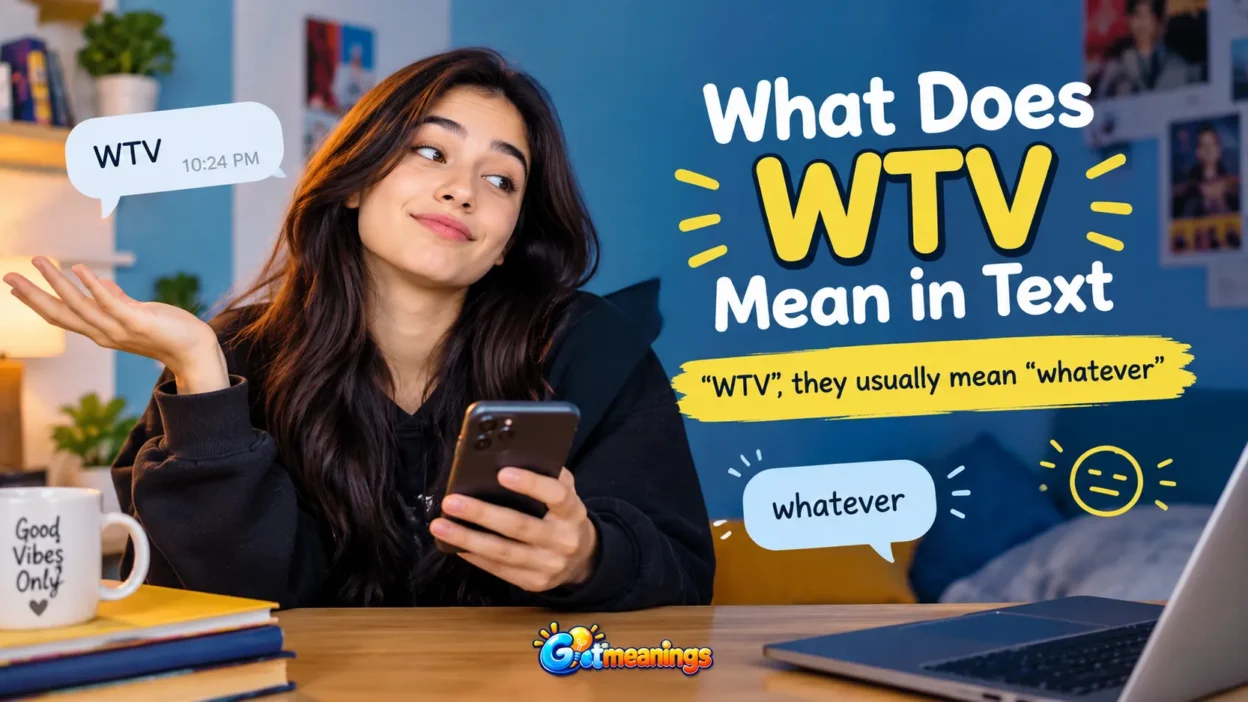
If someone texts you “WTV,” they usually mean “whatever.” It is a common abbreviation used in text messages, online chats, and social media.
People use it to save time when typing or to show that something does not matter much to them.
For example, if a friend asks, “Where do you want to eat?” you might reply, “WTV, I’m fine with anything.” This means you do not have a strong preference.
However, WTV can also sound dismissive, annoyed, or sarcastic, depending on the conversation.
You may see WTV on Snapchat, Instagram, TikTok, WhatsApp, or in regular text messages. Its meaning usually stays the same across these platforms.
In this guide, you will learn what WTV means, how people use it, what tone it can convey, and how to reply when someone sends it.
| Quick Detail | Meaning |
|---|---|
| Slang term | WTV |
| Most common meaning | Whatever |
| Full form | Whatever |
| Typical tone | Casual, neutral, dismissive, or sarcastic |
| Common usage | Text messages, chats, and social media |
What Does WTV Mean in Text & Chat?
WTV means “whatever” in text messages and online chats. It is a shortened way to express indifference, flexibility, or a lack of concern about something.
People often use it when they do not have a strong opinion or when they want someone else to make a choice.
For example:
Person A: “Do you want pizza or burgers tonight?”
Person B: “WTV, both sound good.”
Here, WTV means the person is happy with either option.
However, the same abbreviation can carry a different tone in another conversation.
Person A: “Are you still upset about yesterday?”
Person B: “WTV.”
In this case, the reply may sound annoyed or dismissive. The person might not want to continue the discussion.
The meaning depends on the words around WTV, the relationship between the people, and the situation.
The Main Meanings of WTV
WTV can express several feelings in everyday conversations.
- Indifference: You do not care much about the outcome.
- Flexibility: You are happy with different choices.
- Frustration: You are tired of discussing something.
- Dismissiveness: You do not want to continue the conversation.
- Sarcasm: You may be showing annoyance without saying it directly.
WTV does not always mean someone is angry. A short reply can simply be a quick way to answer a message.
Full Form, Stands For & Short Meaning of WTV
WTV stands for “whatever.” It is an informal abbreviation rather than a traditional acronym with a separate full form.
The word “whatever” has several uses in English. It can mean any choice is acceptable, that something is unimportant, or that a person does not want to discuss a subject further.
WTV carries these meanings into digital conversations.
WTV at a Glance
| Form | Meaning | Example |
|---|---|---|
| WTV | Whatever | “WTV, you choose.” |
| Whatever | Any choice is fine | “Whatever works for you.” |
| WTV? | Whatever? The meaning depends on context | “WTV? Why are you asking?” |
| Wtv lol | Whatever, said casually or jokingly | “Wtv lol, see you later.” |
Capitalization does not usually change the meaning. People may write WTV, wtv, or Wtv depending on their typing style.
Adding “lol,” an emoji, or other words can make the message feel more playful. A bare “WTV,” especially after an argument, may sound colder.
Is WTV an Acronym or an Abbreviation?
In everyday texting, WTV is best understood as an abbreviation of “whatever.” People shorten the word to make messages quicker and more casual.
You do not need to interpret each letter as a separate word. The intended meaning is usually the complete word “whatever.”
Origin, History & First Known Use of WTV
WTV comes from the English word “whatever,” which people use to express a range of meanings, from flexibility to indifference.
As text messaging and online chat became common, people began using shorter forms of words to type quickly. WTV fits this informal style because it replaces a longer word with just three letters.
However, it is difficult to identify one confirmed person, date, or message as the first use of WTV in texting. Without reliable historical evidence, it would be misleading to give an exact origin date.
Why Do People Shorten “Whatever” to WTV?
There are a few practical reasons:
- Faster typing: Three letters take less time to enter than the full word.
- Casual communication: Short forms fit the quick style of texting.
- Less effort: A brief reply can communicate a simple preference or reaction.
- Personal style: Some people naturally use abbreviations in everyday chats.
WTV is part of a wider pattern of informal digital language. Similar examples include IDK, TBH, IMO, and NVM.
These abbreviations make online conversations quicker, but their tone can still depend on context.
How People Use WTV in Daily Conversations
People use WTV when making plans, answering questions, reacting to disagreements, or showing that they have no strong preference.
The important point is that WTV can express either acceptance or indifference. It does not always mean the same thing emotionally.
1. When Any Choice Is Fine
Someone may use WTV when they are happy to let another person decide.
Person A: “Should we watch a comedy or an action movie?”
Person B: “WTV, you can pick.”
Meaning: The person is comfortable with either choice.
2. When Something Does Not Matter
WTV can show that a small detail is not important.
Person A: “Sorry, I bought the blue notebook instead of the black one.”
Person B: “WTV, I like both.”
Meaning: The person does not mind the change.
3. When Someone Feels Annoyed
WTV may be used to end a discussion when someone feels frustrated.
Person A: “I still think you should have listened to me.”
Person B: “WTV.”
Meaning: The person may be tired of the argument or unwilling to continue talking.
4. When Friends Are Joking
Among close friends, WTV can be playful rather than serious.
Person A: “You took forever to get ready!”
Person B: “Wtv 😂 at least I look good.”
Meaning: The person is responding jokingly and does not appear too concerned.
5. When Someone Wants to Move On
A person may use WTV because they want to leave a minor issue behind.
Person A: “Do you want to keep arguing about this?”
Person B: “Nah, wtv. Let’s just move on.”
Meaning: The person wants to stop discussing the disagreement.
Always consider the full message before deciding what the sender means.
WTV Meaning Across WhatsApp, Instagram, TikTok & Snapchat
WTV generally means “whatever” across popular messaging apps and social media platforms. The platform usually does not change the definition, but the conversation can affect the tone.
| Platform | How WTV May Be Used |
|---|---|
| Quick replies, casual conversations, and making plans | |
| Direct messages and replies to friends | |
| TikTok | Comments, messages, and reactions to videos |
| Snapchat | Short chats, snaps, and casual replies |
| SMS texting | Everyday text messages between friends and family |
WTV on WhatsApp
On WhatsApp, WTV may appear in private chats or group conversations.
Example:
Person A: “Are we meeting at 5 or 6?”
Person B: “Wtv, whichever is easier.”
The sender is letting the other person decide.
WTV on Instagram
On Instagram, WTV can appear in direct messages or informal conversations about posts, plans, and personal matters.
Example:
Person A: “Which picture should I post?”
Person B: “WTV, they both look nice.”
The response suggests that either picture is acceptable.
WTV on TikTok
On TikTok, WTV may appear in comments or private messages. Its meaning still depends on the discussion.
A person might use it to show indifference toward a trend, opinion, or video. In a disagreement, it could sound dismissive.
WTV on Snapchat
On Snapchat, WTV is useful for short, informal exchanges.
Example:
Person A: “What should we do today?”
Person B: “Wtv, I’m down for anything.”
The person is open to different activities.
Key takeaway: WTV usually means “whatever” on all these platforms. Do not assume that a person is upset just because they use it. Look at the surrounding messages and their usual communication style.
Different Meanings of WTV in Other Fields
Although WTV most commonly means “whatever” in casual texting, abbreviations can have different meanings in technical, professional, or specialized settings.
The meaning of WTV should not automatically be treated as “whatever” in every situation.
WTV in Casual Online Communication
In messages between friends, family members, or people chatting online, “whatever” is the usual interpretation.
Example: “WTV, we can decide tomorrow.”
WTV as a Context-Specific Abbreviation
In a technical document, workplace message, gaming community, or specialized discussion, WTV could be a locally defined abbreviation. Its meaning would depend on the subject and how the writer uses it.
There is no single alternative meaning that should be assumed in every professional or technical setting.
If you see WTV in a document where “whatever” does not make sense, check the surrounding sentence or ask the sender what it means.
Does WTV Have a Different Meaning in Relationships?
WTV does not have a special relationship-related full form. However, it can carry emotional meaning when used between romantic partners or close friends.
For example:
Person A: “Do you even want to talk about what happened?”
Person B: “WTV.”
The reply may suggest frustration or a desire to avoid the subject. Still, it is not enough on its own to prove that the person no longer cares.
The safest approach is to interpret the message in context rather than assume a hidden meaning.
Common Confusions, Mistakes & Wrong Interpretations
WTV is simple to understand, but people can misread its tone or confuse its meaning with similar abbreviations.
1. Assuming WTV Always Means Anger
One common mistake is treating every WTV message as rude.
That is not always correct. Someone who says “WTV, you choose 😊” may simply be flexible. The same letters in an argument may communicate frustration.
2. Confusing WTV With WTH
WTV and WTH are different abbreviations.
- WTV: Whatever.
- WTH: What the heck, or sometimes a stronger expression depending on the speaker.
WTV often expresses indifference. WTH usually expresses surprise, confusion, or disbelief.
3. Thinking WTV Is a Special Secret Code
WTV is not usually a secret code or a hidden romantic message. It is a common informal shortening of “whatever.”
Its emotional meaning comes from how it is used, not from a separate secret definition.
4. Assuming It Means the Sender Does Not Care About You
A short WTV reply can feel cold, especially during a personal conversation. However, it does not automatically mean the sender does not care about you.
They might be busy, tired, distracted, or unsure what to say. If the topic matters, a calm follow-up can help clear up the confusion.
5. Ignoring Punctuation and Emojis
Compare these messages:
- “WTV 😊” — may sound relaxed or friendly.
- “WTV lol” — may sound casual or playful.
- “WTV.” — may sound final or dismissive in some contexts.
- “WTV!!!” — may suggest strong emotion, depending on the conversation.
These are possible interpretations, not fixed rules. People use punctuation differently, so consider the sender’s usual style.
Similar Terms, Alternatives & Related Slang
Several texting abbreviations are similar to WTV because they communicate indifference, agreement, or a desire to end a discussion. However, they do not all mean the same thing.
| Slang | Full Meaning | Main Use |
|---|---|---|
| IDK | I don’t know | Showing uncertainty |
| IDC | I don’t care | Expressing a lack of concern |
| NVM | Never mind | Taking back a question or dropping a topic |
| TBH | To be honest | Introducing an honest opinion |
| IMO | In my opinion | Sharing a personal view |
| WTH | What the heck | Expressing surprise or confusion |
| Whatever | Any choice is acceptable, or showing indifference | Expressing flexibility or dismissal |
WTV vs. IDC
WTV means “whatever,” while IDC means “I don’t care.”
They can express similar feelings, but IDC is often more direct.
Example:
Person A: “Should I order tea or coffee?”
Person B: “WTV, either is fine.”
This suggests flexibility.
If the reply were “IDC,” it might sound more blunt, although context still matters.
WTV vs. IDK
IDK means “I don’t know.” WTV means “whatever.”
If someone asks what movie you want to watch, IDK means you are unsure. WTV may mean you are willing to watch almost anything.
WTV vs. NVM
NVM means “never mind.” It is often used when someone decides that a question or request no longer matters.
WTV usually communicates indifference or flexibility instead.
Choosing the right abbreviation helps prevent misunderstandings, especially when discussing something important.
Examples of WTV in Real Chat Situations
Here are realistic examples showing how WTV can work in different everyday conversations.
Example 1: Making Plans
Person A: “Do you want to meet at the park or the mall?”
Person B: “WTV, both work for me.”
Meaning: The sender has no strong preference.
Example 2: A Friendly Conversation
Person A: “I picked your favorite snacks for the movie.”
Person B: “Wtv 😂 you know me too well.”
Meaning: The sender is being playful. The emoji helps create a light tone.
Example 3: A Small Mistake
Person A: “I accidentally sent the wrong photo.”
Person B: “WTV, just send the right one.”
Meaning: The sender is not worried about the mistake.
Example 4: An Argument
Person A: “You never listen when I explain things.”
Person B: “WTV, I’m done arguing.”
Meaning: The sender sounds frustrated and wants to end the discussion.
Example 5: Choosing Clothes
Person A: “Should I wear the white shirt or the black one?”
Person B: “WTV, both look good on you.”
Meaning: Either option is acceptable.
Example 6: A Potentially Sarcastic Reply
Person A: “I finished the whole project without any help.”
Person B: “WTV, good for you.”
Meaning: Depending on the relationship and previous messages, the reply may sound sarcastic or dismissive. It could also be sincere in a different context.
Example 7: A Casual Group Chat
Person A: “Who wants to choose the game tonight?”
Person B: “Wtv, let someone else pick.”
Meaning: The sender does not want to make the decision.
Example 8: A Personal Conversation
Person A: “Are you still upset with me?”
Person B: “WTV, let’s talk later.”
Meaning: The sender may not want to discuss the issue right now. A later conversation may clarify their feelings.
These examples show why WTV should be interpreted as part of a complete message rather than as an isolated word.
How to Reply When Someone Says WTV
The best response depends on whether the person sounds relaxed, playful, confused, or annoyed. You do not need to overthink every short message.
1. If They Mean Either Choice Is Fine
Keep your reply simple and make the decision.
Person A: “WTV, you choose.”
Person B: “Okay, let’s get pizza.”
This works because the other person has given you permission to decide.
2. If They Are Being Playful
You can match their casual tone.
Person A: “WTV 😂”
Person B: “Haha, okay, your loss!”
Use this type of reply when you know the person is joking and the conversation feels friendly.
3. If You Are Not Sure What They Mean
Ask a calm question instead of guessing.
Person A: “WTV.”
Person B: “Do you mean either option is fine, or is something bothering you?”
This gives the person a chance to explain without accusing them of being rude.
4. If They Sound Annoyed
Avoid responding with another dismissive message. Give them space or ask to talk later.
Person A: “WTV. I don’t want to discuss this.”
Person B: “Okay, we can take a break and talk when we’re both ready.”
This response respects their wish to pause the conversation.
5. If Their Reply Feels Rude
You can calmly explain how it came across.
Person A: “WTV.”
Person B: “I’m not sure how you meant that. Can you tell me what you think?”
This is useful when the subject matters and you want to avoid an unnecessary argument.
Helpful tip: Do not judge a person’s feelings based on WTV alone. Consider the conversation, your relationship, and their usual texting style before deciding how to respond.
Is WTV Still Popular? Trends & Online Usage
WTV remains understandable as an informal abbreviation for “whatever,” particularly in casual digital conversations. However, its use can vary from person to person and across different online communities.
It is not possible to establish how popular WTV is in 2026 from the abbreviation alone. Without reliable, current usage data, claims that it is trending, growing rapidly, or becoming less common would be speculative.
Why People Continue to Use Short Forms
Texting abbreviations are useful because they help people send quick messages without typing full sentences.
WTV can be convenient when someone wants to make a simple choice, show indifference, or move past a minor issue.
Is WTV Appropriate in Formal Communication?
WTV is best suited to informal settings, such as chats with friends or casual messages.
In a professional email, school assignment, formal request, or important workplace discussion, writing “whatever” or explaining your preference clearly is usually better.
For example, instead of writing:
“WTV, choose a time.”
You could write:
“Any of those times works for me. Please choose whichever is most convenient.”
This sounds clearer and more professional.
Frequently Asked Questions
What does WTV mean in text from a girl or boy?
WTV usually means “whatever,” regardless of who sends it. The sender might be expressing flexibility, indifference, or frustration. Their words and the context matter more than their gender.
Does WTV mean whatever?
Yes. In casual texting and online chats, WTV most commonly stands for “whatever.” It can mean that any choice is acceptable or that the sender does not want to discuss something further.
Is WTV rude?
Not always. WTV can sound neutral or friendly when someone is happy with any choice. It may sound rude or dismissive during an argument, especially when sent as a short reply without additional context.
What does WTV mean on Snapchat?
On Snapchat, WTV usually means “whatever.” People use it in chats and other casual exchanges to show flexibility or indifference. The exact tone depends on the conversation.
What should I reply to WTV?
If the person means that either option is fine, make a choice. If they seem upset, ask calmly whether something is wrong. If the meaning is unclear, you can simply ask, “What do you mean by WTV?”
What is the difference between WTV and IDC?
WTV means “whatever,” while IDC means “I don’t care.” Both can express indifference, but IDC is often more direct and may sound stronger depending on the situation.
Does WTV have a romantic meaning?
WTV does not have a standard romantic meaning. Someone might use it while talking to a romantic partner, but the abbreviation itself usually means “whatever.” The surrounding conversation determines whether the message sounds caring, annoyed, or indifferent.
What does lowercase wtv mean?
Lowercase “wtv” usually means the same thing as uppercase “WTV”: “whatever.” People often use lowercase letters in informal messages, and capitalization rarely changes the meaning.
Can WTV mean something other than whatever?
It can have a context-specific meaning in a specialized conversation, but “whatever” is the usual interpretation in everyday texting. If that meaning does not fit, ask the sender or check the subject being discussed.
Conclusion
WTV most commonly means “whatever” in text messages, social media chats, and everyday online conversations.
People use it when they have no strong preference, want someone else to make a choice, or feel that something is not important.
However, the abbreviation can communicate more than simple indifference. Depending on the conversation, it may sound relaxed, playful, sarcastic, annoyed, or dismissive. Emojis, punctuation, and the relationship between the people can all affect how the message comes across.
If you receive WTV, do not automatically assume the sender is angry or does not care about you. Look at the surrounding messages and consider how that person normally communicates.
If the meaning is unclear, asking a simple question can prevent a misunderstanding.
In most casual conversations, you can safely understand WTV as “whatever.” Use it with friends when the tone fits, but choose clearer wording in formal or sensitive conversations.

Milo Carter is a tax writer who explains tax terms, rules, and common questions in simple, easy-to-understand language.