
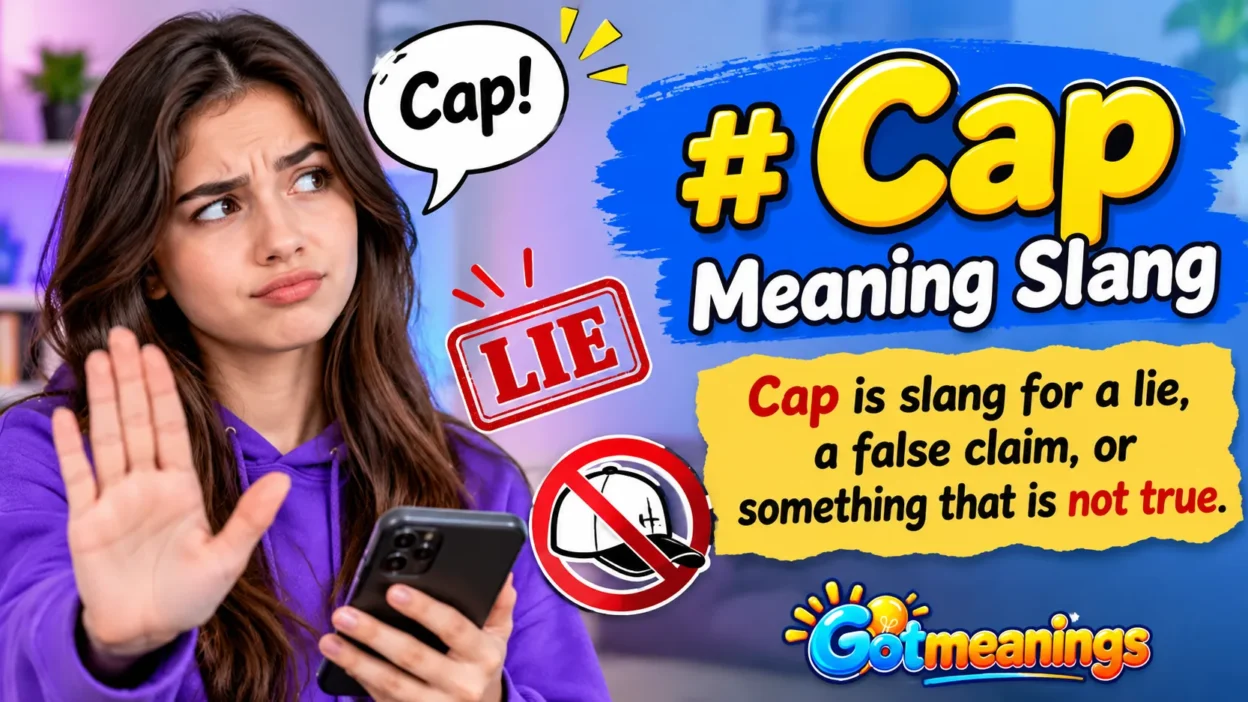
If you have seen someone write “That’s cap,” “No cap,” or “Stop capping” in a text message, you may wonder what they mean. Cap is slang for a lie, a false claim, or something that is not true. People use it in casual conversations to call out someone who seems dishonest or to show that they are being completely honest themselves.
The slang is common in texting, social media comments, memes, and everyday conversations. It can sound playful between friends or more serious when someone questions another person’s honesty. Understanding the words around it helps you get the right meaning. This guide explains cap meaning slang, its usage, common expressions, examples, and natural replies so you can understand it and use it confidently.
| Term | Meaning |
|---|---|
| Cap | A lie or something untrue |
| No cap | No lie; honestly |
| Capping | Lying or exaggerating |
| Stop capping | Stop lying |
| Cap emoji | 🧢 Often represents a lie or false claim |
| Typical tone | Casual, playful, skeptical, or serious |
| Common usage | Texting, social media, and conversations |
What Does Cap Mean in Text & Chat?
Cap means a lie, an untrue statement, or a claim that someone does not believe. When a person says “That’s cap,” they usually mean that someone is lying, exaggerating, or making something up.
The expression is often used when a friend tells an unbelievable story or makes a claim that sounds too good to be true.
For example:
Person A: “I finished the entire game in one hour.”
Person B: “Bro, that’s cap 😂”
Here, Person B does not believe the statement and thinks Person A is exaggerating.
Cap can also be used alone as a short response.
Person A: “I got the highest score without studying.”
Person B: “Cap!”
This means Person B thinks the claim is false.
Is Cap Always an Accusation of Lying?
Not necessarily. Cap can be playful rather than serious.
Friends may use it to tease each other without actually believing the other person is dishonest. However, in an argument, saying “You’re capping” can sound like a direct accusation.
The relationship between the speakers and the situation matter.
Full Form, Stands For & Short Meaning of Cap
Cap is not an abbreviation or acronym, so it does not have an official full form in slang.
It is a slang word that has developed a meaning related to lying or making false claims.
Here is a quick breakdown:
| Expression | Meaning |
|---|---|
| Cap | Lie or false statement |
| No cap | No lie; telling the truth |
| Capping | Lying or exaggerating |
| Stop capping | Stop lying |
| That’s cap | That is not true |
| Big cap | A major lie or exaggerated claim |
| Capper | Someone who lies or exaggerates |
These expressions are closely related, but they are not always used in exactly the same way.
For example, “No cap” often adds emphasis to a truthful statement, while “That’s cap” challenges something another person has said.
Origin, History & First Known Use of Cap
Cap slang is associated with African American Vernacular English (AAVE) and Black American speech traditions. The related expression “capping” has been used in the sense of boasting, exaggerating, or lying.
The exact origin of this slang meaning is not fully settled. It is better not to assign it a specific inventor, date, or single event without reliable evidence.
The expressions “cap” and “no cap” later became widely recognizable in online conversations, music-related language, memes, and social media.
Today, the slang is understood by many English-speaking internet users, even outside the communities where it developed.
It is also important to remember that slang can spread across communities while keeping connections to its original cultural background. Understanding that background helps readers recognize that internet language does not always begin on social media.
How People Use Cap in Daily Conversations
Cap is useful in informal conversations because it communicates disbelief or honesty with very few words.
People usually use it in these situations:
1. Calling Out a Lie
When someone believes another person is making something up, they may say:
“That’s cap.”
It is a quick way to challenge a statement.
2. Reacting to an Unrealistic Story
If a friend shares something unbelievable, cap can express surprise or skepticism.
Example:
Person A: “I met three celebrities at the airport yesterday.”
Person B: “No way, that’s cap 😭”
The response suggests that the story sounds unbelievable.
3. Showing That You Are Honest
People use “no cap” to emphasize that they are telling the truth.
Example:
Person A: “This is the best pizza I’ve ever had, no cap.”
Person B: “Now I need to try it.”
Here, no cap adds emphasis and means the speaker genuinely believes what they said.
4. Teasing Friends
Cap is often used jokingly between people who know each other well.
Example:
Person A: “I can beat you at basketball.”
Person B: “Stop capping 😂”
This sounds playful rather than hostile.
5. Expressing Doubt
Sometimes a person uses cap because they are unsure whether a statement is true.
Example:
Person A: “The school is closed tomorrow.”
Person B: “Is that cap or real?”
The speaker wants confirmation before believing the information.
Cap Meaning Across WhatsApp, Instagram, TikTok & Snapchat
The basic meaning of cap usually stays the same across social media platforms. It means a lie, something false, or a claim that someone doubts.
The difference is mainly how people use it.
Cap on WhatsApp
On WhatsApp, cap appears in private messages, group chats, and conversations between friends.
Example:
Person A: “I told my parents I was studying all night.”
Person B: “That’s cap 😂”
The reply suggests the speaker does not believe the claim.
Cap on Instagram
On Instagram, people may use cap in comments, captions, replies, and direct messages.
Example:
Someone comments:
“Bro said he did it in one day. Cap.”
This means the commenter thinks the claim is false or exaggerated.
Cap on TikTok
TikTok users often use cap when reacting to videos, stories, challenges, and unbelievable claims.
Example:
“There’s no way this actually happened. That’s cap.”
The phrase may appear in comments or as part of a video reaction.
Cap on Snapchat
On Snapchat, cap can appear in chats, story replies, or conversations with friends.
Example:
Person A: “I didn’t open your snap.”
Person B: “Stop capping 😭”
Here, Person B believes Person A is not telling the truth.
Does Cap Have a Different Meaning on Each Platform?
No major platform-specific meaning is required to understand it.
Whether you see cap on WhatsApp, Instagram, TikTok, or Snapchat, it generally means lying, exaggerating, or questioning someone’s claim.
The surrounding message tells you whether the expression is playful or serious.
Different Meanings of Cap in Other Fields
Cap has meanings outside slang. These meanings are not the same as calling someone a liar.
| Field | Meaning of Cap |
|---|---|
| Clothing | A type of hat |
| Finance | A limit or maximum amount |
| Sports | A player’s appearance representing a national team in certain sports |
| Gaming | A maximum limit, such as a level cap |
| Medical or dental | A covering placed over a tooth |
| Slang | A lie or false claim |
Cap in Gaming
In gaming, cap can refer to a maximum limit.
For example, “level cap” means the highest level a character can reach in a particular game.
Cap in Finance
In financial discussions, cap may refer to a limit on an amount, price, or value.
For example, a spending cap is a maximum amount someone is allowed to spend.
Cap in Clothing
A cap is also a type of headwear, such as a baseball cap.
This ordinary meaning is unrelated to slang about lying.
How to Identify the Correct Meaning
Look at the sentence and topic.
If someone says “Stop capping,” they are probably talking about slang.
If someone says “Wear a cap outside,” they mean a hat.
If someone says “The game has a level cap,” they mean a maximum level.
Context is the easiest way to avoid confusion.
Common Confusions, Mistakes & Wrong Interpretations
Cap is simple once you know the meaning, but a few expressions can confuse beginners.
1. Confusing Cap With No Cap
These expressions have opposite meanings in many conversations.
- Cap = lie or something untrue.
- No cap = no lie; honestly.
Example:
“That’s cap” means the speaker thinks something is false.
“No cap” means the speaker is being honest or emphasizing a genuine opinion.
2. Thinking Cap Is Always Rude
Cap is not automatically rude.
Among friends, it can be a playful way to disagree. In a serious conversation, it can sound disrespectful or accusing.
Tone depends on the relationship and the situation.
3. Confusing Capping With Wearing a Cap
The word “capping” can mean lying in slang.
However, cap can also refer to wearing a hat or putting a covering on something.
The sentence determines the intended meaning.
4. Thinking Cap Means Every Kind of Joke
A joke is not always cap.
If someone tells a funny story that everyone understands is fictional, calling it cap may not be necessary.
Cap is more commonly used when a person doubts a claim or thinks someone is exaggerating.
5. Misunderstanding the 🧢 Emoji
The 🧢 emoji is commonly used to represent cap slang.
It can suggest that someone is lying or that a statement is unbelievable.
However, it can also simply represent an actual hat. Always check the surrounding message.
Similar Terms, Alternatives & Related Slang
Several slang expressions have meanings close to cap.
| Slang | Meaning |
|---|---|
| No cap | No lie; honestly |
| Capping | Lying or exaggerating |
| Stop capping | Stop lying |
| That’s cap | That is not true |
| BS | Nonsense or something believed to be false |
| Fake | Not genuine or not real |
| Sus | Suspicious or questionable |
| Fr | For real |
| Deadass | Seriously or genuinely |
| Lowkey | Quietly, subtly, or somewhat |
Cap vs. No Cap
These are the most important expressions to understand.
Cap questions someone’s honesty, while no cap emphasizes that a statement is genuine.
Example:
“Your story is cap.”
This means the speaker does not believe the story.
“I love this song, no cap.”
This means the speaker genuinely likes the song.
Cap vs. Sus
Cap means a lie or an untrue claim.
Sus means suspicious or questionable.
Something can be sus without being a confirmed lie.
Cap vs. Fake
Fake describes something that is not genuine.
Cap is more commonly used to challenge a statement or call out dishonesty.
For example, a fake account is not usually called cap. However, a false story can be called cap.
Examples of Cap in Real Chat Situations
The easiest way to understand cap meaning slang is to see it in realistic messages.
Example 1: Playful Conversation
Person A: “I can finish this entire pizza by myself.”
Person B: “That’s cap 😂”
Meaning: Person B jokingly doubts the claim.
Example 2: Serious Conversation
Person A: “I never told anyone your secret.”
Person B: “Please don’t cap. I trusted you.”
Meaning: Person B is seriously asking the other person not to lie.
Example 3: Honest Statement
Person A: “Your presentation was amazing, no cap.”
Person B: “Thank you! That means a lot. 😊”
Meaning: Person A genuinely believes the presentation was good.
Example 4: Sarcastic Reply
Person A: “I’m always on time.”
Person B: “Yeah, no cap at all 🙄”
Meaning: Person B is being sarcastic because Person A is often late.
Example 5: Friendly Teasing
Person A: “I won five games in a row.”
Person B: “Stop capping bro 😭”
Meaning: Person B playfully doubts the claim.
Example 6: Questioning a Rumor
Person A: “Someone said the exam is canceled.”
Person B: “That’s probably cap. Check with the teacher.”
Meaning: Person B does not trust the information.
Example 7: Affectionate Compliment
Person A: “You’re my favorite person, no cap ❤️”
Person B: “Aww, you’re mine too.”
Meaning: No cap makes the compliment sound sincere and genuine.
Example 8: Calling Out Exaggeration
Person A: “I waited for you for three hours.”
Person B: “Bro, that’s cap. I was only ten minutes late.”
Meaning: Person B believes the other person is exaggerating.
How to Reply When Someone Says Cap
Your reply depends on whether the person is joking, questioning you, or seriously accusing you of lying.
If Someone Says “That’s Cap”
If you are telling the truth, you can respond:
- “No cap, I’m serious.”
- “I’m telling you the truth.”
- “Believe me, it actually happened.”
- “I can prove it.”
If they are joking, you can keep the conversation playful:
- “You just can’t believe it 😂”
- “I swear I’m not capping.”
- “Believe it or not!”
If Someone Says “No Cap”
You can respond naturally:
- “I believe you.”
- “Same here.”
- “For real?”
- “That’s honestly true.”
You do not need to repeat no cap in every reply.
If Someone Says “Stop Capping”
If you were joking:
- “Okay, okay, you caught me 😂”
- “I was just messing with you.”
- “Fine, maybe I exaggerated.”
If you were serious:
- “I’m not lying.”
- “I’m being completely honest.”
- “Why would I make that up?”
If Someone Uses Cap Rudely
If someone accuses you of lying during a serious conversation, stay calm.
You could say:
“I’m telling you what actually happened. Please don’t assume I’m lying.”
This helps make your point without turning the conversation into an argument.
Is Cap Still Popular? Trends & Online Usage
Cap remains a recognizable slang expression in online English, especially in casual messages, memes, comments, and conversations.
However, its use varies by person, age group, community, and platform. Not everyone uses the same slang, and some people may prefer expressions such as “for real,” “seriously,” or “that’s fake.”
Cap is also easy to understand because it has short related expressions:
- “That’s cap.”
- “No cap.”
- “Stop capping.”
- “Cap or facts?”
These phrases work well in quick conversations because they express disbelief or honesty without a long explanation.
The 🧢 emoji can also make the expression recognizable in comments and messages.
There is no need to assume that cap is trending everywhere or that everyone uses it. It is simply a familiar slang term that continues to appear in informal online communication.
Frequently Asked Questions
What does cap mean in slang?
Cap means a lie, an untrue statement, or something someone believes is false. Saying “That’s cap” means you do not believe what another person said.
What does no cap mean in texting?
No cap means “no lie” or “I’m being honest.” People use it to emphasize that their statement is genuine or that they really mean what they say.
What does stop capping mean?
Stop capping means “stop lying” or “stop exaggerating.” It can be playful between friends or serious during an argument.
What does 🧢 mean in slang?
The 🧢 emoji often represents cap, meaning a lie or false claim. It can be used to suggest that someone is lying or that a statement sounds unbelievable.
Is cap a bad word?
No. Cap is not generally considered a swear word. However, calling someone a liar can sound rude, depending on the situation and tone.
What does cap mean on TikTok?
On TikTok, cap usually means a lie, an exaggerated claim, or something the commenter does not believe. The meaning is generally the same as in texting.
What is the difference between cap and no cap?
Cap means a lie or something untrue, while no cap means honesty or truth. They are commonly used as opposite expressions.
Can cap mean a hat?
Yes. Outside slang, cap means a type of hat or covering. In texting, the meaning usually depends on the words around it.
How do you use cap in a sentence?
You can say “That’s cap” when you doubt someone’s statement or “No cap” when you want to emphasize that you are being honest.
Conclusion
Cap meaning slang is simple once you understand its main use. Cap means a lie, a false statement, or something that sounds exaggerated, while no cap means no lie or honestly. These expressions are common in casual texting, social media comments, and everyday conversations.
You may see people write “That’s cap,” “Stop capping,” or use the 🧢 emoji when they doubt a claim. On the other hand, someone may add “no cap” to show that they genuinely mean what they say.
The most important thing is to understand the context. Cap can sound funny between friends, sarcastic in a comment, or serious during an argument. Once you recognize these differences, you can understand the expression easily and use it naturally without confusing it with other meanings of the word.

Milo Carter is a tax writer who explains tax terms, rules, and common questions in simple, easy-to-understand language.