
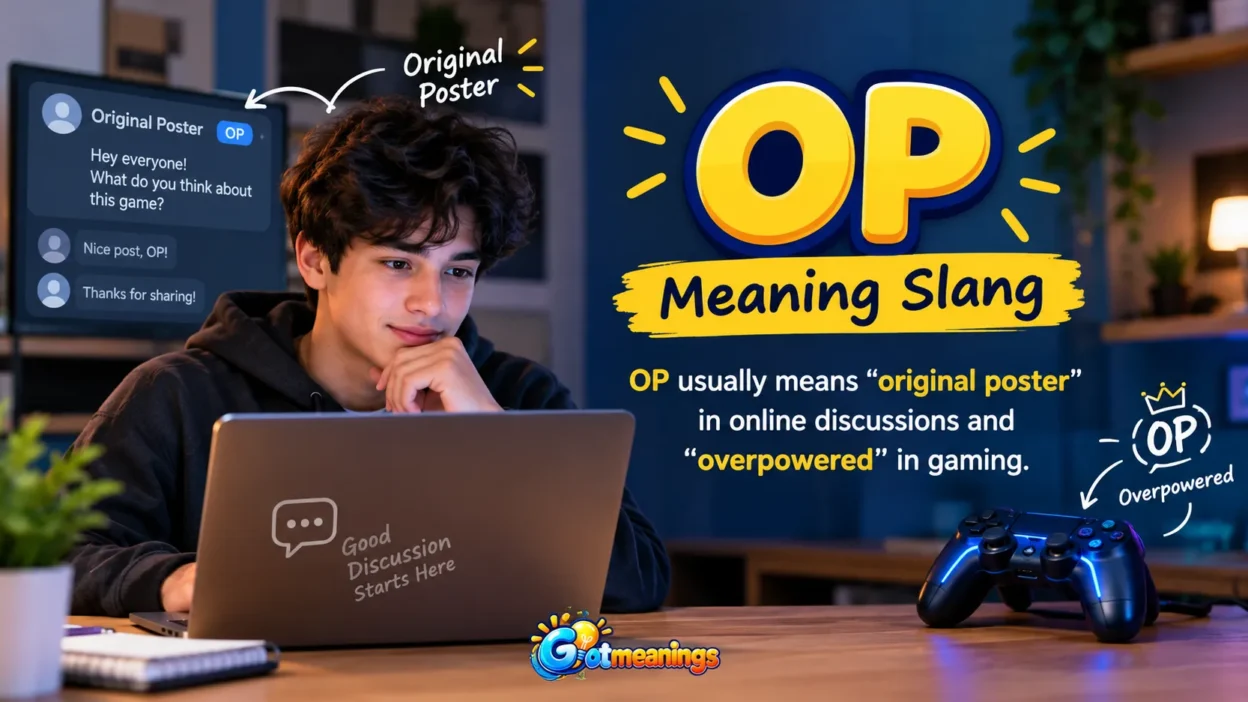
If you have seen someone write “OP” in a text message, TikTok comment, Instagram post, or online discussion, you may wonder what it means. The OP meaning slang usually depends on the context. In online communities, OP most commonly stands for “original poster,” meaning the person who created a post or started a discussion. In gaming and casual conversations, OP can also mean “overpowered,” describing a character, weapon, or ability that is unusually strong.
For example, someone might comment “OP explained everything clearly” to refer to the person who created a post. A gamer might say “That weapon is OP” to mean it is too powerful. Both meanings are common, but they are used in different situations.
In this guide, you will learn what OP means in text, its full form, how people use it across social media platforms, and how to respond when someone uses it in a conversation.
| Category | Meaning |
|---|---|
| Slang term | OP |
| Most common meaning online | Original poster |
| Other common meaning | Overpowered |
| Full form | Depends on context |
| Typical tone | Neutral, casual, or gaming-related |
| Common usage | Social media, forums, gaming, and online chats |
What Does OP Mean in Text & Chat?
OP usually means “original poster” in online discussions and “overpowered” in gaming. The surrounding conversation helps you understand which meaning someone intends.
When people discuss a question, story, photo, or problem posted online, they may use OP to refer to the person who shared it first. This avoids repeating the person’s username or describing them as the author of the post.
For example:
Person A: “Did OP ever explain what happened next?”
Person B: “Yes, they added an update this morning.”
Here, OP means the original poster, or the person who started the discussion.
In gaming conversations, the meaning changes.
Person A: “That new character is OP.”
Person B: “I know! Their attacks are way too strong.”
In this example, OP means overpowered. The speaker thinks the character has more strength or ability than is reasonable for the game.
OP can also appear in other settings with different meanings. Therefore, it is best to read the complete message rather than assume the abbreviation always means the same thing.
Full Form, Stands For & Short Meaning of OP
OP does not have just one full form. Its meaning changes with the topic and the community using it.
The two most common meanings in online slang are original poster and overpowered.
OP Means Original Poster
Original poster refers to the person who first created a post or started an online discussion.
This meaning is common on forums, Reddit-style communities, comment threads, and other platforms where people respond to a particular post.
Example: “OP deserves an answer, not more arguments.”
This means the person who created the original post deserves a helpful response.
OP Means Overpowered
Overpowered describes something that seems much stronger or more effective than other options, especially in video games.
It can refer to a character, weapon, move, ability, strategy, or item.
Example: “This sword is so OP that every battle feels easy.”
The speaker means the sword is unusually powerful.
Other Possible Meanings
OP can have other meanings in specific settings. For example, it may refer to an opening theme in anime communities or an original program in certain technical discussions. In medical contexts, it can also be used as an abbreviation for outpatient or outpatient-related terms, depending on the document.
These meanings are not interchangeable. The topic of the conversation is the best clue.
Origin, History & First Known Use of OP
The abbreviation OP developed different uses in different communities, so it does not have one single origin story.
The term “original poster” became useful in online discussion spaces where users replied to a shared post. Instead of repeatedly naming the author, people could simply refer to them as OP. This made conversations easier to follow, especially in long threads with many replies.
The gaming meaning, “overpowered,” comes from the idea that a character or item has too much power compared with other available options. Gamers often shorten longer words when discussing strategies, character strength, and game balance.
Both meanings fit the fast, informal style of online communication. However, the exact first use of OP in either sense is difficult to establish with confidence without reliable historical evidence.
Today, OP is widely understood in many online communities, but familiarity with one meaning does not guarantee that a reader will recognize the other. Context remains important.
How People Use OP in Daily Conversations
People use OP in casual messages, online discussions, gaming chats, and conversations about internet content.
The intended meaning usually becomes clear from the subject being discussed.
Referring to the Original Poster
When people reply to a post or ask questions about its author, OP usually means original poster.
Examples include:
- “OP should add more details.”
- “I agree with OP on this point.”
- “Has OP replied yet?”
- “Someone needs to answer OP’s question.”
In each case, OP refers to the person who created the original post.
Describing Something as Overpowered
Gamers use OP when a character, item, or ability seems unusually strong.
Examples include:
- “That character is OP in ranked matches.”
- “The developers made this weapon too OP.”
- “Your new build is seriously OP.”
- “That ability needs a balance update.”
The word can express excitement, admiration, frustration, or criticism. Someone may call a powerful character OP as a compliment, while another person may use it to complain that a game feels unfair.
Using OP in Casual Chats
Friends may also use OP when discussing a game, an online post, or a shared conversation.
For example:
Person A: “I finally unlocked the legendary character.”
Person B: “Nice! I heard they’re OP.”
The reply means the character is believed to be extremely powerful.
OP is informal, so it generally fits casual digital conversations better than formal writing. If the audience may not know the abbreviation, writing the full phrase is clearer.
OP Meaning Across WhatsApp, Instagram, TikTok & Snapchat
The basic meanings of OP usually remain the same across social media platforms. However, the type of conversation often determines which meaning is more likely.
OP on WhatsApp
On WhatsApp, OP may appear in group chats about games, memes, social media posts, or online discussions.
Example: “The OP shared the full story in the group.”
Here, OP means original poster.
In a gaming group, “That boss is OP” means the boss is unusually powerful.
OP on Instagram
On Instagram, people may use OP in comments about a post, reel, meme, or discussion.
Example: “OP, where did you buy this jacket?”
The commenter is addressing the person who created the post.
In gaming-related comments, OP can still mean overpowered. The content of the post helps determine the intended meaning.
OP on TikTok
TikTok users may use OP when discussing the creator of a video or a person who started a conversation.
Example: “OP needs to make a part two.”
This refers to the creator of the original post or video.
In gaming clips, OP may describe an unusually strong character or strategy.
OP on Snapchat
On Snapchat, OP may appear in conversations about screenshots, shared posts, gaming, or content discussed with friends.
Example: “Who was OP in that story?”
Depending on the conversation, the person may be asking who created the original post.
OP is not a Snapchat-specific abbreviation, and it does not have a special meaning exclusive to the app.
| Platform or setting | Likely meaning | Example |
|---|---|---|
| Discussion forums | Original poster | “OP answered the question.” |
| Instagram comments | Original poster or overpowered | “OP, share the details.” |
| TikTok gaming clips | Often overpowered in gaming content | “This build is OP.” |
| WhatsApp group chats | Depends on the topic | “That character is OP.” |
| Snapchat conversations | Depends on context | “Who is OP?” |
Different Meanings of OP in Other Fields
Although original poster and overpowered are common slang meanings, OP may have other definitions outside everyday internet conversations.
OP in Anime Communities
In anime discussions, OP often means “opening” or “opening theme.” This refers to the song and opening sequence shown near the beginning of an episode.
Example: “The new anime OP is amazing.”
The speaker is praising the show’s opening theme, not describing a person or a powerful character.
OP in Music and Entertainment
People may use OP as shorthand for an opening song, opening performance, or opening segment when the context makes the meaning clear.
However, not every entertainment community uses the abbreviation in exactly the same way.
OP in Medical Settings
In some medical documents, OP can refer to outpatient care or an outpatient department. The exact interpretation depends on the healthcare system and the document.
Medical abbreviations can be ambiguous, so readers should not rely on casual slang definitions when interpreting medical information.
OP in Business and Technology
In technical or workplace discussions, OP may stand for a specialized term defined by the organization or field. It can also appear in gaming software, programming communities, and operational documents.
There is no single alternative full form that applies to every professional setting. When accuracy matters, check the surrounding text or the document’s glossary.
Common Confusions, Mistakes & Wrong Interpretations
The biggest mistake people make with OP is assuming that it always has one meaning.
Confusing Original Poster With Overpowered
These meanings are different even though they use the same letters.
“OP shared a helpful guide” refers to the author of a post.
“That guide’s strategy is OP” may mean the strategy is unusually powerful in a game.
The words around OP usually make the difference clear.
Assuming OP Is an Insult
OP is not automatically rude or offensive. When it means original poster, it is generally a neutral label. When it means overpowered, it can express praise or criticism.
For example, “Your character is OP!” may be a compliment, a complaint, or a playful observation.
Thinking OP Is Always a Compliment
In gaming, calling something overpowered can be positive or negative. A player might enjoy using a strong character but still believe the character makes the game unfair.
Tone and context matter more than the abbreviation alone.
Confusing OP With OPP
OPP is a different abbreviation that can have separate meanings in slang and other settings. It should not automatically be treated as another spelling of OP.
Likewise, capitalization does not always resolve ambiguity. OP is commonly written in capital letters, but the surrounding conversation is usually the more useful clue.
Misunderstanding Specialized Meanings
Anime, medical, workplace, and technical communities may use OP differently. A meaning that makes sense in one field may be incorrect in another.
If the message remains unclear, asking the sender what they mean is the safest approach.
Similar Terms, Alternatives & Related Slang
Understanding related abbreviations can make online conversations easier to follow.
| Term | Meaning | Common context |
|---|---|---|
| Poster | Person who publishes a post | Online discussions |
| OC | Original content or original character, depending on context | Social media and creative communities |
| Creator | Person who makes or publishes content | Social platforms |
| Broken | Extremely strong or poorly balanced | Gaming |
| Nerf | To reduce a game’s character or item’s power | Gaming |
| Buff | To increase a character’s strength or effectiveness | Gaming |
| Meta | Strategies or choices considered effective in a game | Competitive gaming |
| GG | Good game | Gaming chats |
These terms are related to OP in different ways, but they are not direct replacements in every sentence.
For instance, “OP needs to explain this” refers to the original poster. Replacing OP with “broken” would change the meaning completely.
Similarly, “That weapon is OP” describes excessive power. “That weapon needs a nerf” suggests that its strength should be reduced.
Knowing the topic of the conversation helps you select the correct interpretation.
Examples of OP in Real Chat Situations
The following original examples show how OP can appear in different conversations.
Example 1: Asking About an Online Post
Person A: “Did OP mention why they left the group?”
Person B: “Yes, they explained it in the comments.”
Meaning: OP refers to the person who created the original post.
Example 2: Gaming Compliment
Person A: “I tried the new character, and the damage is incredible.”
Person B: “Right? That character is OP! 🔥”
Meaning: OP means overpowered. The speaker is impressed by the character’s strength.
Example 3: Gaming Complaint
Person A: “Why does everyone keep choosing that weapon?”
Person B: “Because it’s OP and gives players a huge advantage.”
Meaning: The speaker thinks the weapon is too powerful compared with other choices.
Example 4: Asking the Creator a Question
Person A: “OP, can you share the recipe?”
Person B: “Sure! I’ll post the ingredients later. 😊”
Meaning: The first person is directly addressing the author of the post.
Example 5: Anime Discussion
Person A: “Have you listened to the new opening song?”
Person B: “Yes, the OP is stuck in my head!”
Meaning: OP means opening theme in this anime-related conversation.
Example 6: Playful Gaming Conversation
Person A: “You won again using that same character.”
Person B: “What can I say? They’re OP 😂”
Meaning: The reply is playful and suggests that the character’s strength helped the player win.
Example 7: Unclear Meaning
Person A: “I think OP is wrong about this.”
Person B: “Do you mean the original poster or something else?”
Meaning: The abbreviation needs clarification because the conversation does not provide enough information.
How to Reply When Someone Says OP
Your reply depends on whether the person is referring to an online post, describing something powerful, or using the abbreviation in another context.
If OP Means Original Poster
If someone says, “OP explained it well,” you can respond naturally:
- “Yes, the explanation was helpful.”
- “I agree. They made the point clear.”
- “I hope they share an update soon.”
These responses acknowledge the person or post being discussed.
If OP Means Overpowered
When someone says, “That character is OP,” you could reply:
- “Definitely! Their attacks are so strong.”
- “I agree, they might need a nerf.”
- “Maybe, but they’re fun to play.”
- “I think the other character can still compete.”
These replies work whether you agree or disagree with the speaker.
If the Message Is Confusing
If you cannot tell what OP means, ask a short question.
For example:
Person A: “OP was amazing today.”
Person B: “Do you mean the original poster, or are you talking about something else?”
This avoids an awkward misunderstanding and keeps the conversation friendly.
If the Tone Seems Sarcastic
Look at the surrounding words and emojis before deciding how to respond.
For example:
Person A: “Wow, that weapon is so OP 🙄”
Person B: “Yeah, it could use a little balancing.”
The eye-roll emoji suggests frustration or sarcasm rather than excitement.
You do not need to match a rude or sarcastic tone. A calm, direct response is often enough.
Is OP Still Popular? Trends & Online Usage
OP remains a recognizable abbreviation in online discussions and gaming communities. Its usefulness comes from being short and easy to understand within the right context.
In discussion threads, OP helps people refer to the person who started a conversation. In gaming, it provides a quick way to describe a character, item, or strategy that seems unusually strong.
The abbreviation also appears in communities with their own vocabulary, such as anime fandoms. In these settings, OP may refer to an opening theme instead.
However, it would be misleading to claim that OP is trending everywhere or becoming more popular without reliable, current usage data. Different communities use it at different rates, and some people may not know every meaning.
For readers, the practical lesson is simple: OP is useful when the audience understands the context. If you are speaking to someone unfamiliar with the abbreviation, writing “original poster” or “overpowered” in full can prevent confusion.
Frequently Asked Questions
What does OP mean in slang?
OP most commonly means “original poster” in online discussions and “overpowered” in gaming. The topic and surrounding words help determine the intended meaning.
What does OP mean in text from a girl or a boy?
OP does not have a special meaning based on the sender’s gender. It generally means original poster, overpowered, or another context-specific term.
Is OP a compliment or an insult?
It can be either, depending on context. Calling a gaming character OP may express admiration for its strength or criticism that it is unfairly powerful. Referring to someone as the original poster is usually neutral.
What does OP mean on TikTok?
On TikTok, OP can refer to the person who created the original post or video. In gaming content, it may mean overpowered. The video’s subject helps clarify the meaning.
What does OP mean on WhatsApp?
On WhatsApp, OP has no single app-specific definition. People may use it to refer to the original poster or describe a powerful gaming character, depending on the chat.
What does OP stand for in gaming?
In gaming, OP usually stands for “overpowered.” It describes a character, weapon, ability, or strategy that seems too strong compared with other options.
What does OP mean on Reddit?
On Reddit, OP generally means “original poster,” the person who submitted the post being discussed. In some conversations, the abbreviation may refer to the original post itself, but the person is the usual meaning.
What does OP mean in anime?
In anime communities, OP often means “opening” or “opening theme.” It refers to the opening song or sequence of an anime episode.
How should I respond when someone calls something OP?
If they mean overpowered, you can agree, disagree, or discuss whether it needs balancing. For example, “I agree, that character is too strong” is a natural response.
Does OP have a full form?
Yes, but it depends on the context. The two common expansions are “original poster” and “overpowered.” Other fields may use OP for different terms.
Conclusion
The meaning of OP slang depends on where and how it is used. In online discussions, OP usually means “original poster,” referring to the person who created a post or started a conversation.
In gaming, it commonly means “overpowered,” describing a character, weapon, ability, or strategy that seems unusually strong.
The abbreviation can also mean “opening theme” in anime communities and may have specialized meanings in professional or technical settings. That is why reading the full message is important before deciding what someone means.
If you see OP in a text message, comment, or group chat, look at the subject and the words around it. If the meaning is still unclear, asking a quick question can prevent confusion.
Once you recognize the context, understanding OP becomes simple, and you can use it naturally in your own online conversations.

Milo Carter is a tax writer who explains tax terms, rules, and common questions in simple, easy-to-understand language.