
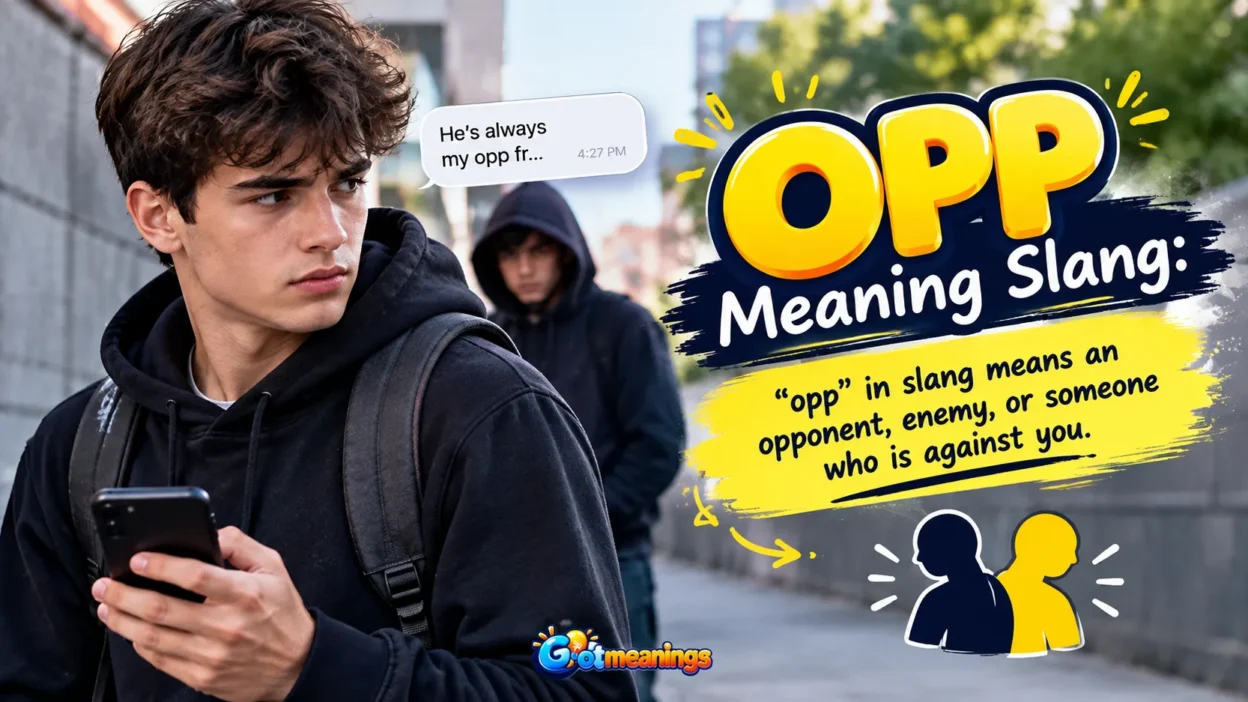
The term “opp” in slang means an opponent, enemy, or someone who is against you. It is commonly used in text messages, social media comments, rap lyrics, and online conversations to describe a person who is seen as an enemy or rival.
For example, if someone says, “He’s an opp,” they usually mean that the person is not a friend and may be working against them.
The word is often associated with street slang and hip-hop culture, but it has also become familiar in everyday online conversations.
Depending on the situation, calling someone an opp can sound serious, playful, or sarcastic.
Friends might use it as a joke, while others may use it to describe a real conflict. In this guide, you will learn what opp means in slang, how people use it in texts, what it means on social media, and how to respond when someone calls another person an opp.
| Category | Meaning |
|---|---|
| Slang term | Opp |
| Most common meaning | Opponent, enemy, or rival |
| Full form | Commonly understood as short for “opposition” or “opponent,” depending on context |
| Typical tone | Serious, casual, joking, or confrontational |
| Common usage | Text messages, social media, rap lyrics, and online chats |
| Example | “Stay away from him. He’s an opp.” |
| Related words | Enemy, rival, opposition, hater |
What Does Opp Mean in Text & Chat?
In text messages and online chats, opp usually means an enemy, rival, or person who is against someone. People use it when they believe another person is disloyal, hostile, or on the opposite side of a disagreement.
For example, someone might text, “I thought he was my friend, but he turned out to be an opp.” This means the person believed they had a friendship but now feels that the other person is working against them.
The exact meaning depends on the conversation. An opp can be someone involved in a serious personal conflict, a rival in a competitive situation, or simply a friend who is acting annoying.
Common Meanings of Opp
The word can have slightly different meanings depending on how it is used.
- Enemy: Someone who dislikes you or wants to cause problems for you.
- Rival: Someone competing against you in a particular situation.
- Opponent: Someone on the other side of an argument, competition, or conflict.
- Disloyal person: Someone who acts like a friend but does things that go against you.
- Joking enemy: A friend who annoys you or disagrees with you in a playful way.
For example, if your friend supports a rival sports team, you might jokingly call them an opp after they celebrate their team’s victory.
However, if someone uses the word during a serious argument, it may express genuine distrust or hostility.
Is Opp a Positive or Negative Word?
Opp usually has a negative meaning because it describes someone as an enemy or opponent. However, the tone can change depending on the relationship between the people involved.
Among friends, it may be harmless teasing. In a tense conversation, it can sound aggressive or accusatory.
For this reason, it is important to consider the surrounding words, emojis, and situation before deciding what someone means.
Full Form, Stands For & Short Meaning of Opp
The word “opp” is commonly used as slang for an opponent or enemy. It is also associated with the word “opposition,” which refers to someone or something on the other side.
Unlike formal abbreviations, opp does not have one universally fixed full form in every context. Its meaning is usually clear from how people use it in conversation.
What Does Opp Stand For?
In everyday slang, opp is commonly connected to these words:
- Opponent: A person competing against you or opposing your position.
- Opposition: A person or group on the other side of a conflict or disagreement.
- Enemy: Someone regarded as hostile or against you.
The most useful way to understand the term is to focus on its meaning rather than assume that it always expands into one exact phrase.
For instance, “Those guys are our opps” means that the people being discussed are rivals or enemies.
Opp Meaning in Simple Words
In simple English, opp means someone who is against you.
Here are a few quick examples:
- “He is my opp.” = He is my enemy or rival.
- “Watch out for the opps.” = Be careful around the people considered your enemies.
- “Why are you acting like an opp?” = Why are you behaving as if you are against me?
- “My friend is an opp today 😂” = My friend is annoying me, probably as a joke.
The final example shows why context matters. A person can use the same word seriously or playfully without changing the basic idea of opposition.
Origin, History & First Known Use of Opp
The slang term “opp” is associated with the idea of opposition and is widely recognized in street slang and hip-hop culture.
It became especially familiar through rap music, where artists may use the word to describe rivals, enemies, or people involved in conflicts. The term also appears in online discussions about music, street culture, and rival groups.
However, it is difficult to identify one universally accepted first use of the slang term. Without reliable historical evidence, it would be misleading to assign a specific person, song, or year as its definite origin.
How Opp Became Familiar in Online Conversations
Slang often spreads through music, social groups, entertainment, and everyday speech. When people hear a word repeatedly in songs or videos, they may begin using it in their own conversations.
The same process can help explain why opp appears in social media captions, comments, memes, and text messages.
For example, someone might watch a video about two rival musicians and comment, “They’ve been opps for years.” The comment suggests that the two people have a history of rivalry or conflict.
As the term spread into more casual online settings, people also began using it humorously. A friend who refuses to share food might be called an opp, even when there is no genuine hostility.
This does not mean the word has lost its negative meaning. Instead, its tone depends on how the speaker uses it and how the listener understands it.
How People Use Opp in Daily Conversations
People use opp when talking about enemies, rivals, disagreements, or someone they believe is acting against them. The word is informal, so it is more suitable for casual conversations than professional or formal communication.
Using Opp to Describe an Enemy
This is one of the most common uses.
Example:
“My brother said that guy is an opp, so I should stay away from him.”
Here, opp describes someone viewed as an enemy or a person who may cause trouble.
Using Opp for Friendly Teasing
People sometimes use the term jokingly when friends disagree or compete.
Example:
“You finished the last slice of pizza without asking? You’re an opp 😂”
The speaker is pretending that the friend is an enemy because of a minor, funny situation.
Using Opp for Competition
The term can also refer to rivals in games, sports, or other competitive situations.
Example:
“Our opponents are strong this season, but we’re ready.”
A person might use “opps” more casually in the same context, although “opponents” is more neutral and appropriate in formal writing.
Using Opp to Describe Disloyalty
Sometimes, the word refers to a person who appears friendly but behaves in a way that feels disloyal.
Example:
“He shared my private conversation with everyone. That was an opp move.”
In this sentence, “opp move” means an action that seems unfriendly or against the speaker’s interests.
Still, calling someone an opp does not prove that the person is actually an enemy. It only communicates how the speaker views their behavior.
Opp Meaning Across WhatsApp, Instagram, TikTok & Snapchat
The meaning of opp generally stays the same across major social media platforms. It usually refers to an enemy, rival, or person who is against someone.
What changes is the setting in which the word appears. A private message may carry a different tone from a public comment or a joke in a short video.
Opp Meaning on WhatsApp
On WhatsApp, opp may appear in private messages, group chats, or status updates.
Example:
Person A: “Why didn’t you invite Sam to the party?”
Person B: “Because he’s been acting like an opp lately.”
Here, the speaker believes Sam has been behaving like an enemy or acting against the group.
In a private chat, the meaning may depend on previous messages and the relationship between the people talking.
Opp Meaning on Instagram
On Instagram, the word can appear in comments, captions, memes, and discussions about rivalries.
Example:
“Bro called his best friend an opp over a football match 😂”
This caption uses the term humorously to describe a disagreement between friends.
In other situations, a comment about someone’s opps may refer to real rivals or people involved in a conflict.
Opp Meaning on TikTok
On TikTok, opp may appear in comedy videos, music-related content, skits, and discussions about friendship or rivalry.
For example, a creator might make a video about a friend who refuses to share snacks and caption it, “When your bestie turns into an opp.”
The word is being used as a joke rather than a serious accusation.
However, not every TikTok use is humorous. Videos about real disputes may use opp in its more serious sense.
Opp Meaning on Snapchat
On Snapchat, people may use opp in direct messages, group conversations, or captions.
Example:
Person A: “Why did you leave the group chat?”
Person B: “Everyone was acting like opps, so I left.”
The speaker means that the group members seemed unfriendly or were acting against them.
Does Opp Have a Different Meaning on Each Platform?
Not usually. The central meaning remains similar across WhatsApp, Instagram, TikTok, and Snapchat.
| Platform | Typical context | Possible meaning |
|---|---|---|
| Private messages and group chats | Enemy, rival, or disloyal person | |
| Comments, captions, and memes | Rival or joking enemy | |
| TikTok | Comedy videos, skits, and music discussions | Enemy, opponent, or playful rival |
| Snapchat | Direct messages and group conversations | Someone acting against you |
| Online gaming chats | Competitive matches | Opponent or rival |
These are common examples, not fixed platform-specific definitions. The conversation itself is usually the best guide.
Different Meanings of Opp in Other Fields
Although opp most often refers to an enemy or rival in slang, the word or its capitalized form can have other meanings in different settings.
It is important not to assume that every appearance of “opp” refers to an enemy.
Opp in Gaming
In gaming conversations, opp can refer to an opponent or a rival player.
For example:
“Those opps are camping near the entrance.”
In this context, the speaker is talking about opposing players in a game. The term may sound competitive rather than personal.
Opp in Politics and Debate
In informal discussions, people may use opp to refer to the opposing side in a debate or competition.
However, “opposition,” “opponent,” or “opposing party” is generally clearer in formal political writing.
The slang form should not be confused with an official political title or abbreviation unless the surrounding context supports that interpretation.
OPP as an Acronym
When written in capital letters, OPP can represent an organization, program, or other phrase specific to a particular field or location.
For example, in Ontario, Canada, OPP commonly stands for the Ontario Provincial Police.
In that setting, the acronym refers to a police service, not an enemy.
Other organizations may also use OPP as an abbreviation. The correct meaning depends on the subject being discussed.
How to Identify the Correct Meaning
Use these clues to understand the intended meaning:
- Casual text or social media post: It probably refers to an enemy or rival.
- Online game: It may refer to an opposing player or team.
- News report about Ontario law enforcement: OPP may mean Ontario Provincial Police.
- Official document or technical discussion: Check the surrounding text before interpreting the acronym.
Capitalization can provide a clue, but it is not enough on its own to establish the meaning.
Common Confusions, Mistakes & Wrong Interpretations
Because opp is informal slang, people sometimes misunderstand it when they encounter it for the first time.
Confusing Opp With a General Friend
An opp is not simply another word for a friend. Its usual meaning points toward opposition, rivalry, or hostility.
However, friends sometimes call each other opps as a joke. In that case, the word expresses playful frustration rather than a genuine enemy relationship.
Assuming Every Use Is Serious
Someone might say, “You’re my opp because you ate my fries.”
This does not necessarily mean the speaker feels real hatred. The exaggerated wording may be intended to make a small disagreement funny.
On the other hand, if the same person uses the term during a serious dispute, it may express real distrust.
Confusing Opp With Op
The words “opp” and “op” can look similar, but they may have different meanings.
In slang, opp commonly means an enemy or rival.
In some online gaming communities, “OP” means “overpowered,” describing something unusually strong or effective in a game. In other contexts, “op” may mean “original poster,” the person who started an online discussion.
The intended meaning depends on the topic and spelling.
Assuming Opp Always Has a Fixed Full Form
People sometimes search for a single official expansion of the word. However, slang does not always follow the same rules as formal abbreviations.
Opp is commonly linked to “opponent” and “opposition,” but its everyday meaning is more important than treating it as an acronym with one mandatory full form.
Thinking the Word Always Refers to Criminal Activity
The term is associated with street slang and hip-hop culture, but it is also used casually in jokes, games, and everyday conversations.
A person using opp to describe a friend who stole their dessert is not necessarily referring to a serious conflict.
At the same time, the word can carry a serious meaning in discussions of real rivalries. Avoid assuming either interpretation without considering the context.
Similar Terms, Alternatives & Related Slang
Several words are similar to opp, but they are not always interchangeable. Some describe direct hostility, while others refer to competition or dislike.
| Term | Meaning | Difference from opp |
|---|---|---|
| Enemy | Someone who is hostile toward you | Usually more direct and serious |
| Rival | Someone competing against you | Does not always suggest hostility |
| Opponent | Someone on the opposing side | More neutral and formal |
| Hater | Someone who expresses dislike or negativity | Focuses on criticism or resentment |
| Foe | An enemy or adversary | More formal or literary |
| Beef | An argument or ongoing conflict | Describes the conflict rather than the person |
| Snitch | Someone who reports another person’s actions, often to authorities or an opposing group | Refers to reporting or informing, not simply being a rival |
| Bestie | A close friend | Usually the opposite of an enemy, though it can be used sarcastically |
Opp vs. Enemy
An enemy is someone regarded as hostile. Opp can communicate a similar idea, but it is more informal and closely associated with slang.
Opp vs. Rival
A rival is someone competing for the same goal. Two sports teams can be rivals without hating each other.
Calling someone an opp may suggest a more personal or adversarial relationship, although people sometimes use it jokingly.
Opp vs. Hater
A hater is someone who criticizes, resents, or expresses negativity toward another person.
An opp is someone considered an enemy or opponent. The two ideas can overlap, but they do not mean exactly the same thing.
Opp vs. Beef
Beef refers to a disagreement, argument, or ongoing conflict. Opp usually refers to a person or group seen as being on the opposing side.
For example, “They have beef” describes a conflict, while “They are opps” describes the relationship between the people involved.
Examples of Opp in Real Chat Situations
The following examples show how people may use opp in different conversations. The meaning can change with the situation, relationship, and tone.
Example 1: A Serious Situation
Person A: “Why don’t you trust Mark anymore?”
Person B: “He lied to me about something important. He’s an opp now.”
Meaning: The speaker feels betrayed and now views Mark as an enemy or someone who cannot be trusted.
Example 2: A Friendly Joke
Person A: “I saved you a seat, but I ate your chocolate.”
Person B: “You’re an opp for that 😂”
Meaning: The speaker is jokingly calling their friend an enemy because the friend ate their chocolate.
Example 3: A Sports Rivalry
Person A: “Who are you supporting in tonight’s match?”
Person B: “The other team. I guess we’re opps today.”
Meaning: The two people support opposing teams. The word is being used playfully to describe their temporary rivalry.
Example 4: A Disagreement Between Friends
Person A: “You told everyone what I said yesterday.”
Person B: “I didn’t mean to upset you.”
Person A: “That was an opp move, honestly.”
Meaning: The speaker believes the other person’s action was disloyal or harmful.
Example 5: A Social Media Comment
Person A: “My little brother finished all the cookies.”
Person B: “Certified opp behavior 😭”
Meaning: The reply humorously describes the brother’s behavior as if he were an enemy. The crying emoji suggests exaggerated frustration or laughter, depending on the conversation.
Example 6: A Gaming Conversation
Person A: “Someone keeps attacking us near the bridge.”
Person B: “Those opps are waiting for us. Let’s take another route.”
Meaning: Opps refers to opposing players or rivals in the game.
Example 7: A Confusing Message
Person A: “Why did you call Jake an opp?”
Person B: “He keeps making jokes about me, even after I asked him to stop.”
Meaning: The speaker believes Jake is treating them badly. The explanation helps clarify that the term expresses frustration rather than a random insult.
Example 8: A Playful Message With an Emoji
Person A: “You went out for ice cream without me?”
Person B: “Sorry bestie 😭🍦”
Person A: “Wow, you’re an opp now 😂”
Meaning: The speaker is teasing their friend about leaving them out. The laughing emoji suggests the accusation is not meant to be taken literally.
These examples demonstrate that opp can express real distrust, friendly teasing, competition, or frustration. The surrounding conversation usually reveals which meaning is intended.
How to Reply When Someone Says Opp
The best response depends on whether the person is joking, describing a serious problem, or using the word in a way you do not understand.
You do not always need to respond aggressively. A calm or playful reply may be more suitable.
If Someone Calls You an Opp as a Joke
If the conversation is lighthearted, you can respond with humor.
Examples:
- “Bro, we’re on the same team 😂”
- “Not an opp, just hungry!”
- “You’re doing too much 😭”
- “I’ll make it up to you next time.”
These replies work when both people understand that the word is being used playfully.
If Someone Calls You an Opp Seriously
If the person sounds upset, try to understand why they feel that way.
Examples:
- “Why do you feel that way?”
- “Did I do something to upset you?”
- “Let’s talk about what happened.”
- “I didn’t mean to go against you. Can we clear this up?”
These responses invite a conversation without making the disagreement worse.
If You Do Not Understand the Word
It is perfectly fine to ask what someone means.
You could say:
- “What do you mean by opp?”
- “Are you joking or being serious?”
- “Do you mean an enemy or just a rival?”
Asking for clarification is often better than guessing, especially when the conversation seems tense.
If Someone Uses Opp to Insult You
You can set a boundary without returning the insult.
For example:
“I don’t want to argue. If something is bothering you, tell me directly.”
If the person is joking, they may explain what they meant. If they are serious, a calm response can help you decide whether the issue needs further discussion.
Remember that you do not have to accept someone’s description of you simply because they use a slang term.
Is Opp Still Popular? Trends & Online Usage
Opp is a recognizable slang term in online conversations, particularly in contexts influenced by hip-hop, gaming, memes, and informal social media language. However, its exact popularity can vary by age group, location, community, and platform.
It is not possible to establish its current ranking or measure how frequently everyone uses it without reliable, up-to-date usage data. Therefore, it is better to understand the term as an established slang expression rather than assume it is the newest or most popular word online.
Why People Continue to Use Opp
The word is short and easy to fit into messages, captions, and comments. It also communicates a clear idea of rivalry or opposition in just a few letters.
For example, “He’s an opp” is a brief way to say that someone is viewed as an enemy or rival.
Its flexibility also makes it useful for humor. People can apply it to anything from a serious disagreement to a friend taking the last slice of pizza.
Is Opp Used by Everyone?
No. Slang varies between communities, and not everyone uses or understands the same expressions.
Some people recognize opp immediately, while others may be more familiar with words such as enemy, rival, or hater. Its use may also feel more natural in some social groups than in others.
If you are unsure whether the person you are talking to understands the term, using a clearer word may help avoid confusion.
Should You Use Opp in Formal Communication?
Generally, no. Opp is informal slang and may sound unclear or inappropriate in professional settings.
In an email, school assignment, workplace conversation, or formal report, words such as “opponent,” “rival,” or “opposition” are usually better choices.
In casual conversations, however, opp can be a natural way to describe an enemy or rival when the people involved understand the expression.
Frequently Asked Questions
What does opp mean in slang?
Opp usually means an enemy, rival, or person who is against you. It is common in informal conversations, social media posts, and hip-hop-related slang. The term can be serious or playful depending on the context.
What does opp mean in texting?
In texting, opp generally describes someone who is seen as an enemy, opponent, or disloyal person. Friends may also use it jokingly when someone does something annoying, such as eating their food without asking.
What does opp stand for?
Opp is commonly associated with “opponent” or “opposition.” However, slang usage does not always have one fixed, official full form. In everyday conversation, it generally means an enemy or rival.
Is opp a bad word?
Opp is not generally considered a profanity, but it can have a negative or confrontational meaning. Calling someone an opp may sound insulting if the person believes the speaker is accusing them of being an enemy.
What does opp mean on TikTok?
On TikTok, opp usually means an enemy, rival, or someone acting against another person. It also appears in comedy videos and memes where creators jokingly call friends or family members opps over minor disagreements.
What does opp mean on Instagram?
On Instagram, opp commonly refers to an enemy or rival. It may appear in captions, comments, memes, or conversations about personal disagreements. The tone can range from humorous to serious.
What does opp mean on Snapchat?
On Snapchat, opp usually refers to someone who is considered an enemy, rival, or disloyal person. The intended meaning depends on the message and the relationship between the people chatting.
What is the difference between opp and op?
Opp usually means an enemy or rival in slang. Op can mean different things depending on the context, including “overpowered” in gaming or “original poster” in online discussions. The spelling and subject help determine the intended meaning.
Can you call your friend an opp?
Yes. People sometimes call friends opps as a joke when they do something annoying or unexpected. For example, you might jokingly call a friend an opp for eating your snacks. However, the word can sound serious if used during a real disagreement.
What does opps mean?
Opps is the plural form commonly used in slang to refer to multiple enemies or rivals. For example, “Watch out for the opps” means to be careful around the people considered enemies. In casual conversations, it can also refer jokingly to a group of rivals.
Is opp the same as an enemy?
The meanings are similar, but they are not always identical. An enemy is someone regarded as hostile, while an opponent may simply be someone competing against you. Opp can refer to either, depending on the context.
How should I respond if someone calls me an opp?
First, consider the tone. If the person is joking, you can respond playfully. If they seem upset, ask what happened and give them a chance to explain. If you do not understand the message, simply ask what they mean.
Conclusion
The main takeaway is that opp meaning slang refers to an enemy, rival, or person who is seen as being against you.
The term is widely recognizable in informal conversations, text messages, social media posts, gaming chats, and hip-hop-related discussions.
It is a short way to describe opposition, but it does not always express genuine hostility.
Friends may use opp humorously when someone takes their food, loses a game, or does something annoying.
In a serious conversation, however, the same word can suggest distrust, disloyalty, or an ongoing conflict. Context is the key to understanding the intended meaning.
If you see opp in a message, look at the surrounding words, emojis, and relationship between the people involved.
When the meaning is unclear, asking for clarification is the simplest solution.
Understanding these small differences can help you interpret online slang more accurately and respond in a way that fits the situation.

Milo Carter is a tax writer who explains tax terms, rules, and common questions in simple, easy-to-understand language.