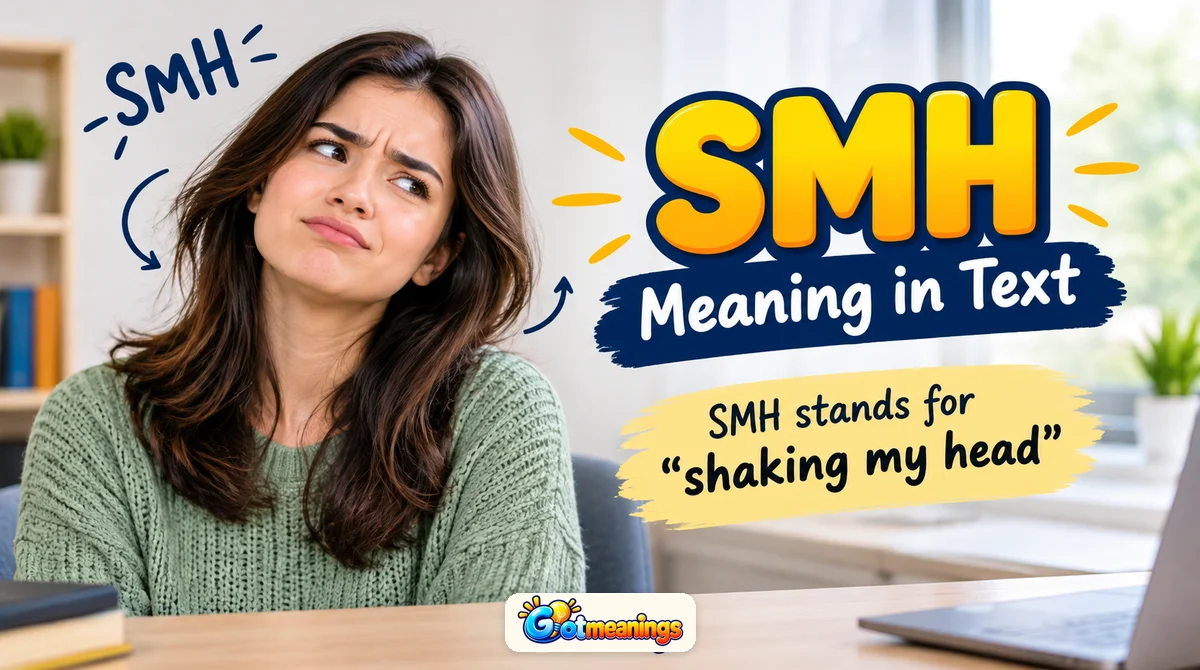
If someone sends you “SMH” in a text message, they are usually expressing disappointment, disbelief, frustration, or disapproval.
SMH stands for “shaking my head.” It represents the reaction people make when something seems foolish, surprising, annoying, or hard to believe. For example, if your friend forgets their homework again, you might reply, “You did it again? SMH 😂”
This popular internet abbreviation appears in text messages, group chats, social media comments, and online conversations.
Depending on the situation, it can sound playful, sarcastic, disappointed, or mildly critical. It does not always mean that someone is genuinely angry.
In this guide, you will learn the SMH meaning in text, what the letters stand for, how people use it on different platforms, and how to reply when someone sends it to you. You will also discover common misunderstandings and useful examples of SMH in everyday conversations.
| Quick reference | Meaning |
|---|---|
| Term | SMH |
| Most common meaning | Shaking my head |
| Full form | Shaking my head |
| Typical tone | Disappointed, disapproving, frustrated, or playful |
| Common usage | Text messages, social media, and online chats |
| Formal or informal? | Informal |
| Is it offensive? | Usually not, but it can sound judgmental |
What Does SMH Mean in Text & Chat?
SMH means “shaking my head.” People use it when they want to show disapproval, disbelief, disappointment, or frustration without writing a long explanation.
Imagine reading a message about someone making the same avoidable mistake for the fifth time. Instead of explaining how unreasonable the situation seems, you might simply write “SMH.” The abbreviation communicates your reaction in three letters.
Its meaning can change slightly with the situation.
- Disappointment: Someone breaks a promise or lets you down.
- Disbelief: You hear something that seems impossible or ridiculous.
- Frustration: A person repeats a mistake despite being warned.
- Disapproval: You disagree with someone’s behavior or decision.
- Playful teasing: A friend does something silly, and you respond jokingly.
For example:
Person A: “I spent an hour looking for my phone, and it was in my hand.”
Person B: “SMH 😂”
The reply means that the speaker finds the mistake funny or ridiculous. The laughing emoji makes the response feel more playful than serious.
SMH can appear at the beginning or end of a sentence, or it can stand alone as a complete reaction. The surrounding words and emojis help show the intended tone.
Full Form, Stands For & Short Meaning of SMH
SMH stands for “shaking my head.” This is its standard meaning in texting and internet slang.
It is technically an initialism because each letter is pronounced separately: S-M-H. Many people casually call it an acronym, but initialism is the more precise term.
Here is a quick breakdown:
| Letter | Word |
|---|---|
| S | Shaking |
| M | My |
| H | Head |
The phrase refers to the familiar gesture of moving your head from side to side to express disagreement, disbelief, or disappointment.
Is SMH a word, abbreviation, or acronym?
SMH is an abbreviation used in informal digital communication. More specifically, it is an initialism because its letters represent the words in a phrase.
You do not need to pronounce it as a word. In most conversations, people simply type the three letters.
Does SMH have any other full forms?
Occasionally, someone may use SMH to mean “scratching my head” when they are confused or puzzled. Other interpretations can occur in specific communities, but they are less common than “shaking my head” in ordinary texting.
Always consider the sentence before deciding what the letters mean. If someone writes, “SMH, I cannot figure out this problem,” they may be expressing confusion rather than criticizing anyone.
Origin, History & First Known Use of SMH
SMH developed as part of informal internet and text-message language. Its meaning comes from the everyday gesture of shaking your head to communicate disbelief, disagreement, or disappointment.
The exact person who first used SMH, and the precise date it entered everyday online conversation, are not firmly established. Dictionary.com explains that the abbreviation emerged in online communication during the 2000s. A definition was recorded on Urban Dictionary in 2004, making that an early documented online reference rather than proof of the term’s exact invention date.
As text messaging, internet forums, and social networking became common ways to communicate, short expressions helped users share reactions quickly. SMH fit naturally into this style because it conveyed an emotion without requiring a full sentence.
It later became familiar in social media posts, comments, memes, and reaction images.
The abbreviation also has a cultural history. Dictionary.com notes that early, notable uses were present in Black internet communities. This is worth recognizing without claiming that one individual or a single online community can be proven to have invented it.
The important point is that SMH grew from a recognizable human gesture into a convenient written expression. Its familiar meaning remains “shaking my head,” even though its emotional tone can vary.
How People Use SMH in Daily Conversations
People use SMH to react to everyday situations, from minor mistakes to disappointing news. It is especially useful when a person wants to express a feeling quickly.
To show disappointment
When someone fails to keep a promise or makes a poor choice, SMH can communicate disappointment.
Example:
Person A: “He promised to help us, but he never showed up.”
Person B: “SMH, that’s really disappointing.”
The response shows disapproval of the person’s behavior.
To express disbelief
SMH can also mean that something is difficult to believe.
Example:
Person A: “She paid for a brand-new laptop and left it on the bus.”
Person B: “SMH, how does that even happen?”
Here, the speaker is surprised and cannot quite believe what happened.
To joke with friends
Among friends, SMH often becomes a lighthearted way to point out silly behavior.
Example:
Person A: “I put salt in my coffee instead of sugar.”
Person B: “SMH 😂 You need sleep.”
The reply is playful rather than hostile. The emoji and friendly wording make that clear.
To react to frustrating situations
SMH does not always target another person. It can express frustration with technology, bad luck, or an inconvenient situation.
Example:
Person A: “My internet stopped working right before the online exam.”
Person B: “SMH, the worst possible timing.”
In this case, the abbreviation communicates frustration with the situation, not judgment of the person.
SMH Meaning Across WhatsApp, Instagram, TikTok & Snapchat
The usual meaning of SMH stays the same across major messaging and social media platforms: “shaking my head.” The platform generally changes where people use it, not what it stands for.
| Platform | Typical use | Example |
|---|---|---|
| Private chats and group conversations | “You forgot the keys again? SMH 😂” | |
| Comments, captions, and direct messages | “SMH, that comment was unnecessary.” | |
| TikTok | Reactions to videos and comments | “SMH at people who ignore the instructions.” |
| Snapchat | Quick messages and replies to friends | “SMH, you sent that to the wrong person.” |
SMH on WhatsApp
On WhatsApp, SMH often appears in personal conversations, family groups, and friend chats. It can express annoyance, surprise, or friendly teasing.
For example, “SMH, you already watched the whole series without me?” may be a playful complaint.
SMH on Instagram
Instagram users may write SMH under posts or in direct messages when reacting to a disappointing statement, unusual behavior, or an opinion they dislike.
In public comments, however, it can feel more critical because other people may interpret it as a judgment of the person being discussed.
SMH on TikTok
On TikTok, SMH can appear in comments about funny mistakes, questionable decisions, surprising situations, or behavior that viewers disapprove of.
The actual meaning depends on the video and the comment around it. The letters do not have a special, separate TikTok definition.
SMH on Snapchat
On Snapchat, SMH is another shorthand for a quick reaction between friends. A message such as “SMH, you forgot again” might express frustration, while “SMH 😂” may be affectionate teasing.
Across all four platforms, context matters more than the app itself.
Different Meanings of SMH in Other Fields
Although “shaking my head” is the dominant interpretation in casual online conversations, SMH can have other meanings in certain contexts.
| Meaning or use | Context |
|---|---|
| Shaking my head | General texting and internet slang |
| Scratching my head | Occasional informal expression of confusion |
| So much hate | Less common, context-dependent online usage |
| Sydney Morning Herald | The name of an Australian newspaper |
SMH meaning when someone is confused
Some people interpret SMH as “scratching my head” when they do not understand something or cannot find a solution.
For example:
Person A: “The instructions say to turn it on, but nothing happens.”
Person B: “SMH, I can’t work this out.”
This could express confusion, although readers will usually assume “shaking my head” unless the context suggests otherwise.
SMH in news and other organizations
SMH can also be an abbreviation for the Sydney Morning Herald, an Australian newspaper. In that setting, it refers to a publication rather than an emotional reaction.
Similarly, organizations and professional fields may use the same letters for names or technical terms. Such meanings should be interpreted using the surrounding subject matter rather than automatically applying internet slang.
A useful rule: In casual messages, assume “shaking my head” first. In news articles, professional documents, or specialized discussions, check the context before deciding what SMH means.
Common Confusions, Mistakes & Wrong Interpretations
SMH is easy to understand once you know the basic definition, but its tone can lead to misunderstandings.
Thinking SMH always means anger
SMH can communicate frustration or disapproval, but it does not always mean that someone is angry. A friend may use it to tease you about a harmless mistake.
Compare these messages:
- “SMH, you forgot again.” — Possibly annoyed or disappointed.
- “SMH 😂 you wore two different shoes.” — Likely playful.
The emoji, relationship, and situation can change the meaning.
Confusing SMH with LOL
LOL means “laughing out loud,” while SMH means “shaking my head.”
LOL usually signals amusement, although it can also be used sarcastically. SMH more often signals disbelief, disapproval, or frustration.
People sometimes use both together, as in “SMH LOL,” to show that something is ridiculous and funny at the same time.
Assuming it is always insulting
SMH can sound dismissive when directed at another person. However, it can also target a situation, express disappointment in oneself, or serve as a friendly joke.
For example, “SMH at myself for forgetting my wallet” shows self-directed frustration rather than an insult toward someone else.
Taking a short reply too personally
A standalone “SMH” may feel cold because it does not explain the sender’s feelings. Still, it is not enough on its own to determine whether the sender is seriously upset.
Consider the recent conversation, your relationship, and any accompanying message. If the intention remains unclear, asking a calm question is often better than assuming the worst.
Confusing SMH and SMDH
SMDH stands for “shaking my damn head.” It generally adds emphasis to the same basic reaction. It is not the standard full form of SMH.
SMH itself does not contain profanity and is generally mild. SMDH includes a stronger expression, although the level of offensiveness depends on the audience and setting.
Similar Terms, Alternatives & Related Slang
Several internet expressions can communicate feelings similar to SMH. However, each one has a different emphasis.
| Term | Full meaning | Main purpose |
|---|---|---|
| SMDH | Shaking my damn head | Stronger disappointment or frustration |
| LOL | Laughing out loud | Amusement or sometimes sarcasm |
| SMH | Shaking my head | Disbelief, disapproval, or frustration |
| Facepalm 🤦 | A gesture of putting a hand to the face | Embarrassment or disbelief |
| WTF | What the heck or a stronger variation | Shock, confusion, or frustration |
| OMG | Oh my God | Surprise, excitement, or disbelief |
| IDK | I don’t know | Uncertainty or lack of information |
| IKR | I know, right? | Agreement or shared disbelief |
SMH vs. SMDH
SMDH is generally more emphatic. Someone might use SMH for mild disappointment and SMDH when a situation seems especially frustrating.
Neither expression has a fixed level of seriousness; the surrounding conversation still matters.
SMH vs. facepalm
A facepalm communicates a similar reaction through an emoji or a reference to the physical gesture of covering one’s face with a hand.
SMH focuses on shaking the head, while a facepalm often suggests embarrassment, disbelief, or frustration with an obvious mistake.
SMH vs. WTF
WTF tends to express stronger shock, confusion, or frustration and can be considered vulgar because of its underlying wording. SMH is usually milder.
If you want to express disapproval without using a potentially offensive phrase, SMH may be the more suitable option.
Other ways to express SMH
Instead of using the abbreviation, you can write:
- “I can’t believe this.”
- “That’s disappointing.”
- “Seriously?”
- “What were you thinking?”
- “I don’t even know what to say.”
- “This is frustrating.”
These alternatives are useful when you want your message to be clearer or more appropriate for a formal conversation.
Examples of SMH in Real Chat Situations
The following examples show how SMH works in different everyday situations. The tone changes with the wording, relationship, and emojis.
Example 1: A repeated mistake
Person A: “I forgot to charge my phone again, and now it’s dead.”
Person B: “SMH 😂 You never learn.”
Meaning: The second person is teasing a friend about a repeated mistake. The laughing emoji makes the response playful.
Example 2: Disappointment in a friend
Person A: “He said he would keep my secret, but he told everyone.”
Person B: “SMH. That’s not okay.”
Meaning: Here, SMH expresses disapproval and disappointment. The words that follow make the serious tone clear.
Example 3: A frustrating situation
Person A: “The bus left just as I reached the stop.”
Person B: “SMH, what terrible timing.”
Meaning: The reaction shows frustration with bad luck rather than blame toward another person.
Example 4: Sarcasm
Person A: “I stayed up all night studying and forgot to attend the exam.”
Person B: “SMH, excellent planning.”
Meaning: The response is sarcastic. “Excellent planning” means the opposite of what it literally says.
Example 5: Laughing at yourself
Person A: “I searched the house for my glasses while wearing them.”
Person B: “SMH at myself. I need more sleep.”
Meaning: The speaker is making fun of their own absent-mindedness. SMH does not always criticize someone else.
Example 6: Reacting to an online comment
Person A: “Someone said you can’t learn a new skill after age 30.”
Person B: “SMH, people really believe that?”
Meaning: SMH shows disbelief and disagreement with the claim.
Example 7: Friendly teasing
Person A: “I ordered pizza and forgot to add my favorite topping.”
Person B: “SMH 😭 How could you do that?”
Meaning: The crying emoji is exaggerated for humor. The sender is likely joking rather than genuinely upset.
Example 8: A potentially rude message
Person A: “I made a mistake in the group project.”
Person B: “SMH. Unbelievable.”
Meaning: This response may sound judgmental or harsh. Without more context, it is difficult to know whether the sender is seriously angry or simply expressing frustration.
How to Reply When Someone Says SMH
Your best response depends on why the other person used SMH. You do not need to treat every instance as an argument.
When the person is joking
Respond with humor if the conversation feels friendly.
Example:
Person A: “You put your shirt on inside out. SMH 😂”
Person B: “It’s a new fashion trend. You wouldn’t understand. 😎”
This keeps the conversation light and playful.
When the person is disappointed
Acknowledge the issue rather than responding defensively.
Example:
Person A: “You forgot our meeting again. SMH.”
Person B: “You’re right. I’m sorry I forgot. I’ll make sure it doesn’t happen again.”
This response takes responsibility without making the disagreement worse.
When the meaning is unclear
Ask what the person means instead of guessing.
Example:
Person A: “SMH.”
Person B: “Wait, what happened? Are you upset about something?”
This gives the other person a chance to explain their reaction.
When the message feels rude
You can respond calmly and set a boundary if necessary.
Example:
Person A: “You made another mistake. SMH.”
Person B: “I understand you’re frustrated, but please tell me what needs fixing instead of mocking me.”
This approach addresses the behavior without escalating the conversation.
When you want a short reply
A long response is not always necessary. Depending on the context, you can reply with:
- “I know, right?”
- “My bad!”
- “Fair enough.”
- “What’s wrong?”
- “I didn’t mean it that way.”
- “Haha, I deserve that one.”
Choose a response that fits the relationship and the seriousness of the situation. If someone seems genuinely upset, a clear and respectful reply is usually more useful than another abbreviation.
Is SMH Still Popular? Trends & Online Usage
SMH remains a recognizable expression in online English and is listed in dictionaries such as Cambridge Dictionary and Collins English Dictionary as an abbreviation used in messaging and social media. These references support its established meaning, although they do not prove how frequently people use it compared with other slang in 2026.
Its continued usefulness comes from its simplicity. Three letters can communicate disbelief, frustration, disappointment, or a humorous reaction without requiring a complete sentence.
People may write it in uppercase as SMH or lowercase as smh. Both forms generally carry the same meaning. Lowercase versions may feel more casual, but capitalization alone does not establish the sender’s mood.
The term also works alongside emojis, GIFs, and other internet expressions. A person might write “smh 😭” for exaggerated disbelief or “SMH.” to make a reaction feel more serious. These are common ways to add emotional context, not fixed rules.
However, not everyone uses internet slang in the same way. Some readers understand SMH immediately, while others may need its meaning explained.
For professional emails, formal reports, or sensitive discussions, it is often clearer to write what you mean. Saying “I’m disappointed by this decision” communicates more than a standalone SMH.
The practical takeaway is that SMH is established internet slang, but its exact tone depends on the people and situation. There is no need to treat every use as evidence of anger or assume that it is currently trending.
Frequently Asked Questions
What does SMH mean in text from a girl or a boy?
SMH means “shaking my head” regardless of who sends it. A girl or boy may use it to show disbelief, disappointment, frustration, or playful teasing. The message and relationship matter more than the sender’s gender.
Does SMH mean anger?
Not necessarily. It can express anger or frustration, but it may also communicate mild disappointment, disbelief, humor, or friendly teasing. Look at the surrounding words, emojis, and conversation before deciding how serious it is.
What does SMH mean from a crush?
If your crush sends SMH, it usually expresses the same basic reaction as it does in other conversations. It could be playful teasing, mild annoyance, or disbelief. The abbreviation alone does not prove romantic interest or rejection.
What does SMH mean on WhatsApp?
On WhatsApp, SMH generally means “shaking my head.” People use it in private chats and group conversations to react to mistakes, surprising news, frustrating situations, or behavior they find ridiculous.
What is the difference between SMH and SMDH?
SMH stands for “shaking my head,” while SMDH stands for “shaking my damn head.” SMDH usually expresses a stronger reaction, although the difference depends on the sender and context.
Is SMH rude or disrespectful?
SMH is not inherently offensive, but it can sound dismissive or judgmental when directed at someone. Between close friends, it may be harmless teasing. In a serious conversation, it may make the other person feel criticized.
What should I reply when someone texts SMH?
Match your reply to the situation. If the sender is joking, respond playfully. If you have made a mistake, acknowledge it. If the message is unclear, ask what they mean. If it feels disrespectful, explain calmly how you would prefer to be addressed.
Can SMH mean something other than shaking my head?
Yes. In some informal conversations, it can mean “scratching my head” to express confusion. It can also refer to an organization or publication in a different context. However, “shaking my head” is the standard meaning in everyday texting.
Conclusion
SMH means “shaking my head” and is commonly used in text messages, online chats, and social media to express disbelief, disappointment, disapproval, or frustration.
It can also make a conversation more playful when friends use it to tease each other about silly mistakes.
The most important thing to remember is that SMH does not automatically mean someone is angry or insulting you. A message such as “SMH 😂” may be lighthearted, while “SMH. That’s unacceptable” is more likely to communicate serious disapproval.
The surrounding words, emojis, and relationship between the people help reveal the intended tone.
You may see SMH on WhatsApp, Instagram, TikTok, Snapchat, and other digital platforms. Its main meaning generally remains the same across them.
When the tone is unclear, consider the context or ask a simple question rather than jumping to conclusions.
Once you understand these differences, you can recognize SMH more easily and use it appropriately in everyday conversations.

Milo Carter is a tax writer who explains tax terms, rules, and common questions in simple, easy-to-understand language.