
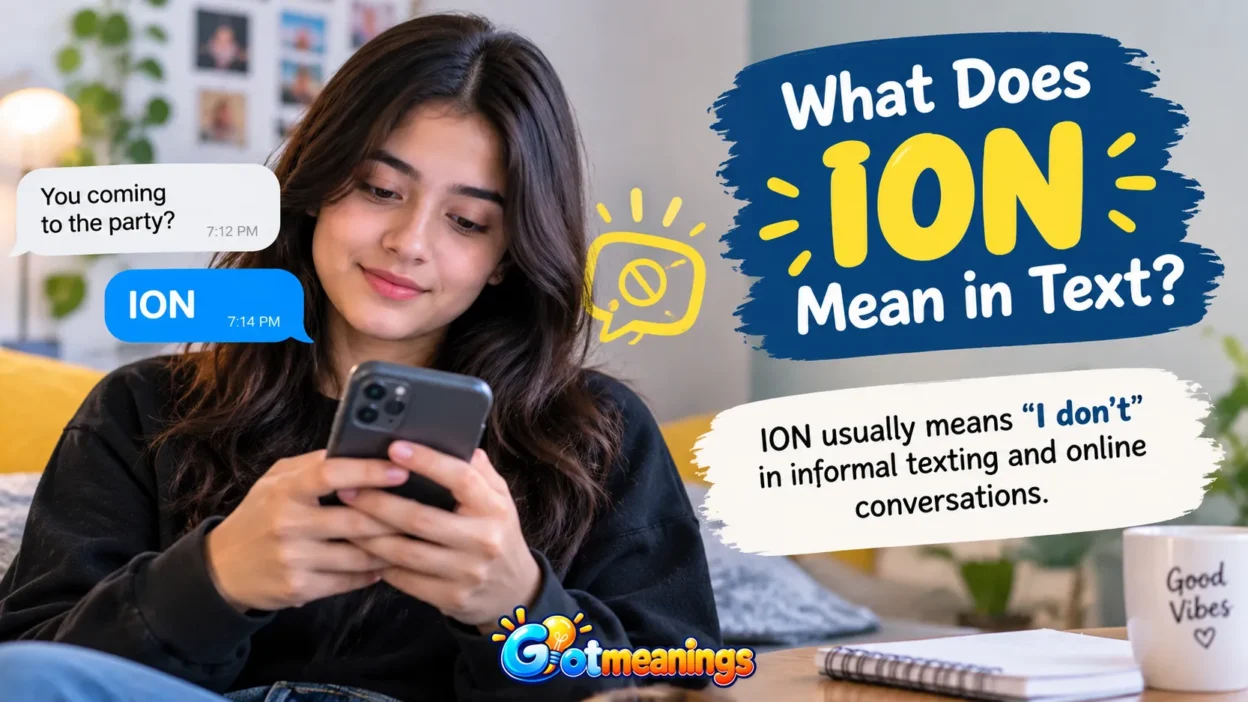
If you have seen “ION” in a text message, social media comment, or online chat, you may wonder what it means.
In texting, ION most commonly stands for “I don’t.” It is an informal abbreviation used in casual conversations, especially when someone wants to express that they do not feel like doing something, disagree with something, or are not interested.
For example, someone might text, “ion wanna go out tonight,” meaning “I don’t want to go out tonight.” The spelling may look unusual, but it reflects the way some people pronounce the phrase in casual speech.
However, ION can also mean “in other news” in some online conversations. Its meaning depends on the sentence and the context.
This guide explains what ION means in text, how people use it on social media, where it comes from, and how to respond when someone sends it.
| Category | Meaning |
|---|---|
| Texting abbreviation | I don’t |
| Alternative meaning | In other news |
| Full form | Depends on context |
| Typical tone | Casual and informal |
| Common usage | Text messages, social media, and online chats |
What Does ION Mean in Text & Chat?
ION usually means “I don’t” in informal texting and online conversations. People use it as a shortened spelling that reflects casual pronunciation. It is common in relaxed conversations where speed and an informal tone matter more than standard spelling.
For example:
Person A: “ion think that’s a good idea.”
Person B: “Why not? 😂”
Here, ION means “I don’t.” The complete sentence is “I don’t think that’s a good idea.”
People may use ION before words such as “know,” “want,” “think,” or “care.” The exact meaning becomes clear from the words that follow it.
Examples include:
- “ion know” — I don’t know.
- “ion want that” — I don’t want that.
- “ion think so” — I don’t think so.
- “ion care” — I don’t care.
- “ion feel like going” — I don’t feel like going.
ION is informal, so it is better suited to texting friends than writing school assignments, business emails, or professional messages.
It can sound neutral, playful, dismissive, or annoyed. For example, “ion know lol” may sound relaxed, while “ion care anymore” can suggest frustration or emotional distance.
Full Form, Stands For & Short Meaning of ION
ION does not have one universal full form in texting. Its meaning depends on how it is used.
1. ION Means “I Don’t”
This is a common interpretation in casual text messages. It represents an informal pronunciation of “I don’t.”
Example:
Person A: “Are you coming to the party?”
Person B: “ion think so.”
Meaning: “I don’t think so.”
2. ION Means “In Other News”
In some online writing, ION is an abbreviation for “in other news.” People use it to introduce a new topic, often after discussing something unrelated.
Example:
Person A: “That movie was terrible.”
Person B: “ION, my favorite show has a new episode tonight!”
Meaning: “In other news, my favorite show has a new episode tonight!”
This use is more likely when ION appears at the beginning of a sentence and introduces a change of subject.
3. ION as a Technical Word
Outside texting, an ion is an atom or molecule with an electrical charge because it has gained or lost electrons. This is a scientific meaning, not a texting abbreviation.
Quick tip: If ION appears before a verb such as “know,” “want,” or “think,” it may mean “I don’t.” If it introduces an unrelated update, it may mean “in other news.”
Origin, History & First Known Use of ION
The texting use of ION is connected to informal online writing and pronunciation-based spellings. In some speech communities, “I don’t” may be pronounced in a way that sounds closer to “ion.” Texting can reflect this pronunciation by using ION as a short written form.
Like many slang expressions, its use is shaped by casual conversation, messaging habits, and online communities. People often shorten words or write them as they sound to make messages feel relaxed and natural.
However, it is difficult to identify one person, platform, or exact date as the origin of ION in texting without reliable historical evidence. It would be inaccurate to claim that a particular social media app invented the abbreviation.
The expression “in other news” has a separate history as an ordinary English phrase. Its abbreviation, ION, can appear in informal online writing when someone changes the subject.
The important distinction is that these are different uses of the same letters. The surrounding sentence helps determine which meaning the writer intends.
How People Use ION in Daily Conversations
People use ION in different ways depending on what they want to communicate. Most commonly, it expresses a lack of knowledge, interest, desire, or agreement.
Expressing Uncertainty
Someone may use ION when they are unsure about something.
Example:
Person A: “Do you know when the shop closes?”
Person B: “ion know, maybe at 9.”
Meaning: “I don’t know, maybe at 9.”
The message sounds casual and does not necessarily show frustration.
Saying No or Showing Disinterest
ION can help someone decline an invitation or explain that they do not want something.
Example:
Person A: “Wanna play another game?”
Person B: “ion feel like playing anymore.”
Meaning: “I don’t feel like playing anymore.”
This is a simple way to express a lack of interest.
Disagreeing With Someone
People may use ION to express a different opinion.
Example:
Person A: “That was the best episode ever.”
Person B: “ion think it was that good tbh.”
Meaning: “I don’t think it was that good, to be honest.”
The phrase is informal, but it does not automatically mean the person is being rude.
Changing the Subject
ION can also introduce a different topic when it means “in other news.”
Example:
Person A: “I finally finished my homework.”
Person B: “Nice! ION, did you see the new trailer?”
Meaning: “In other news, did you see the new trailer?”
In this example, ION signals a topic change rather than a negative response.
ION Meaning Across WhatsApp, Instagram, TikTok & Snapchat
The meaning of ION generally depends more on the sentence than on the platform. It does not have a completely different definition on every social media app.
ION on WhatsApp
On WhatsApp, friends may use ION in private messages to express their thoughts, feelings, or plans.
Example: “ion think I’ll be free today.”
Meaning: “I don’t think I’ll be free today.”
ION on Instagram
On Instagram, ION may appear in direct messages, comments, captions, or replies. Its tone depends on the conversation.
Example: “ion even follow that account anymore.”
Meaning: “I don’t even follow that account anymore.”
ION on TikTok
On TikTok, users may use ION in comments, captions, or discussions about videos. It can express an opinion or a reaction.
Example: “ion get the hype around this trend.”
Meaning: “I don’t get the hype around this trend.”
ION on Snapchat
On Snapchat, ION can appear in quick messages between friends. Because these conversations are often brief, informal spelling is common.
Example: “ion wanna go out rn.”
Meaning: “I don’t want to go out right now.”
Does ION Change Meaning Between Platforms?
Not usually. The same two main interpretations—“I don’t” and “in other news”—can appear across different platforms.
The sentence structure is the best clue. If ION fits naturally before a verb, it may mean “I don’t.” If it introduces a new subject, “in other news” may make more sense.
Different Meanings of ION in Other Fields
Although ION is used in texting, it also has meanings outside casual conversations. Understanding the setting can prevent confusion.
ION in Science
In chemistry and physics, an ion is an atom or molecule that carries an electrical charge. This happens when it gains or loses electrons.
For example, sodium ions and chloride ions play an important role in chemistry and many biological processes.
In a science lesson, textbook, or laboratory discussion, ION is usually the scientific term rather than a texting abbreviation.
ION in Online Writing
In informal online writing, ION can stand for “in other news.” It introduces an additional update or a new subject.
For example: “ION, I finally booked my trip.”
This means the writer is moving to another topic.
ION in Names and Abbreviations
ION may also appear in organization names, product names, technical labels, or other specialized abbreviations. These meanings vary by field and should not be assumed without context.
When you encounter ION outside a casual chat, look at the surrounding information before deciding what it means.
Common Confusions, Mistakes & Wrong Interpretations
ION can be confusing because the same letters have more than one meaning. Here are some common mistakes to avoid.
Assuming ION Always Means “I Don’t”
Although “I don’t” is a common texting interpretation, it is not the only possibility.
For example, “ION, I watched a great movie yesterday” may mean “In other news, I watched a great movie yesterday.”
The topic change provides an important clue.
Confusing ION With IMO
ION and IMO look similar, but they mean different things.
- ION: Often “I don’t” in casual texting; sometimes “in other news.”
- IMO: “In my opinion.”
Example:
“ion like that song” means “I don’t like that song.”
“IMO, that song is great” means “In my opinion, that song is great.”
Thinking ION Is Always Rude
ION does not automatically sound disrespectful. Its tone depends on the full message and the relationship between the people.
For example, “ion know lol” can be lighthearted. However, “ion care what you think” may sound dismissive because of the words surrounding it.
Treating Every Use as a Formal Acronym
Some people use ION as an informal spelling rather than a traditional acronym. It does not always have a formal word-by-word expansion.
Ignoring Punctuation and Context
Compare these two messages:
- “ion know 😂” — likely a casual expression of uncertainty.
- “ION: the concert starts at 8” — may introduce a new topic, depending on the writer’s style.
Capitalization alone does not prove the intended meaning. The complete sentence is more useful.
Similar Terms, Alternatives & Related Slang
Several texting abbreviations are related to ION because they express uncertainty, opinions, or casual reactions.
| Term | Meaning | Example |
|---|---|---|
| IDK | I don’t know | “idk what happened” |
| IMO | In my opinion | “imo, it’s worth watching” |
| TBH | To be honest | “tbh, I didn’t like it” |
| IDC | I don’t care | “idc which movie we watch” |
| RN | Right now | “I’m busy rn” |
| NGL | Not gonna lie | “ngl, that was funny” |
| FR | For real | “that’s true fr” |
These terms are not interchangeable in every situation.
For example, ION can express “I don’t want to go,” while IDC communicates a lack of concern or interest. IDK expresses uncertainty, not necessarily a refusal.
Choosing the right abbreviation helps make a message clearer. If the other person may not recognize slang, writing the complete phrase is often the easiest option.
Examples of ION in Real Chat Situations
The following examples show how ION can work in different everyday conversations.
Example 1: Expressing Uncertainty
Person A: “Do you think it will rain tomorrow?”
Person B: “ion know, the weather keeps changing.”
Meaning: The person does not know whether it will rain.
Example 2: Declining an Invitation
Person A: “Wanna grab food after class?”
Person B: “ion feel like going out today 😭”
Meaning: The person does not feel like going out. The emoji may make the refusal feel softer or more expressive.
Example 3: Sharing an Opinion
Person A: “Everyone says that game is amazing.”
Person B: “ion think it’s that fun tbh.”
Meaning: The person disagrees with the popular opinion. The message is informal, but not necessarily hostile.
Example 4: Showing Frustration
Person A: “Why didn’t you tell me earlier?”
Person B: “ion know what else to say.”
Meaning: The person may feel uncomfortable, frustrated, or unsure how to respond. The surrounding conversation helps clarify the emotion.
Example 5: Using ION to Change the Subject
Person A: “I finally cleaned my room.”
Person B: “Good job! ION, are we still meeting tomorrow?”
Meaning: Here, ION means “in other news” and introduces a different topic.
Example 6: A Playful Conversation
Person A: “You always say you hate coffee, but you drink mine 😂”
Person B: “ion hate coffee, I hate buying it myself 😂”
Meaning: The person is joking. ION means “I don’t,” and the humor comes from the contrast between drinking someone else’s coffee and paying for their own.
Example 7: A Potentially Dismissive Reply
Person A: “I spent hours explaining why this matters to me.”
Person B: “ion care.”
Meaning: The reply means “I don’t care” and may sound hurtful or dismissive. In this situation, the wording is much harsher than a casual “ion know.”
These examples show that ION itself does not determine the emotional tone. The complete sentence, punctuation, emojis, and relationship between the speakers all matter.
How to Reply When Someone Says ION
The best response depends on what the person means and how they say it. First, work out whether ION means “I don’t” or “in other news.”
When They Mean “I Don’t Know”
If someone says “ion know,” you can ask a follow-up question or move on.
Examples:
- “No worries, I’ll check.”
- “That’s okay! Let me know if you find out.”
- “Any guesses? 😂”
Choose a response that fits the situation.
When They Do Not Want to Do Something
If someone says “ion wanna go,” respect their answer instead of pressuring them.
Examples:
- “No problem, maybe another day.”
- “That’s fine! We can stay in.”
- “All good, get some rest 😊”
When They Disagree With You
If someone says “ion think so,” you can ask why or share your own view calmly.
Examples:
- “Fair enough. What makes you think that?”
- “That’s okay, we can disagree.”
- “I see your point, but I look at it differently.”
When They Say “ION” to Change the Subject
If the message means “in other news,” respond to the new topic.
Example:
Person A: “ION, I got tickets for Saturday!”
Person B: “That’s awesome! Who’s going with you?”
When the Message Sounds Rude
If someone says “ion care” during a serious conversation, you do not need to match their tone.
You could say:
- “That sounded dismissive. Can we talk about it calmly?”
- “If you don’t want to discuss it now, we can talk later.”
- “I’d appreciate it if you took what I’m saying seriously.”
If you are unsure what the sender means, a simple question such as “What do you mean by ION here?” can prevent misunderstandings.
Is ION Still Popular? Trends & Online Usage
ION remains recognizable as an informal texting abbreviation, but its popularity can vary by community, age group, region, and platform. Without reliable current usage data, it is not possible to give an exact ranking or claim that it is becoming more or less popular in 2026.
The expression fits naturally into casual digital communication because people often shorten phrases or spell them according to pronunciation. You may encounter it in private messages, comments, captions, or conversations between friends.
However, not everyone uses or understands the same slang. Some readers may interpret ION as “in other news,” while others may recognize only the “I don’t” meaning.
For clear communication, consider your audience. If you are messaging someone who regularly uses informal slang, ION may be easy to understand. In a professional setting or a conversation with someone unfamiliar with it, writing “I don’t” or “in other news” is usually clearer.
Frequently Asked Questions
What does ION mean in text messages?
ION commonly means “I don’t” in informal texting. For example, “ion know” means “I don’t know.” In some contexts, it also stands for “in other news.”
What does ION stand for in slang?
In slang, ION often represents “I don’t,” reflecting casual pronunciation. It can also abbreviate “in other news” when someone introduces a different topic.
What does ION mean on Snapchat?
On Snapchat, ION commonly means “I don’t” in casual messages. For example, “ion wanna go” means “I don’t want to go.” The intended meaning depends on the sentence.
What does ION mean on TikTok?
On TikTok, ION may appear in comments, captions, or discussions. It often means “I don’t,” as in “ion get it,” but it can also mean “in other news” in some contexts.
Is ION the same as IDK?
No. IDK means “I don’t know.” ION often means “I don’t,” and it can be followed by words such as “want,” “think,” or “care.” Although “ion know” and “idk” can communicate similar ideas, they are written differently.
Does ION mean “I don’t care”?
Not by itself in every context. ION can form part of the phrase “ion care,” which means “I don’t care.” However, ION alone does not necessarily communicate indifference.
Is ION rude or disrespectful?
ION is not automatically rude. A message such as “ion know lol” can sound relaxed, while “ion care about your feelings” may sound dismissive. The complete sentence and situation determine the tone.
What does ION mean when someone starts a sentence with it?
When ION begins a sentence that introduces a different subject, it may mean “in other news.” For example, “ION, I passed my exam” signals a change of topic. However, sentence position alone does not guarantee this meaning.
How should I reply when someone texts ION?
Read the full message first. If the person means “I don’t know,” you could say, “No worries!” If they are declining an invitation, respond politely. If you cannot tell what they mean, ask them to clarify.
Is ION a real word or just internet slang?
ION is used as informal texting slang, but it is not a standard spelling of “I don’t” in formal English. Separately, an ion is an established scientific term for an electrically charged atom or molecule.
Conclusion
ION is a useful example of how informal texting changes the way people write everyday English. In many casual conversations, it means “I don’t,” as in “ion know,” “ion want to,” or “ion think so.” People use it to express uncertainty, share opinions, decline invitations, or explain their feelings without typing the full phrase.
ION can also mean “in other news,” especially when someone introduces a new topic. Outside online conversations, the word has a separate scientific meaning related to electrically charged atoms or molecules.
The most important thing to remember is that context determines the intended meaning. Look at the surrounding words, the topic, and the tone before interpreting a message.
When you are unsure, asking the sender what they mean is better than making an assumption. Understanding these small differences can help you communicate more clearly and avoid unnecessary confusion in everyday chats.

Milo Carter is a tax writer who explains tax terms, rules, and common questions in simple, easy-to-understand language.