
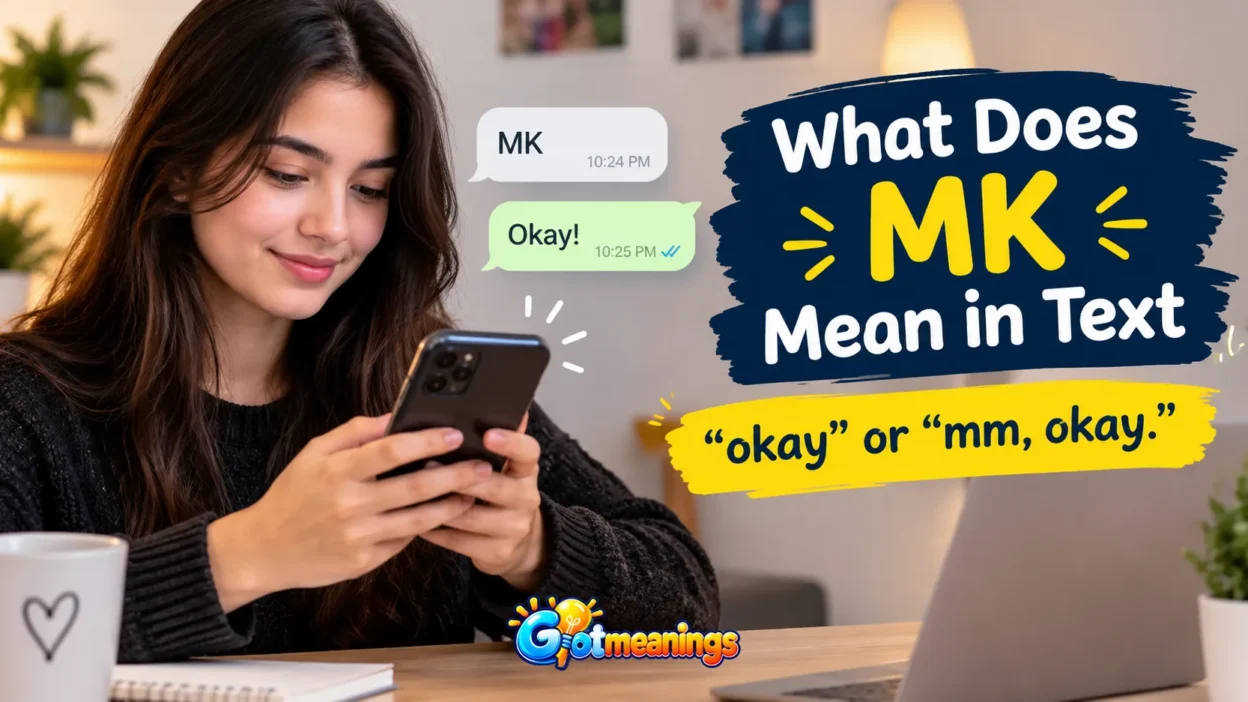
If someone sends you “mk” in a text message, they usually mean “okay” or “mm, okay.” It is a short way to acknowledge a message, agree to something, or show that they have received the information.
However, depending on the conversation, “mk” can sometimes sound neutral, casual, uninterested, or slightly annoyed.
You may see MK in text messages, group chats, social media comments, and everyday online conversations. For example, if you tell a friend that you will meet them at 6 PM and they reply “mk,” they probably mean they understand and agree.
Still, a short reply can feel different depending on the situation and your relationship with the person.
In this guide, you will learn what MK means in text, whether it sounds rude, how people use it across social media platforms, and how to reply naturally.
You will also find realistic examples to help you understand its meaning in different situations.
| Category | Meaning |
|---|---|
| Texting term | MK |
| Most common meaning | Okay or mm, okay |
| Full form | No universally established full form in casual texting |
| Typical tone | Casual, neutral, or sometimes dismissive |
| Common usage | Text messages, chats, and social media conversations |
What Does MK Mean in Text & Chat?
MK usually means “okay” in texting. It is an informal response that shows someone has read your message, understands what you said, or accepts a suggestion.
For example, if you ask a friend whether they can meet after school, they might reply “mk” instead of typing “okay.” The response is short and casual, so there is usually no need to read too much into it.
However, MK does not always express excitement or strong agreement. It can simply mean that the person has acknowledged your message.
Here are some common ways to understand it:
- Acknowledgment: The person has read and understood your message.
- Agreement: They accept a plan or suggestion.
- Neutral response: They have nothing more to add.
- Possible annoyance: They may be responding briefly because they are upset or uninterested.
The meaning depends on the surrounding conversation. If someone normally sends short messages, MK may be completely ordinary. If they suddenly switch from friendly replies to one-word answers during an argument, it could suggest frustration.
Full Form, Stands For & Short Meaning of MK
MK does not have one official full form that applies to every text conversation. In everyday texting, it is commonly used as a shortened form of “okay” or an informal spelling of “mm, okay.”
People often shorten familiar words because typing a brief response is faster and easier. MK serves this purpose without changing the basic message.
Consider these examples:
- MK = Okay: A simple acknowledgment or acceptance.
- MK = Mm, okay: A slightly more reserved response, depending on the conversation.
- MK = I understand: Sometimes it confirms that the message has been received, without expressing strong enthusiasm.
These interpretations overlap, and the exact meaning cannot always be determined from the letters alone.
It is also important not to assume that MK always stands for a longer phrase. Unlike abbreviations with a widely recognized expansion, its casual texting use does not require a fixed word for every letter.
In other settings, MK may be an abbreviation, code, name, or technical label. Those meanings should not be confused with its common use in informal messages.
Origin, History & First Known Use of MK
There is no single, confidently established origin date for MK as a casual texting expression.
Its modern use fits a broader pattern in digital communication: people often shorten common words and phrases to make messages quicker to type. Expressions such as “k,” “kk,” and “mk” can all appear as brief acknowledgments, although their tone and meaning may differ.
The word “okay” itself has a long history, but that does not establish when MK first became common in online conversations.
It is also difficult to identify one person, website, or social media platform that introduced this particular texting form. Informal abbreviations often develop through everyday use rather than through a documented announcement or official definition.
Today, MK can appear in ordinary one-to-one messages, casual group chats, and social media conversations. Its meaning is best understood through how people use it in context, rather than through an assumed historical origin.
How People Use MK in Daily Conversations
People use MK when they want to respond quickly without writing a complete sentence. It can acknowledge information, accept a plan, or end a conversation without adding much detail.
To acknowledge information
Someone might send MK after receiving an update.
Example:
Person A: “Your package should arrive tomorrow.”
Person B: “Mk, thanks!”
Here, MK simply means the person understands the update.
To agree to a plan
MK can also indicate that someone accepts a suggestion.
Example:
Person A: “Let’s meet outside the library at 4.”
Person B: “Mk, see you there.”
The reply suggests agreement, although it does not express much excitement.
To respond during a disagreement
A short MK can sometimes communicate frustration or a desire to stop discussing something.
Example:
Person A: “I already explained why I couldn’t come yesterday.”
Person B: “Mk.”
In this situation, the response could sound distant or annoyed. However, it does not prove that the person is angry. They may simply want to end the discussion.
To keep a conversation brief
Some people prefer short messages, especially when they are busy. For them, MK is a normal acknowledgment rather than a sign of disinterest.
The key is to consider the person’s usual communication style before interpreting their response emotionally.
MK Meaning Across WhatsApp, Instagram, TikTok & Snapchat
MK generally keeps the same basic meaning across messaging apps and social platforms: “okay” or “mm, okay.” The platform does not automatically change what the abbreviation means.
MK on WhatsApp
On WhatsApp, MK may appear in private chats or group conversations when someone acknowledges information or agrees to a plan.
Example:
Person A: “I’ll send you the notes tonight.”
Person B: “Mk, thank you!”
This is a simple acknowledgment. The surrounding words make the response sound friendly.
MK on Instagram
On Instagram, someone might use MK in direct messages when replying to an invitation, a question, or a casual update.
Example:
Person A: “I tagged you in the story.”
Person B: “Mk, I’ll check it.”
The reply means the person has understood the message and plans to look at the story.
MK on TikTok
In TikTok comments or direct messages, MK may be used as a short acknowledgment. However, the meaning of a comment can depend heavily on the video and the discussion.
A standalone “mk” under a video could sound dismissive if it appears to brush off someone’s opinion. In another conversation, it might simply mean “okay.”
MK on Snapchat
On Snapchat, MK may appear in quick replies about plans, snaps, or everyday conversations.
Example:
Person A: “I’ll snap you when I get home.”
Person B: “Mk 😊”
The emoji gives the message a warmer tone and makes it less likely to sound abrupt.
| Platform | Common interpretation | What to consider |
|---|---|---|
| Okay or acknowledgment | The message before it | |
| Casual agreement | Whether the conversation is friendly | |
| TikTok | Acknowledgment or possible dismissal | The comment’s context |
| Snapchat | Brief confirmation | Emojis and usual texting habits |
In short, MK usually does not have a different definition on each platform. The tone changes more often than the core meaning.
Different Meanings of MK in Other Fields
Although MK commonly means “okay” in casual texting, the same letters can mean different things outside everyday conversation.
For example, MK may appear as an abbreviation in a workplace message, a technical document, a product name, or a discussion about a particular subject. Its interpretation depends on the field.
In science, engineering, business, and entertainment, short letter combinations can serve as labels or shorthand. The intended meaning may be specific to that setting and may have nothing to do with texting.
MK can also appear as part of a username, nickname, brand name, or title. In such cases, it may not represent an abbreviation at all.
It is best to distinguish between these possibilities:
- Casual texting: Usually “okay” or “mm, okay.”
- Work or technical communication: May be a field-specific abbreviation.
- Names and titles: May simply be initials or part of a name.
- Other online communities: May have a specialized meaning established by the group.
Do not assume that a technical or specialized interpretation applies to an ordinary text message. Likewise, do not automatically interpret MK as “okay” when it appears in a document that clearly uses technical terminology.
Common Confusions, Mistakes & Wrong Interpretations
MK is easy to misunderstand because it contains very little information about the sender’s feelings.
Assuming MK always means anger
A brief response can feel cold, but it does not necessarily indicate anger. The sender may be busy, distracted, or simply accustomed to using short replies.
Look at the rest of the conversation before deciding that something is wrong.
Confusing MK with K
Both MK and K can be used as short acknowledgments, but people may perceive them differently.
“K” is often read as a direct, minimal version of “okay.” MK can sound like “mm, okay” to some readers, giving it a slightly more conversational or hesitant feel.
Neither abbreviation has a fixed emotional meaning in every situation.
Thinking MK is always enthusiastic agreement
MK usually indicates acknowledgment or acceptance, but it does not necessarily mean the person is excited about the idea.
If you invite someone to an event and they reply “mk,” you may need to ask a follow-up question if you require a clear commitment.
Treating every short reply as passive-aggressive
Passive-aggressive communication is possible, but a single abbreviation is not enough to establish that intention.
Repeated dismissive responses, hostile wording, or a clear disagreement may provide more useful clues than the letters alone.
Assuming every MK has the same full form
In casual texting, MK is commonly understood as “okay” or “mm, okay.” In other settings, it may be a different abbreviation or label. Always consider the topic and surrounding words.
Similar Terms, Alternatives & Related Slang
Several short expressions are used in a similar way to MK. They can acknowledge a message or indicate agreement, but they do not all carry the same tone.
| Term | Common meaning | Typical impression |
|---|---|---|
| K | Okay | Very brief; may sound abrupt |
| KK | Okay, okay | Often casual or friendly |
| OK | Okay | Clear and neutral |
| Okay | Agreement or acknowledgment | More complete and clear |
| Alr | Alright | Casual acceptance |
| Bet | Agreed or sounds good | Informal and confident |
| Sure | Agreement | Depends on wording and context |
| Got it | I understand | Clear acknowledgment |
| Mhm | Yes or acknowledgment | Can indicate agreement or listening |
| I guess | Reluctant agreement | Often suggests uncertainty |
These expressions are not exact replacements in every situation.
For example, “bet” often conveys confident agreement, while “got it” clearly confirms understanding. MK is usually less specific and may communicate little beyond acknowledgment.
If you want to avoid misunderstandings, use a fuller response such as “Okay, that works for me” or “Got it, thanks.” These replies make your intention easier to understand.
Examples of MK in Real Chat Situations
The following examples show how MK can work in everyday conversations. They are illustrative scenarios, not reports of actual private conversations.
Example 1: Making plans
Person A: “Can we meet at the coffee shop at 5 PM?”
Person B: “Mk, see you then.”
Meaning: Person B acknowledges and accepts the plan.
Example 2: Responding to an update
Person A: “The teacher moved the test to Friday.”
Person B: “Mk, thanks for letting me know.”
Meaning: MK indicates that Person B has received the information.
Example 3: A friendly conversation
Person A: “I’ll save you a seat 😊”
Person B: “Mk, you’re the best!”
Meaning: The additional words make the response sound warm and appreciative.
Example 4: A potentially annoyed reply
Person A: “I can’t talk right now. I’ll explain later.”
Person B: “Mk.”
Meaning: Person B may sound disappointed or distant, but the message alone does not prove that they are upset.
Example 5: A casual gaming conversation
Person A: “Join the game when you’re ready.”
Person B: “Mk, give me two minutes.”
Meaning: Person B understands the invitation and expects to join shortly.
Example 6: Responding to a suggestion
Person A: “Maybe we should order pizza instead.”
Person B: “Mk, that’s fine.”
Meaning: Person B appears to accept the suggestion. The phrase “that’s fine” makes the agreement clearer.
Example 7: Ending a disagreement
Person A: “Let’s stop arguing and talk tomorrow.”
Person B: “Mk, we can discuss it later.”
Meaning: The response accepts a pause in the conversation. It may sound serious rather than playful.
Example 8: An unclear response
Person A: “Are you actually coming to the party?”
Person B: “Mk.”
Meaning: MK does not clearly confirm attendance here. A direct follow-up would help avoid confusion.
These examples show why context matters. The same abbreviation can sound friendly, neutral, uncertain, or dismissive depending on the message around it.
How to Reply When Someone Says MK
Your best reply depends on what the other person is acknowledging and whether you need more information.
When MK means ordinary agreement
If the person has accepted your plan, you can keep the conversation simple.
Possible replies:
- “Great, see you then!”
- “Perfect, thanks.”
- “Sounds good.”
You do not need to continue the conversation if everything is already clear.
When the response seems friendly
If the conversation is relaxed, you can respond naturally.
Possible replies:
- “Okayy 😊”
- “Awesome!”
- “Haha, cool.”
Match the other person’s tone rather than forcing a longer exchange.
When you are unsure what they mean
If MK does not clearly answer your question, ask for clarification.
Possible replies:
- “Just checking, does that mean yes?”
- “Are we still meeting at 5?”
- “Do you mean that’s okay with you?”
This is especially useful when plans, deadlines, or important decisions are involved.
When MK sounds annoyed
If the response follows a disagreement, avoid assuming the worst or replying aggressively.
Possible replies:
- “Are we okay?”
- “I don’t want us to misunderstand each other.”
- “We can talk when you’re ready.”
A calm question can help clarify the situation without making the disagreement worse.
When you do not want to continue chatting
Sometimes MK is simply an acknowledgment that closes the conversation. You may not need to reply at all.
If you do want to respond, “Okay, talk later” is a clear and polite option.
Is MK Still Popular? Trends & Online Usage
MK remains understandable as a casual texting abbreviation, but there is no single reliable measure here that establishes how popular it is compared with other short replies in 2026.
Its use fits the general style of digital messaging, where people often favor quick acknowledgments over complete sentences. Short expressions are especially easy to use in fast-moving conversations, but individual preferences vary.
Some people regularly use MK, while others prefer “okay,” “k,” “kk,” or “alr.” Age, region, friend groups, and personal texting habits can all influence which expressions people choose.
It is also worth remembering that familiarity with an abbreviation does not make its tone universal. One person may see MK as a normal response, while another may interpret it as cold or uninterested.
Rather than focusing on whether the abbreviation is trending, pay attention to how the person uses it. Their usual messaging style and the conversation itself provide better clues to its intended meaning.
Frequently Asked Questions
What does MK mean in text from a girl or a guy?
MK usually means “okay” or “mm, okay,” regardless of who sends it. It does not automatically indicate romantic interest, anger, or disinterest. The surrounding conversation and the person’s usual texting style are more helpful clues.
Is MK rude in texting?
MK is not inherently rude. It can be a normal, casual acknowledgment. However, it may sound abrupt or dismissive during a serious conversation, especially if the sender uses it to end a discussion.
What does MK mean from a crush?
When a crush sends MK, it usually means “okay” or that they have acknowledged your message. The abbreviation alone does not reveal whether they like you. Look at the broader conversation rather than drawing conclusions from one short reply.
What is the difference between MK and K?
Both can mean “okay.” K is often interpreted as a very brief acknowledgment, while MK may sound more like “mm, okay” to some people. Neither has a universally fixed tone, so context matters.
What does MK mean on Snapchat?
On Snapchat, MK generally means “okay” or “mm, okay.” It can acknowledge a snap-related message, confirm a plan, or provide a quick response. Emojis and surrounding words can make the message feel warmer or more distant.
How should I respond to MK?
If the conversation is clear, you can reply with “Okay,” “Sounds good,” or “See you then.” If you are unsure whether the person agrees to something important, ask a direct follow-up question.
Does MK mean the person is mad at me?
Not necessarily. MK may sound cold in some situations, but the sender could simply be busy or prefer short messages. Consider the conversation as a whole before assuming that the person is angry.
Does MK have a full form?
In everyday texting, MK is commonly used to mean “okay” or “mm, okay.” It does not have one universally established full form for this use. In specialized contexts, the same letters may have other meanings.
Can MK mean something other than okay?
Yes. In a technical discussion, a name, a title, or a particular online community, MK may represent something else. In ordinary text conversations, however, “okay” is the most useful starting interpretation.
Conclusion
MK in text usually means “okay” or “mm, okay.” People use it to acknowledge messages, accept suggestions, and respond quickly in everyday conversations.
It is a casual abbreviation that works across messaging apps and social media, including WhatsApp, Instagram, TikTok, and Snapchat.
However, MK does not always communicate the same feeling. Depending on the conversation, it can sound neutral, friendly, hesitant, or slightly dismissive. A short reply alone is not enough to determine whether someone is annoyed, uninterested, or simply busy.
The best way to understand MK is to look at the message before it, the relationship between the people, and the sender’s usual texting habits.
If the response leaves an important question unanswered, ask for clarification instead of guessing.
When you use MK yourself, remember that a little extra wording or an emoji can make your intention clearer.
This helps keep everyday conversations natural and reduces the chance of misunderstandings.

Milo Carter is a tax writer who explains tax terms, rules, and common questions in simple, easy-to-understand language.