
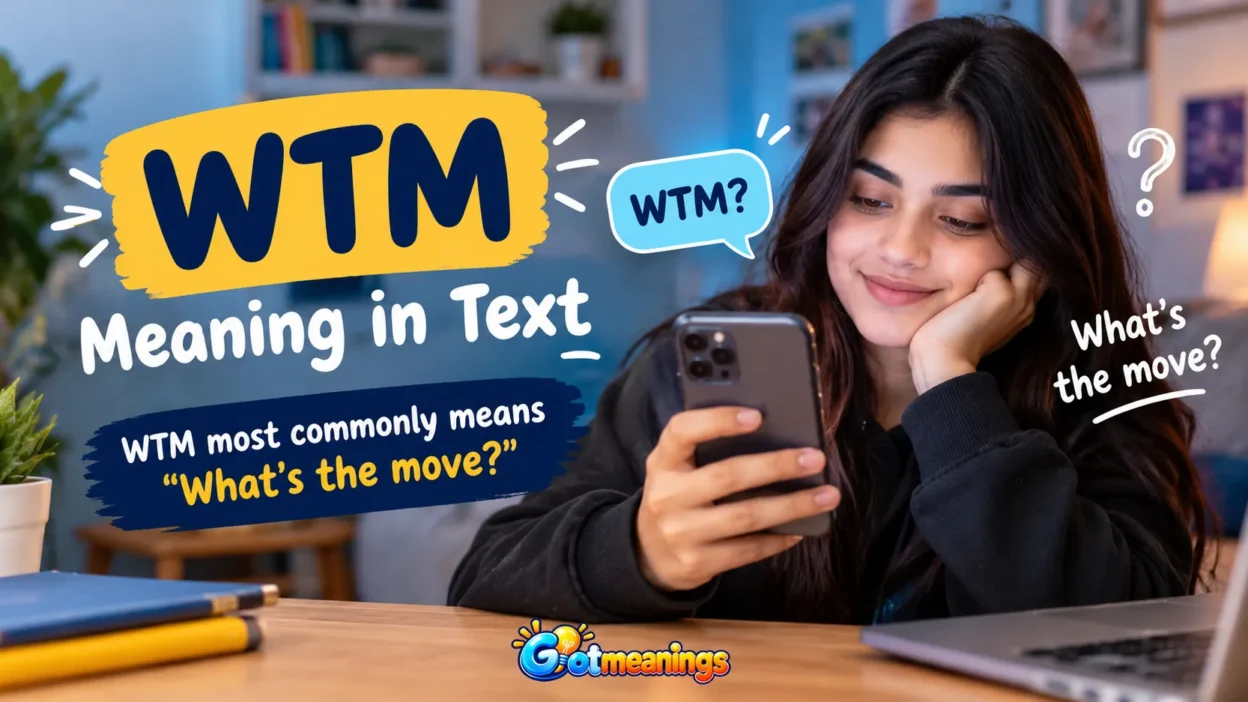
If you have received a text message containing “WTM,” you may be wondering what the sender is trying to say. WTM most commonly means “What’s the move?” in texting and online conversations.
People use it to ask about plans, suggest doing something, or find out what everyone wants to do next. For example, a friend might text, “WTM tonight?” to ask what the group is planning for the evening.
However, WTM can have other meanings depending on the conversation. In some situations, it may stand for “What’s the matter?” when someone wants to know whether something is wrong.
The sender’s wording, the topic, and your relationship with them can help you understand the intended meaning.
In this guide, you will learn what WTM means in text, how people use it on social media, how to reply naturally, and how to recognize its meaning in different situations.
| Quick detail | Meaning |
|---|---|
| Slang term | WTM |
| Most common meaning | What’s the move? |
| Other possible meaning | What’s the matter? |
| Full form | Depends on context |
| Typical tone | Casual, friendly, or concerned |
| Common usage | Text messages, group chats, and social media |
What Does WTM Mean in Text & Chat?
WTM usually means “What’s the move?” in text messages. It is an informal way to ask about plans, activities, or what people want to do next.
People often use this abbreviation when they want to make plans without writing a long message. Instead of asking, “What are we going to do tonight?” someone can simply send “WTM tonight?”
Here are a few common examples:
- “WTM this weekend?” means “What are we doing this weekend?”
- “WTM after class?” means “What are the plans after class?”
- “WTM tonight 👀” means “Is something happening tonight?” or “What are we doing tonight?”
The phrase usually has a relaxed, social tone. It can suggest that the sender wants to hang out, go somewhere, join an activity, or make plans with friends.
Can WTM Mean Something Else?
Yes. WTM can also mean “What’s the matter?” in conversations where someone is checking on another person.
For example:
Person A: “I don’t feel like talking today.”
Person B: “WTM? Are you okay?”
Here, WTM is likely asking what is wrong rather than asking about plans.
The context is important. If someone mentions a party, a weekend, or going out, “What’s the move?” is a natural interpretation. If someone sounds upset or mentions a problem, “What’s the matter?” may fit better.
Full Form, Stands For & Short Meaning of WTM
WTM does not have one universal full form in every conversation. In casual texting, its meaning depends on what the people are discussing.
The two useful interpretations to know are “What’s the move?” and “What’s the matter?”
| Meaning | What the sender wants to know | Example |
|---|---|---|
| What’s the move? | What are the plans? | “WTM this weekend?” |
| What’s the matter? | What is wrong? | “You seem quiet. WTM?” |
| Context-specific meaning | Something defined by the conversation | A group may use WTM as an inside abbreviation |
WTM as “What’s the Move?”
This is a common interpretation in informal social conversations. The sender may be asking whether you want to meet, go out, attend an event, or decide on an activity.
For example, “WTM after dinner?” could mean the person wants to know whether you are going somewhere afterward.
WTM as “What’s the Matter?”
This interpretation focuses on someone’s feelings or situation. The sender may be checking whether you are upset, worried, or dealing with a problem.
However, the abbreviation alone does not prove that the person is concerned. Read the surrounding messages before deciding what they mean.
Does WTM Have an Official Full Form?
WTM is an abbreviation rather than a term with one official expansion across all settings. In everyday texting, the intended phrase is usually clear from the topic and wording.
It is best not to assume that every person uses WTM in exactly the same way.
Origin, History & First Known Use of WTM
The exact origin and first use of WTM as internet slang are not firmly established here. It would be misleading to assign the abbreviation a specific creator, date, or platform without reliable evidence.
Its use fits a broader pattern in digital communication: people shorten common phrases to make messages faster and easier to type.
“What’s the move?” is an informal expression used to ask about plans or the next activity. Shortening it to WTM makes sense in quick conversations, especially when friends are deciding what to do.
Texting abbreviations became useful as mobile messaging and online chats made brief communication common. Social media also provides spaces where people can use familiar expressions without explaining every word.
Still, the history of the phrase and the history of the abbreviation are not necessarily the same. The expression may have been used in speech before people began writing it as WTM.
The safest takeaway is simple: WTM is a modern texting abbreviation whose meaning should be understood from context, rather than from an assumed origin story.
How People Use WTM in Daily Conversations
People use WTM to ask questions, make plans, check on someone, or keep a conversation moving. The meaning depends on what happened before the message was sent.
Making Plans With Friends
This is a natural setting for “What’s the move?”
Example:
Person A: “We’re all free on Saturday.”
Person B: “WTM? We could go bowling.”
Here, Person B wants to decide what everyone should do.
Starting a Casual Conversation
Someone might send WTM when they want to talk about possible activities but have not chosen anything yet.
Example:
Person A: “I’m bored at home.”
Person B: “WTM? Want to grab something to eat?”
The sender is suggesting an activity and inviting the other person to participate.
Checking on Someone
WTM may mean “What’s the matter?” if the other person appears upset or behaves differently.
Example:
Person A: “I had a really bad day.”
Person B: “WTM? Do you want to talk about it?”
In this example, the sender is asking what happened or what is wrong.
Using WTM in a Playful Way
Friends may use the abbreviation when they are excited about an upcoming event.
Example:
Person A: “Friday is finally here!”
Person B: “WTM 😂 We need a plan.”
The laughing emoji makes the message feel lighthearted and enthusiastic.
Understanding the Tone
WTM is usually casual, but the tone can change.
- Friendly: “WTM this weekend?”
- Excited: “WTM tonighttt?”
- Concerned: “You sound upset. WTM?”
- Playful: “WTM 👀”
- Impatient: “WTM? We need to decide now.”
Punctuation, emojis, and the relationship between the people all help shape the message.
WTM Meaning Across WhatsApp, Instagram, TikTok & Snapchat
WTM generally keeps the same possible meanings across social media platforms. The app itself does not determine the expansion; the conversation does.
WTM Meaning on WhatsApp
On WhatsApp, WTM can appear in private chats, friend groups, or conversations about upcoming plans.
Example:
Person A: “Everyone is free tomorrow.”
Person B: “WTM? Let’s plan something.”
The sender wants to know what the group should do.
WTM Meaning on Instagram
On Instagram, people may use WTM in direct messages or replies to stories. It can be a way to start a conversation or ask about plans.
For example, if someone posts about being bored, a friend might reply, “WTM?” to suggest meeting up or doing something together.
The message could also have a different meaning if the conversation is about a personal problem.
WTM Meaning on TikTok
On TikTok, WTM may appear in comments, captions, or private messages. Someone might use it when discussing an event, responding to a friend’s video, or making plans after seeing a post.
Its meaning still depends on the surrounding text. There is no need to assume that TikTok gives WTM a special, separate definition.
WTM Meaning on Snapchat
On Snapchat, WTM can be used in quick chats and replies to snaps. A person might send it when they want to hang out or find out what others are doing.
Example:
Person A: “Nothing to do today 😴”
Person B: “WTM? Let’s go somewhere.”
Here, the sender is asking about plans and offering an idea.
Does WTM Change Meaning Between Platforms?
| Platform | Possible use | Likely interpretation |
|---|---|---|
| Group planning | What’s the move? | |
| Replying to a story | What are the plans? | |
| TikTok | Comments or messages | Depends on context |
| Snapchat | Casual chats | What’s the move? or another context-based meaning |
These are examples of how the abbreviation may be used, not rules that apply to every conversation.
Different Meanings of WTM in Other Fields
Although WTM is familiar in casual messaging, the same letters may have different meanings in professional, technical, or specialized settings.
The correct expansion depends on the subject being discussed.
For example, WTM may appear as an abbreviation in a workplace document, a technical discussion, a group name, or a specialized community. In those settings, the intended meaning may have nothing to do with texting slang.
If you see WTM in a formal email, report, website, or technical document, look for a definition nearby. The writer may explain the abbreviation the first time it appears.
It is also useful to distinguish an established technical abbreviation from a meaning someone has created for a particular group. An acronym used by one organization is not necessarily a universal definition.
For everyday messages, however, you can usually begin by considering “What’s the move?” and then check whether the conversation supports that interpretation.
Important: Do not automatically apply the texting meaning to a professional or technical context. The surrounding subject matters more than the letters alone.
Common Confusions, Mistakes & Wrong Interpretations
WTM is short, so it can be easy to misunderstand when the sender provides little context.
Assuming It Always Means “What’s the Move?”
This is one of the main mistakes to avoid. While “What’s the move?” is a common interpretation, a person may be asking “What’s the matter?” instead.
If someone has just told you that they are having a difficult day, consider the emotional context before replying with weekend plans.
Confusing WTM With WYD
WTM and WYD are both used in casual conversations, but they ask different questions.
- WTM: What’s the move? What are the plans?
- WYD: What are you doing?
For example, “WYD?” asks about your current activity. “WTM tonight?” is more likely to ask about plans for later.
Thinking WTM Is Always Romantic
WTM is not automatically a flirting abbreviation. Friends, classmates, coworkers who communicate casually, and other acquaintances may use it to discuss plans.
A romantic meaning is possible only when the wider conversation supports it.
Reading Too Much Into an Emoji
An emoji can suggest excitement, humor, concern, or playfulness, but it cannot always reveal the sender’s exact intention.
For instance, “WTM 👀” may sound curious or excited. It does not necessarily mean the sender is flirting.
Assuming the Sender Is Being Rude
A short message may seem blunt because it lacks extra words. However, WTM is not inherently rude or disrespectful.
The sender’s usual communication style, punctuation, and previous messages can help you judge the tone.
How to Avoid Misunderstandings
If you are unsure, ask a short follow-up question.
For example:
- “Do you mean plans for tonight?”
- “What do you mean by WTM?”
- “Are you asking if something is wrong?”
A simple clarification is usually better than guessing and giving an unrelated answer.
Similar Terms, Alternatives & Related Slang
Several texting abbreviations serve a similar purpose to WTM. Knowing the difference can help you understand messages more quickly.
| Slang | Full form | Main purpose |
|---|---|---|
| WTM | What’s the move? | Ask about plans |
| WYD | What are you doing? | Ask about current activity |
| WYA | Where you at? | Ask someone’s location |
| HMU | Hit me up | Invite someone to contact you |
| LMK | Let me know | Ask for an update or answer |
| HBU | How about you? | Ask for the other person’s response |
| WYA later? | Where you at later? | Ask about someone’s later location or availability |
These expressions are related because they help people communicate quickly, but they are not interchangeable.
For example, “WYD tonight?” asks what someone is doing, while “WTM tonight?” often asks what the plan is. The difference is small but useful.
If you want to ask a friend about plans without using slang, you can simply write, “What are we doing tonight?” This is clear and works in almost any casual conversation.
Examples of WTM in Real Chat Situations
The following examples show how WTM can work in different conversations. Each exchange is illustrative, so the intended meaning comes from the surrounding message.
Example 1: Planning a Weekend
Person A: “I don’t have anything planned for Saturday.”
Person B: “WTM? Let’s check out that new café.”
Meaning: Person B is asking what the plan should be and suggesting an activity.
Example 2: Asking About Evening Plans
Person A: “Are you free after dinner?”
Person B: “Yeah, WTM?”
Meaning: Person B wants to know what they will do together.
Example 3: Making Plans in a Group Chat
Person A: “Everyone has finished their exams!”
Person B: “WTM this weekend? 🎉”
Meaning: Person B is asking the group to decide on a celebration or another activity. The emoji adds excitement.
Example 4: Checking on a Friend
Person A: “I don’t want to talk to anyone today.”
Person B: “WTM? I’m here if you need me.”
Meaning: Person B is likely asking what is wrong. The supportive second sentence suggests concern rather than a question about plans.
Example 5: Casual and Playful Conversation
Person A: “I’m so bored right now 😂”
Person B: “WTM? Let’s find something fun to do.”
Meaning: Person B is suggesting an activity and responding in a friendly way.
Example 6: A Message With a Curious Tone
Person A: “Guess what, I have a surprise for you.”
Person B: “WTM 👀 Tell me more!”
Meaning: Person B sounds curious and excited. Here, WTM is being used informally, and the rest of the message helps clarify the intent.
Example 7: A Slightly Impatient Message
Person A: “We need to leave in twenty minutes.”
Person B: “WTM? Have you decided where we’re going?”
Meaning: Person B wants a clear plan. The situation may make the question sound urgent, but it is not necessarily rude.
Example 8: When the Meaning Is Unclear
Person A: “I need to tell you something.”
Person B: “WTM? Is everything okay?”
Meaning: Person B may be asking what is wrong or what is happening. The follow-up question shows concern.
These examples demonstrate why it is important to read the whole conversation instead of treating WTM as a phrase with only one possible meaning.
How to Reply When Someone Says WTM
The best reply depends on what the sender means. If the message is about plans, suggest an activity or ask what they have in mind. If the person appears concerned, respond to the situation rather than assuming they want to make plans.
When They Ask About Plans
You can reply with a suggestion, ask for ideas, or explain that you are unavailable.
Examples:
- “Let’s grab some food.”
- “I’m free tonight. What do you have in mind?”
- “We could watch a movie.”
- “Nothing planned yet. Any ideas?”
- “I’m busy tonight, but maybe tomorrow.”
These replies keep the conversation natural and make it easy to decide what happens next.
When You Want to Sound Friendly
If you are happy to spend time with the person, suggest something simple.
Example:
Person A: “WTM this weekend?”
Person B: “Let’s go shopping and get lunch afterward 😊”
This gives the other person a clear idea to respond to.
When They May Be Asking What Is Wrong
If the conversation seems emotional, you can answer honestly or ask what they mean.
Examples:
- “I’m just having a rough day.”
- “Nothing serious, just feeling tired.”
- “I’m okay, thanks for checking.”
- “Did you mean what’s wrong?”
You do not need to share personal details you are not comfortable discussing.
When You Are Confused
There is nothing wrong with asking for clarification.
You could say:
- “WTM as in, what’s the plan?”
- “What do you mean?”
- “Are you asking what we’re doing tonight?”
These responses are useful when the abbreviation could have more than one meaning.
When You Do Not Want to Make Plans
You can politely decline without sounding unfriendly.
For example:
Person A: “WTM tonight?”
Person B: “I’m staying home tonight, but thanks for asking!”
A clear and kind response helps avoid confusion while respecting your own plans.
Is WTM Still Popular? Trends & Online Usage
WTM is recognizable as informal texting shorthand, especially when people discuss plans. However, its exact popularity, frequency, and ranking across social media platforms cannot be established here without current usage data.
Its appeal is easy to understand: short abbreviations save time and fit naturally into quick messages. Friends may use WTM when deciding where to go, what to do, or whether anyone has made plans.
Still, not everyone uses the same slang. Some people prefer complete phrases, while others use abbreviations regularly. Age, location, friend groups, and personal texting habits can all affect which expressions people recognize.
The phrase “What’s the move?” can also appear in ordinary conversation without being shortened to WTM. As a result, the expression may be familiar even to someone who rarely types the abbreviation.
When you encounter WTM online, focus on the message rather than assuming that everyone uses it in the same way. The surrounding conversation remains the most useful clue to its meaning.
Frequently Asked Questions
What does WTM mean in text from a guy or girl?
WTM often means “What’s the move?” when someone asks about plans. A guy or girl might use it to see whether you want to hang out, but the abbreviation alone does not prove romantic interest.
Does WTM mean “What’s the matter”?
Yes, it can mean “What’s the matter?” when someone is asking about a problem or checking on your feelings. However, “What’s the move?” is another common interpretation in casual social conversations.
What does WTM mean on Snapchat?
On Snapchat, WTM often asks about plans or what someone wants to do. The intended meaning can change if the conversation is about a problem rather than an activity.
What should I reply to WTM?
If the person is asking about plans, suggest an activity or ask what they have in mind. You could reply, “Let’s get something to eat,” or “I’m free later. What are you thinking?”
Is WTM a flirting term?
Not by itself. WTM can be used by friends or acquaintances who want to make plans. Whether a message is flirty depends on the wider conversation and the relationship between the people.
What is the difference between WTM and WYD?
WTM often means “What’s the move?” and asks about plans. WYD means “What are you doing?” and usually asks about someone’s current activity, although it can also refer to what they are doing later.
Does WTM have a full form?
In casual texting, WTM commonly stands for “What’s the move?” It can also mean “What’s the matter?” in some contexts. There is no single expansion that applies to every situation.
Is WTM rude or disrespectful?
WTM is not inherently rude. It is usually casual and direct. However, the tone may feel impatient or abrupt depending on the wording, punctuation, and situation.
Can I use WTM in a professional email?
It is generally better to avoid informal slang like WTM in formal emails unless you know the recipient understands it and the setting allows casual language. A phrase such as “What are the plans?” is clearer in professional communication.
What does WTM mean when someone adds an emoji?
The emoji may add emotion or help establish the tone. For example, “WTM 😂” may sound playful, while “WTM 👀” can suggest curiosity or excitement. The surrounding message is still important.
Conclusion
WTM most commonly means “What’s the move?” in casual text messages and online chats.
People use it to ask about plans, suggest activities, or find out what friends want to do next. For example, “WTM tonight?” is a quick way to ask about evening plans.
However, WTM can also mean “What’s the matter?” when someone is checking on another person or asking about a problem.
The correct interpretation depends on the conversation, the relationship between the people, and the words or emojis surrounding the abbreviation.
If someone sends you WTM, look at the previous messages before deciding how to reply. You can suggest an activity, share your plans, or ask for clarification if the meaning is unclear.
You do not need to memorize every possible expansion. Understanding the context is the easiest way to interpret WTM naturally and use it appropriately in your own conversations.

Milo Carter is a tax writer who explains tax terms, rules, and common questions in simple, easy-to-understand language.