

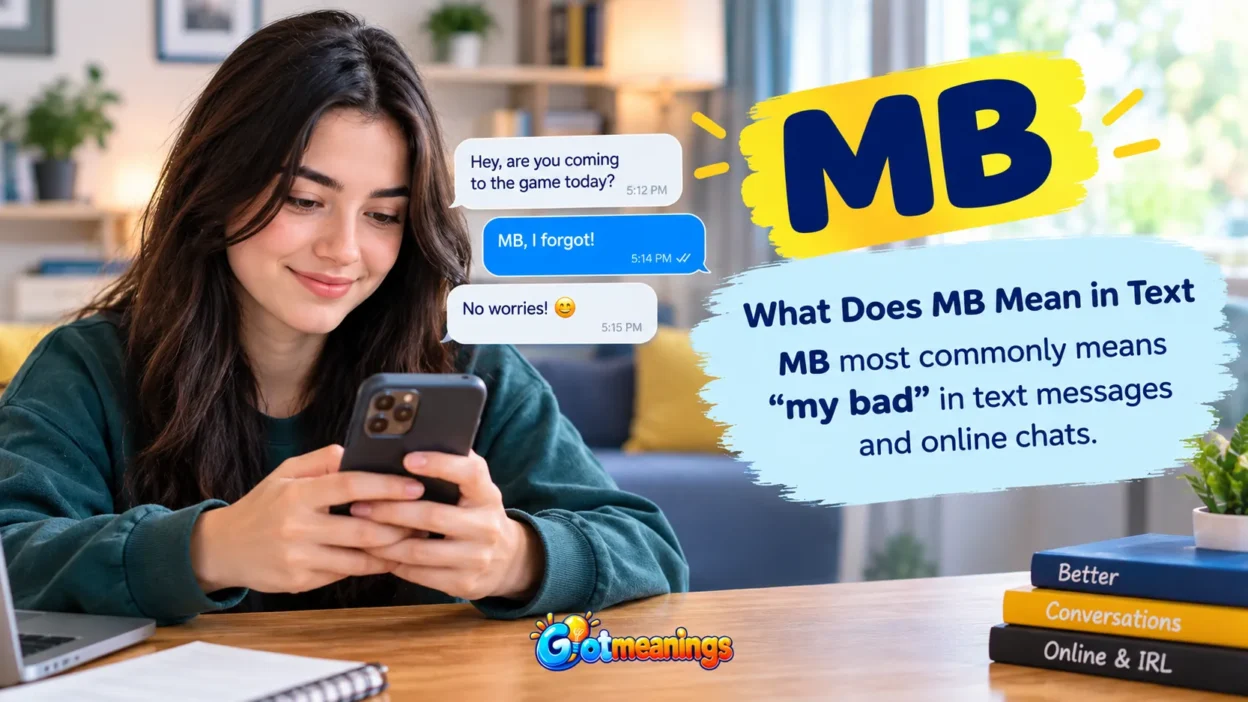
If someone sends you “mb” in a text message, they usually mean “my bad.” It is a casual way to say sorry, admit a mistake, or accept responsibility for something small. For example, if a friend replies late or forgets to send you something, they might text, “mb, I forgot.” In this case, they are saying, “My bad, I forgot.”
However, MB can have other meanings depending on the conversation. In some situations, it may stand for “maybe” or refer to megabytes when discussing phones, apps, and internet data. The surrounding words usually help you understand which meaning fits best.
People commonly use MB in text messages, group chats, and online conversations because it is quick and easy to type. In this guide, you will learn what MB means in text, how people use it on different platforms, how to reply, and how to avoid common misunderstandings.
| Term | Meaning | Full Form | Typical Tone | Common Usage |
|---|---|---|---|---|
| MB | My bad | My bad | Casual, apologetic | Admitting a small mistake |
| MB | Maybe | Maybe | Uncertain, informal | Giving an unsure answer |
| MB | Megabyte | Megabyte | Technical, neutral | Discussing file sizes and data |
| MB | Context-dependent abbreviation | Varies | Depends on the conversation | Private chats and specialized topics |
What Does MB Mean in Text & Chat?
MB most commonly means “my bad” in text messages and online chats. People use it to admit a mistake, apologize casually, or show that they understand they did something wrong.
For example, imagine that your friend sends you a message asking where you are. You read it but forget to reply. Later, you might write, “mb, I was busy.”
This tells your friend that you recognize you did not respond earlier.
MB is popular in casual conversations because it communicates an apology without requiring a long explanation. It is common between friends, classmates, gaming partners, and people who regularly communicate online.
Here are a few situations in which someone might use MB:
- Forgetting something: “MB, I forgot to call you.”
- Sending incorrect information: “mb, I gave you the wrong time.”
- Replying late: “Sorry, mb for the late reply.”
- Making a small mistake: “MB, I thought you said Friday.”
- Misunderstanding a message: “Oh mb, I read that wrong.”
The abbreviation usually sounds relaxed and informal. It does not always express a serious apology.
For a minor mistake, “mb” may be enough. However, if someone has been hurt or a serious problem has occurred, a clear and thoughtful apology is usually more appropriate.
Full Form, Stands For & Short Meaning of MB
The most common meaning of MB in casual texting is “my bad.” This phrase is used when someone admits that a mistake was their fault.
Unlike many abbreviations, MB does not have one universal full form across every situation. Its meaning depends on the subject and the words around it.
MB as My Bad
“My bad” is an informal expression used to accept responsibility for a mistake.
For example:
“MB, I sent the wrong screenshot.”
This means the person admits that they sent the incorrect screenshot.
It is generally friendly and casual. People often use it when they want to acknowledge a mistake without making the conversation too serious.
MB as Maybe
In some personal conversations, MB may be used to mean “maybe.” However, this interpretation is less dependable because many people simply write “maybe” or use other abbreviations.
For example:
Person A: “Are you coming to the party tonight?”
Person B: “mb, depends on my plans.”
Here, the person is expressing uncertainty rather than apologizing.
Because MB is not a universally established abbreviation for “maybe,” you should use the rest of the message to determine the intended meaning.
MB as Megabyte
In technology, MB stands for “megabyte,” a unit used to measure digital information.
For example:
“This photo is 4 MB.”
In this sentence, MB refers to the file’s size, not an apology.
This meaning is common when people discuss phone storage, photos, downloads, applications, and internet-related topics.
Quick Comparison
| Context | Possible Meaning | Example |
|---|---|---|
| Casual conversation | My bad | “MB, I forgot.” |
| An uncertain answer | Maybe, if the context supports it | “MB I’ll join later.” |
| Technology | Megabyte | “The file is 10 MB.” |
The main rule is simple: in an ordinary social chat, start by considering “my bad.” In a conversation about data or file sizes, “megabyte” is more likely.
Origin, History & First Known Use of MB
The expression “my bad” existed before modern texting became popular. It developed as an informal way to admit a mistake or accept responsibility.
Over time, shorter forms of language became common in digital communication. Text messages, instant messaging, and online games encouraged people to use abbreviations that were quick to type.
MB fits this style because it reduces “my bad” to just two letters.
However, it is important to distinguish the history of the phrase from the history of the abbreviation. The existence of “my bad” does not establish an exact date when people first began using MB in text messages.
Without reliable historical evidence, it would be misleading to assign a precise first-use date to the abbreviation.
Today, MB is understood by many people in informal digital conversations, although its meaning can vary between communities and individual users.
The technical abbreviation MB has a separate history in computing. In that setting, it represents a megabyte, a unit of digital information. This technical meaning is unrelated to the informal expression “my bad.”
How People Use MB in Daily Conversations
People usually use MB when they want to acknowledge a small mistake without interrupting the natural flow of a conversation.
Its meaning is generally clear when someone has made an obvious error or forgotten something.
To Apologize for a Small Mistake
A person might write:
“MB, I thought the meeting started at 3.”
They are admitting that they misunderstood the time.
To Accept Responsibility
MB can also show that someone knows they made an error.
For example:
“MB, that was my mistake.”
This wording makes the meaning especially clear because it directly connects the abbreviation with responsibility.
To Correct a Misunderstanding
Imagine that you misunderstand a friend’s message and respond incorrectly.
You might say:
“Ohh, MB. I thought you meant tomorrow.”
Here, MB helps acknowledge the misunderstanding and move the conversation forward.
To Keep a Conversation Casual
Friends often use MB without adding a long apology.
For example:
“MB bro, I didn’t see your message.”
The words “bro” and the casual sentence make the message sound friendly and informal.
Does MB Always Mean the Person Is Sorry?
Not necessarily.
MB often communicates an apology, but the depth of that apology depends on the situation. Sometimes it is a sincere acknowledgment of a mistake. Other times, it is simply a quick way to move past a minor problem.
For a serious mistake, using MB alone may sound dismissive. A more thoughtful message can help show that the person understands the impact of their actions.
MB Meaning Across WhatsApp, Instagram, TikTok & Snapchat
The basic meaning of MB usually stays the same across messaging and social platforms. When used in casual conversation, it most often means “my bad.”
However, the exact interpretation still depends on the message and the people involved.
MB on WhatsApp
On WhatsApp, people may use MB in private messages and group chats to acknowledge a mistake.
Example:
“MB, I sent that message to the wrong group.”
The sender is admitting that they made an error.
MB on Instagram
On Instagram, MB can appear in direct messages when someone wants to apologize or correct a misunderstanding.
Example:
“MB, I thought that was your old account.”
The abbreviation helps keep the reply short and casual.
MB on TikTok
On TikTok, users may use MB in comments or private conversations, especially when responding to a misunderstanding.
Example:
“MB, I didn’t realize you were joking.”
The intended meaning is still “my bad.” The platform does not give the abbreviation a separate, universal definition.
MB on Snapchat
On Snapchat, MB can be used in quick messages between friends.
Example:
“MB, I forgot to reply to your snap.”
Here, the sender is casually acknowledging that they forgot to respond.
Does MB Have a Different Meaning on Each Platform?
Not usually. The abbreviation itself does not have a fixed, platform-specific meaning.
| Platform | Likely Meaning in Casual Chat | Example |
|---|---|---|
| My bad | “MB, wrong group.” | |
| My bad | “MB, I misunderstood.” | |
| TikTok | My bad | “MB, I missed that.” |
| Snapchat | My bad | “MB, forgot to reply.” |
These examples illustrate common conversational uses, not separate official definitions for each platform.
Different Meanings of MB in Other Fields
Although “my bad” is the main meaning in casual texting, MB can refer to something entirely different in other settings.
Understanding the subject of the conversation is the best way to identify the intended meaning.
MB in Technology
In computing, MB stands for megabyte, a unit used to describe digital information.
You might see it when checking the size of a photo, video, document, or downloaded file.
Example:
“The document is only 2 MB.”
This means the document has a file size of 2 megabytes.
A megabyte is a unit of digital information. In common decimal usage, one megabyte equals 1,000,000 bytes. Some computing contexts use binary units instead, so the exact measurement convention can matter.
MB in Phone Storage and Internet Discussions
People often use MB when talking about mobile data, downloads, and storage.
For example:
“You have 500 MB of data left.”
In this context, MB refers to a quantity of data rather than an apology.
MB in Geographic Abbreviations
MB can also stand for Manitoba, a Canadian province, in certain geographic and address-related contexts.
For example, MB may appear in a Canadian mailing address.
This use has nothing to do with slang or text-message apologies.
MB in Specialized Conversations
Other fields, organizations, and communities may use MB as an abbreviation for a specific name, term, or concept.
These meanings cannot be identified reliably without additional context.
If someone sends MB in a conversation about a specialized subject, do not automatically assume they mean “my bad.”
The surrounding topic matters more than the letters alone.
Common Confusions, Mistakes & Wrong Interpretations
Because MB is short, it can be easy to misunderstand. The same two letters can refer to different things depending on the conversation.
Here are some common mistakes to avoid.
Assuming MB Always Means My Bad
Although “my bad” is the most likely interpretation in casual texting, it is not the only one.
If someone writes, “The video is 25 MB,” the meaning is clearly related to digital file size.
Always consider the sentence as a whole.
Confusing MB With Maybe
Some people may use MB informally to mean “maybe,” but this is not a reliable interpretation in every conversation.
Compare these examples:
“MB, I forgot to tell you.”
This most likely means “my bad.”
“MB I’ll come later.”
This might mean “maybe I’ll come later,” depending on the sender’s habits and the conversation.
If the meaning is unclear, asking a quick question is better than guessing.
Thinking MB Is Always a Serious Apology
MB can express regret, but it is usually casual.
If a friend says, “MB, I forgot your charger,” the message may be enough for a minor mistake.
If someone says something hurtful, however, “mb” by itself may not show enough care or responsibility.
The seriousness of the situation affects how the message sounds.
Misreading the Tone
The abbreviation does not automatically sound rude, friendly, or sarcastic.
Compare:
“MB 😊”
This may sound warm and friendly.
“mb.”
Depending on the conversation, this could sound neutral, brief, or slightly dismissive.
Neither interpretation is guaranteed. Punctuation, previous messages, and the relationship between the people all affect the tone.
Confusing Uppercase and Lowercase
MB, mb, and Mb can appear similar, but capitalization may matter in technical contexts.
In casual texting, MB and mb usually carry the same meaning.
In measurement systems, capitalization is more important because different letter combinations can represent different units. When discussing file sizes, it is best to follow the standard notation used in that context.
Similar Terms, Alternatives & Related Slang
Several other abbreviations and expressions serve a purpose similar to MB. Some express an apology, while others acknowledge an error or ask for forgiveness.
Knowing the differences can help you choose the right phrase.
| Term | Meaning | Typical Use |
|---|---|---|
| MB | My bad | Casual apology |
| Sry | Sorry | Quick apology |
| My mistake | An error was my fault | Clear acknowledgment |
| Oops | A small mistake happened | Casual or playful reaction |
| Apologies | An expression of regret | More formal or polite situations |
| NVM | Never mind | Dropping or correcting a topic |
| IDC | I don’t care | Expressing a lack of concern |
| LOL | Laughing out loud | Humor or amusement |
These expressions are not interchangeable in every situation.
For example, “oops” often reacts to a mistake, while “MB” more directly accepts responsibility for it.
Similarly, “NVM” means “never mind,” not “my bad.” Using the wrong abbreviation can change the message’s meaning.
If you want to sound more sincere, you can write the full phrase instead of using an abbreviation.
For example:
“I’m sorry I forgot. I’ll make sure it doesn’t happen again.”
This is more suitable when the mistake matters to the other person.
Examples of MB in Real Chat Situations
The easiest way to understand MB is to see how people use it in everyday conversations.
The examples below show different situations, from forgotten messages to simple misunderstandings.
Example 1: Forgetting to Reply
Person A: “You saw my message yesterday but didn’t reply.”
Person B: “MB, I got busy and forgot. 😅”
Meaning: Person B is admitting that they forgot to respond. The emoji gives the message a casual, slightly embarrassed tone.
Example 2: Sending the Wrong Information
Person A: “You told me the movie starts at 8, but it’s actually at 7.”
Person B: “Oh, MB! I read the time wrong.”
Meaning: Person B accepts responsibility for sharing incorrect information.
Example 3: Making Plans
Person A: “You said you would meet us at the cafe.”
Person B: “MB, I forgot we changed the location.”
Meaning: The speaker is apologizing for forgetting an update.
Example 4: A Friendly Conversation
Person A: “You took my fries without asking!”
Person B: “MB 😂 I’ll get you another portion.”
Meaning: The apology is playful because the mistake is minor and the laughing emoji adds humor.
Example 5: Correcting a Misunderstanding
Person A: “I said I couldn’t come today, not tomorrow.”
Person B: “Ohh, MB. I misunderstood your message.”
Meaning: Person B recognizes that they read the message incorrectly.
Example 6: A Brief or Unclear Apology
Person A: “You shared the wrong photo in the group.”
Person B: “mb.”
Meaning: Person B may be admitting the mistake, but the short reply does not reveal much emotion. Depending on the situation, the other person might see it as casual or dismissive.
Example 7: Talking About File Size
Person A: “Why is this picture taking so long to upload?”
Person B: “It’s 18 MB, so the file might take a little longer.”
Meaning: Here, MB means megabytes. It is a technical unit, not texting slang.
Example 8: An Uncertain Answer
Person A: “Are you joining us for lunch?”
Person B: “Maybe, I’m not sure yet.”
Meaning: The reply expresses uncertainty. If the person instead writes “MB,” you may need more context to determine whether they intended “maybe” or something else.
These examples show why it is important to read the entire message instead of interpreting the abbreviation in isolation.
How to Reply When Someone Says MB
When someone sends you MB, the best response depends on what happened and whether the mistake matters.
If the meaning is “my bad,” you can accept the apology, reassure the person, or explain why the issue matters.
When the Mistake Is Small
If a friend apologizes for something minor, a simple response is usually enough.
Examples:
- “No worries!”
- “It’s all good.”
- “You’re fine.”
- “Don’t worry about it.”
These replies show that you accept the apology and want to move on.
When You Want to Be Friendly
You can keep the conversation relaxed if the person is someone you know well.
For example:
Person A: “MB, I forgot to send you the notes.”
Person B: “Haha, no problem. Send them when you can. 😊”
This response is friendly without making the mistake seem serious.
When the Mistake Caused a Problem
If the mistake affected your plans or caused inconvenience, you can accept the apology while explaining the issue.
For example:
Person A: “MB, I forgot to tell you the meeting was moved.”
Person B: “Thanks for saying that. I missed part of it because I didn’t know.”
This response is calm and direct. It acknowledges the apology without pretending the mistake had no effect.
When the Message Is Confusing
If you cannot tell what MB means, ask for clarification.
You could reply:
“Do you mean ‘my bad’?”
Or:
“Wait, what do you mean by MB here?”
There is no need to guess when the surrounding conversation does not make the meaning clear.
When the Apology Seems Dismissive
If someone uses MB after doing something hurtful, you can explain how you feel.
For example:
Person A: “MB.”
Person B: “I appreciate that, but what happened really bothered me. Can we talk about it?”
This gives the person an opportunity to understand the impact of their actions.
You do not have to treat every apology as sufficient just because someone acknowledges a mistake.
Is MB Still Popular? Trends & Online Usage
MB remains a recognizable shorthand in casual digital communication, especially when people use “my bad” to acknowledge small mistakes.
Its appeal is simple: it is short, easy to type, and fits naturally into informal messages.
However, there is no need to assume that everyone uses it or understands it in the same way. Abbreviations vary between age groups, friend groups, online communities, and individual communication styles.
Some people prefer MB because they use short replies throughout the day. Others write “my bad,” “sorry,” or the complete sentence because they want to be clearer.
The platform does not determine whether MB is appropriate. The relationship between the people and the seriousness of the situation matter more.
For example, MB may be perfectly natural when apologizing to a friend for a delayed reply. In a professional message about a serious error, a more complete explanation may be better.
It is also important not to confuse general familiarity with proof of a current trend. Without reliable, up-to-date usage data, it would be inaccurate to claim that MB is growing rapidly or is the most popular abbreviation among a particular group.
The safest approach is to use MB when the conversation is informal and the intended meaning is clear.
Frequently Asked Questions
What does MB mean in text messages?
MB most commonly means “my bad” in casual text messages. It is used to admit a mistake, apologize, or accept responsibility for something. For example, “MB, I forgot” means “My bad, I forgot.”
Does MB mean my bad or maybe?
MB most commonly means “my bad” in casual texting. Some people may use it to mean “maybe,” but this is less reliable. Check the surrounding sentence to understand the intended meaning.
What does MB mean on WhatsApp?
On WhatsApp, MB usually means “my bad” when someone is acknowledging a mistake in a private chat or group conversation. The abbreviation generally has the same meaning as it does in other casual messaging settings.
What does MB mean on Instagram?
In Instagram direct messages, MB commonly means “my bad.” Someone might use it after misunderstanding a message, forgetting to reply, or sending the wrong information.
What does MB mean on Snapchat?
On Snapchat, MB often means “my bad” when friends communicate through quick messages. For example, “MB, I forgot to reply” is a casual way to apologize for a delayed response.
Is MB rude or disrespectful?
MB is not inherently rude. It is usually casual and neutral, but it can sound dismissive if the mistake is serious and the person offers no meaningful apology. Context and tone matter.
How should I reply to MB?
If the mistake is minor, you can say “No worries,” “It’s all good,” or “Don’t worry about it.” If the mistake affected you, explain the problem calmly. If you do not understand the abbreviation, ask what the person means.
What does MB mean in gaming?
In gaming chats, MB can mean “my bad” when a player admits a mistake, such as missing a target or making a poor move. In a technical discussion, it may instead mean megabyte. The context determines the meaning.
What does MB mean when talking about file size?
When discussing files, downloads, or storage, MB stands for megabyte. It is a unit of digital information used to describe file sizes and data amounts.
Is MB the same as sorry?
Not exactly. MB means “my bad” and usually acknowledges personal responsibility for a mistake. Sorry is a broader expression of regret. Both can function as apologies, but they may communicate slightly different things.
Conclusion
MB most commonly means “my bad” in text messages, making it a quick and casual way to acknowledge a mistake.
People use it when they forget to reply, misunderstand something, share incorrect information, or make a small error.
It is especially useful in informal conversations with friends and other people they know well.
However, the meaning of MB is not always the same. In technology-related discussions, it commonly stands for megabyte, while some people may use it informally to suggest “maybe.” Looking at the surrounding words and the subject of the conversation will usually help you understand which meaning fits.
The tone also matters. A short “mb” may be enough for a minor mistake, but a more thoughtful apology is often better when someone has been hurt or inconvenienced.
When you use or receive MB, focus on the context rather than the letters alone. This simple habit can help you understand messages correctly and respond naturally.

Milo Carter is a tax writer who explains tax terms, rules, and common questions in simple, easy-to-understand language.